Wednesday, 14 September 2016

Protagonists and Observers

If I was an energetic sort, I would make a tongue in cheek "Writer Advice bingo card". Everyone who haunts a forum with an active writing community will probably be able to think of five good truisms for this within a second. One of the candidates for this card would be "Everyone is a protagonist in their own story", a piece of advice that has been on my mind since reading Jo Zebedee's wonderful blog post about the subject.

For those not familiar with the term, it boils down to the fact that all the secondary characters in a story aren't just bits of scenery for the main character, but characters with their own motivation, goals and outlook. Its a regularly repeated piece of advice because its very easy for authors to treat them as the former and a lot better to treat them as the latter. Its also often remarked upon that secondary characters often have more fun and charm that the main character; outstanding secondary characters are often the hook that really drags readers in.

Then Juliana Spink-Mills posted a riff on the subject, linking the concept to personal experience and my brain went into overdrive. I started thinking about how often we get to be the protagonists in our own lives, how people perceive the idea of themselves being a protagonist. I think most people have episodes in their life where they are not the protagonist* - but if we are not the protagonist, what are we? Me, myself, I would say when that happens, I often find myself an observer of someone else's story. But it is still my story. I am simultaneously protagonist and observer.

So what happens when your story's protagonist becomes an observer? What happens when they venture into someone else's story?

Temporarily, the story becomes about the protagonist's reactions, not their actions. This is something of a high-risk high-reward move. The risk is that the protagonist is seen as boring and passive because they're being inactive. People don't want to read about how the protagonist watched all these amazing people solve the problem of the world's imminent end. Its why all those farmboys level up very quickly.


Your protagonist don't get to say that shit if they're always an observer
However, to paraphrase Jim Butcher, reactions are how you get readers to give a flying frack about your characters. Watching them love, hate, get confused, wonder why their significant other hates cheese - that's where readers form bonds. Reactions are what makes characters. That and the choices they make, and we need their reactions for their choices to make sense. 

Having a protagonist react to other people's issues rather than their own allows them to demonstrate their character more fully. You can't see empathy if they're thinking mainly about themselves. You can't hug yourself either, or stand there looking awkward with a hand half-raised as a bad substitute. A protagonist that's not always reacting about their own issues is a lot harder to label as a whiner too.

How people observe tends to reveal a lot about them too. Do they notice the way people fiddle or the slight variation in intonation? Do they have a febrile imagination, filling out people's lives for them with the slightest glance? Do they need beating with the clue stick before they spot things? Another way of putting this would be saying that when the protagonist stumbles into someone else's story, they become the narrator. A short glance at any forum would tell you how much readers think they can work out authors based on how the story is told. When a protagonist tells a story, the author can make it far more explicit how the protagonist is affecting the story they're telling.

The protagonist is always the protagonist. But sometimes we get more of them when they're in someone else's story other than their own.

Wednesday, 7 September 2016

The Fionavar Tapestry review

Since it seems people enjoyed the Pawn of Prophecy review nearly as much as I enjoyed writing it, I thought I'd do some more old school fantasy stuff. I had meant to continue through the rest of the Belgariad, but it occurred to me that this wasn't the most efficient way to do things. No, the best way to do it would be to review whole series at a go. Since I've queered that pitch with the Belgariad, I need a new victim.

Enter Guy Gavriel Kay's The Fionavar Tapestry.

I'm assuming most people reading this know who GGK is; if you don't, you're probably missing out. He's never been one of the genre's rock stars, possibly because of some unconventional choices, but he's consistently been one of the best. He's famous for his literary style and strong focus on very human characters. Tigana is often heralded as his magnum opus but it all started in 1984 with The Summer Tree, first book of the The Fionavar Tapestry, and the five poor sods sent away from our reality to the world of Fionavar


The realistic response to finding yourself on a different world
Needless to say, our five intrepid heroes land in a bad situation, which quickly gets worse, and by the time things wrap up in the not at all forebodingly named The Darkest Road, they're just one unlikely hero away from the Dark Lord roflstomping everything. The Fionavar Tapestry has a lot of things going for it but originality is not one of them. This is High Fantasy writ large. Indeed, Kay's on the record as saying:


"At one significant level I wrote the Fionavar Tapestry with the metaphor in mind of throwing down a gauntlet to all of the people who are perceived as having diminished and degraded the genre of high fantasy in the post- Tolkien period by writing derivative, mercenary, lazy fantasies. I saw myself to some degree as trying to say: I'm going to use as many of the central motifs and themes of high fantasy as I can, and I shall try to give the lie to those who have debased it, by showing that there's still a great deal of life in the genre, that it's infinitely larger than twenty years' of hack work. We're not capable of debasing it, ultimately."

And this is very high fantasy indeed. Good vs Evil! Hatred of the light for it is not the dark! The Fate of Kings and Desperate Men! Elves, Dwarves, Orcs Svart Alfar, Mages, and Dragons! GGK runs the entire high fantasy playbook here and he does it without a single twist.

So in an age where high fantasy is usually served with grit strewn all over it like they were sprinkles on a donut, and people complain vociferously about the well-worn tropes of high fantasy, why is anyone going to want to read this?


Its not fair to categorise all of modern fantasy as this. Just a fair amount.


Its only fair to point out that for someone completely burnt out on High Fantasy, The Fionavar Tapestry is not a great book choice. You have been warned now. However, if you've room for more books with Elves and Everything - even if its just one more - and you're not willing to wait for me to do it (I keed) - then consider this one. The reason for this can be summed up with one word: Passion.

For one thing, GGK is passionate about High Fantasy in a way that I don't think most authors in the genre are. Oh, they're passionate about their story, and the stories that inspired it, but not the whole damn shooting match itself. He's writing about this because he thinks it matters, because there's some literary worth rather than just "Hey, I have a neat story". And it shows. He writes all the old familiar cliches with such unabashed sincerity that they feel fresh again. By and large, he does so with thoughtfulness too. Yes, he doesn't really question why the Svart Alfar so loyally serve the Dark Lord, but most of the time he thinks a little about why things work the way they do. The result is a rich, compelling world with real mythic resonance. 

The passion also extends to the characters. These are people that love, hate, mourn and most crucially of all, act. As such, its very easy to love and/or hate them in turn. Its also very easy to roll the eyes like they're Vegas dice at times. Sometimes the melodrama takes that step too far and becomes 'wait did you actually just say that'. Sometimes the prose can get a little purple - okay, scratch that. GGK is fantasy's king of purple prose, especially at this stage in his career. It is totally worth putting up the odd spot of shark-jumping when he gets it wrong because most of the time he gets it right and its glorious. I don't generally find books to be that emotional but there were times when my heart ached for the characters of The Fionavar Tapestry and that simply doesn't happen without feeling they really care about what's happening.


Not only am I actually Donkey Kong, but I did make this face a three times, particularly when at the end *REDACTED FOR SPOILERS*
So it elves and shit with an admirably straight face and feels turned up to 11. What else?

Well its a rather fine story with some rather interesting thematic parts. For example, a number of characters face choices over what to do with their power. Some cling on to it at any cost; some relinquish it. No spoilers, but each and every choice comes with a price. There is a great deal too on the destructive side of love and how we react to heartbreak and abandonment. Maybe I should do a spoiler heavy article on this (maybe one day I'll get round to my article comparing Dumbledore and Granny Weatherwax with an emphasis on love and power).

The interweaving of Arthurian mythology is also rather interesting. Fantasies bridging two distinct worlds are not commonplace these days (although you could argue Urban Fantasy has a lot of it) and as such we get pieces inspired by myth, or pieces based on myth. The Fionavar Tapestry is both at the same time. 

It also features a number of great characters, great arcs and straight up awesome moments. A lot of the moments go to Diarmuid, the generous and scene stealing prince of Brennin, but there's plenty to go round. Dave's arc as he goes from someone who renounces friendship easily to member of a tight bromance is also very touching, but Kim and the dwarf Matt Soren both get pretty awesome storylines too, which coincide neatly with a rather cool scene involving a dragon. Lancelot's big fight is amazing too. 

There's quite a few moments like this too.

I'm starting to lose the track of myself so its time to wrap up. The Fionavar Tapestry is not without its flaws. Many of the flaws are of the type the modern age, if we can judge it as a whole, seems rather impatient with. But unless the flaws are of the kind that make apples taste like ash in your mouth, we should judge a book by its strengths. These are books that do High Fantasy right. They focus on the characters, both on their grand mythical dramas and their little human quirks.

Many authors have set to write out with Tolkien weighing on their mind. The majority of them  (or at least the majority with Tolkien as a positive influence) would have clearly done better for a little distance. In fact, Kay might be the only one where this isn't so, largely because rather than leaning on Tolkien's work, he leaned on Tolkien's influences. An easy and obvious thing to do perhaps, yet few seem to be doing it.

This is why if you read only two High Fantasy series in your whole life, one should be The Lord of the Rings - the other The Fionavar Tapestry.


Monday, 29 August 2016

Oracle by Susan Boulton

Of the many branches that exist of the great world tree of Fantasy, those drawing inspiration from the Industrial Revolution are ones I rarely run squirrel-like along. I'm not even sure what the right term for such books are (Google suggests Gaslamp fantasy). Its just generally not my cup of tea as a period of history or genre setting. As such, I must candidly admit that I probably wouldn't have picked up Susan Boulton's Oracle if I hadn't been informed it was on sale for 99p. Truth be told, I still probably wouldn't have if I wasn't quite curious about what I've heard of her next planned book, Hand of Glory. But I was and - hey, 99p. (spoiler - its no longer on sale but is totally worth what you'll pay).


This blog is all about those memes
This was what is commonly referred to as a good call.

I had come to this conclusion by the end of the first chapter. Getting the opening pages right is a source of much angst on most writing forums: Susan Boulton appears to have found it a breeze. The world and main character are introduced vividly but there is no shortage of action to hook the reader in. It is a wonderful set-up that sold me on the book utterly. 

Despite how much I loved the opening, I did falter a little with the next few chapters. The mood shifts, the pace slows, and it is not immediately obvious why we should care for the new characters. At first, it could almost be a different book altogether. This sense of dislocation did not last too long for me however. As the pages turn, we learn more about the characters and more importantly, we learn more about the questions confronting them. Its the sense of mystery that draws me back in most of all. Well, that and the writing itself

Susan Boulton's prose is really rather excellent. It manages the neat trick of being at once dense and light, which makes it officially better than cake. Dense, as in that there is an awful lot of information and atmosphere getting crammed in. Light, as in that it doesn't slow down the reader at all. There's a slightly stiff, formal approach to it that fits the subject matter like a gentleman's calfskin glove. As its best, it reminds me a little of John Banville's work when writing as Benjamin Black. And I absolutely love me some Benjamin Black.


Come to think of it, the Benjamin Black comparison runs deeper than just the words. There's the same sense of a comfortable elite under soft warm lights, praying no one looks at the shadows that hides their secrets and pain. Oracle features more idealistic characters however; they have more in common with the world of The West Wing. It is better to let Oracle stand on its own though; a world filled with political and social turbulence, through which a range of characters stride as they deal with mystery and their own alienation from society alike. 

The characters are by and large more interesting than lovable. I can't quite put my finger on why I felt that way on the latter point - there is something very charming about Oracle herself though - but that's fine. Interesting is more than enough. They develop nicely throughout the story as we learn more about them and their motivations, particularly the secondary characters, who by and large get the most interesting revelations. 

Oracle is not perfect though; nothing is. There is one area that I feel shows notable frailties and that is the plot - which oddly enough, is also one of my favourite things about the book. Oracle does have a compelling plot; just there are things that jarred me. There are a few plot twists where I feel the characters' actions make very little sense and there's a few pacing issues too. I've already mentioned the slowdown after the opening. By contrast, the ending goes by too fast for me and the solution comes too easy. That's a minor quibble though. The characters have earned that after all they've been through and in truth, I got my sense of resolution from having them arrive at being able to apply the solution anyway. 


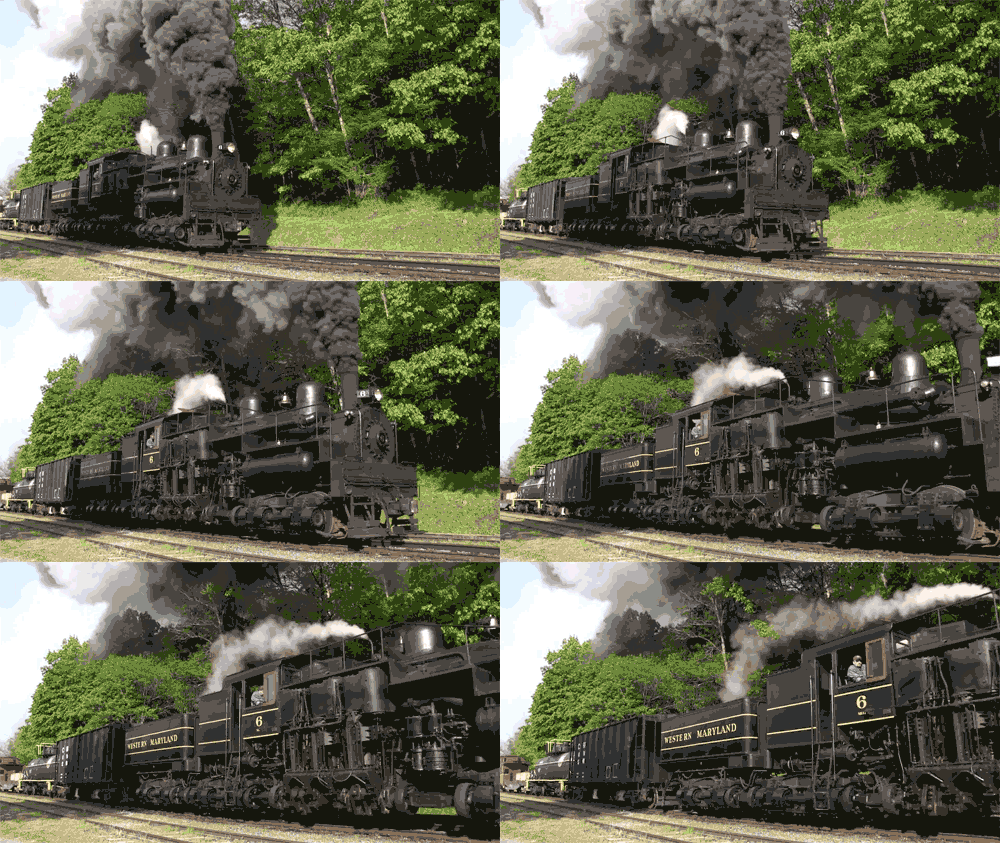
There was no way I was getting throughout this without a steam train gif
Normally, the hardest bit of a review is giving people an accurate guide as to whether they'll like it. Oracle makes it rather easy. You download the kindle sample, you see whether you agree with me about just how enjoyable the prose is, and you pays your money or not accordingly. If you do, you may have to give the story a little patience, but it is a cracking wee story and once its got you its difficult to put down. It helps if you like steam trains, politicking, dogs and nice young ladies swearing - in fact, if you hate those things, then probably just ignore this review. 

Yeah, I know its a little late to be saying that. Sorry.

But those are just the clothes the story wears. The heart of it is a story about the fate of one woman and the way those out of stride with reality deal with it. And its beautifully written - did I mention that? I may have brought it for 99p but Oracle is worth a great deal more than that.

Friday, 19 August 2016

Pawn of Prophecy Review (mild spoilers ahoy)

I have very mixed feelings about David Eddings as an author. Some of his books rank among my very favourites; some of his books make me wonder why I ever liked him at all. Even in his best books there are numerous flaws and a google search of 'David Eddings hack' will quickly pull up many complaints on that score. If you read The Rivan Codex and judge him by his own words, calling him a hack is far from unjustified.

Yet I still re-read his books. I'll still go out to bat for him as an enjoyable author and one worth learning from.

And that's what I'm going to do right now because I just re-read Pawn of Prophecy and its review time.


Well. Bat for at times. 

See, Pawn of Prophecy is the first of a five book series about a Farm Boy who turns out to be the Chosen One and with the aid of the Magical McGuffin, defeats the Dark Lord and Saves The World. And there's not an awful lot I can say about that other than maybe, just maybe, that wasn't as horribly cliche in 1982. In 2016 however, that's a point of historical curiousity, not something that will save your reading experience if you're so over that type of cliched fantasy. I'm okay with it - in fact, I'd hold there's a shortage of farm boys these days, not that I plan to correct this - but it is inescapably as cliched a premise as ever made it big in fantasy. Which in itself makes the book worthy of study if you ask me.

The book starts with our proto-Chosen One, Garion, growing up on a farm with his aunt Pol. Garion's childhood is covered in extensive detail before the outside world intrudes on both his life and the plot. At which point he goes out into the night on a harum-scarum quest that will drag him halfway across the continent, put him in mortal danger, see him meet the great and mighty and start to discover the hidden truth about the world. All in one 104,000 word book!

I do sometimes imagine Garion looking like this
Take a moment to digest that word count. To put it into perspective, Sword of Shannara weighs in at 265k words. The Eye of the World beats that at 285k words. I can't find one for Feist's Magician but given it was released in many markets as two books and the paperback is 864 pages long and it quickly becomes apparent that by the standard of blockbuster debuts of the time, Pawn of Prophecy is teeny-tiny.

Part of the reason is that the book only follows Garion, rather than multiple PoVs. The greater part of the reason is that Eddings really gets the story chugging along without too much complications. For many, that is part of the charm; straight forwards and inviting to the reader. For others, the lack of depth is off-putting, more suitable for teenagers. I'm in Crowd A. Sometimes that's what I want and I wish that more brave souls in the fantasy genre had followed suit and wrote fast-paced epics. Anyone who wishes to follow suit could do worse than read Pawn of Prophecy. Not everything has to be slower than Doom Metal on Ketamine.

Epic Fantasy's Spiritual Sibling: Doom Metal
No one cares if the plot is pacey and the prose is reader friendly if its all about dull stuff though. Given the heavy emphasis I laid earlier on just how cliche this is, one might worry about whether the ideas are interesting enough to hold up. It is a bit hit and miss. No one will ever read Eddings for the deep and innovative world making; no one will do so for the "Oh My Sweet Jesus" plot twists. The characters? At one point, re-reading it with far better genre knowledge than I had the first time, I actually exclaimed out loud "That's Fahfrd and the Grey Mouser!" Originality is not really Eddings' strong point.

Nevertheless, it is interesting. He puts just enough twist of his own on things. He's very good at making sure the good guys are liked and the bad guys are disliked. There's always something happening and its usually easy to imagine. In retrospect, he's possibly the greatest script writer the WWF never had. Arguably, it takes a lot of talent to make heavy use of straight up cliches interesting. It certainly takes something and whatever it is, Eddings had it.

What makes Eddings really stand out for me however is his levity. Long before I ever read Pratchett, David Eddings taught me that saving the world didn't have to be a po-faced business. People joke frequently in Pawn of Prophecy, none more so than the narrator. There's no shortage of authors these days who treat fantasy with a heavy dose of irreverence but Eddings remains a master of the art. His light hearted voice is a huge part of what makes this book so entertaining.

And at his peak, Eddings is near as fine an entertainer as ever worked in the genre. Its a shame his imagination never matched his facility for entertainment, as history is likely to forget him, but as long as people read him there will be readers having fun. He's the pop music of fantasy, the cheese, the Hollywood blockbusters. Pawn of Prophecy is, like so many debuts, not the strongest example of an author's work, but definitely one of the most charming. Given that Eddings' readability lies entirely in just how charming you find his wry take on straight up genre fantasy, that's a good thing.


There are two things in Pawn of Prophecy that must be brought up before ending this review. I'll start with the negative.

Eddings' penchant for racial stereotypes is a wee bit jarring. Let it be stated that the man did call himself out on it and make a concerted effort to show everyone's point of view as the series goes on, but that doesn't change the fact that nigh universally, someone from X Culture will have Y Characteristic. Its not just the bad guys either, its everyone. Its far less prevalent in later works so I don't think its a case of Eddings holding unfortunate views but at the very least, its shockingly lazy writing. I do not find it book spoiling, but Caveat Emptor.

The positive however is Aunt Pol. We all know what a true fantasy mentor looks like; an old git with beard, staff and seven sets of "I Heart Gandalf" pyjamas, one for each day of the week. Needless to say, Eddings has one of these, but our old wizard is not the true mentor. Oh, he's a mentor, but the true mentor is Aunt Pol. In fact Pol - or Polgara, to use her proper name - is arguably the true hero of the piece, the Samwise Gamgee of the Belgariad.

Now, there's a fair few female Main Characters these days. Plenty of kickass love interests. Plenty of dangerous friends, dangerouser enemies, and Guns of the Navaronne-esque frenemies. But major female mentors are difficult to think of. Highly maternal major female characters are even rarer, possible because conceiving a Chosen One is the most dangerous thing in all fiction. Characters that are both? I am really struggling to think of any other than Isana in the Codex Alera. Polgara's position in the book is as if JK Rowling decided to roll Molly Weasley and McGonagall into one character who then crisply informed Dumbledore to stay out of the way as she had a boy to raise and a world to save.

Who doesn't want more characters like this?

As far as I'm concerned, over thirty years down the line Polgara remains an incredibly important character in fantasy's over all canon. She is still one of the best representations of a universal archetype in the genre. She's also an entertaining character in her own right; her interactions with Garion are frequently the best bits of Pawn of Prophecy and the many sequels. I'd recommend reading the book just for those and Polgara will stand as one of the best creations of Eddings and his wife Leigh (later credited as a co-author). 

Of course, I recommend reading Pawn of Prophecy in general. I don't recommend it to everyone; hopefully the review has allowed people to recognise whether they'll like it or not. That is the point of a review after all. But to those who like some fantasy that's light-hearted and fun, and are not too bothered if the shape feels very familiar, here is a book that is likely to become a friend - if it is not already. After all, it's been around for thirty four years by now.

Thirty four years and still relevant. Not bad for a hack. 

Friday, 5 August 2016

The Basics

This blog's been silent for a number of reasons but one of the main reasons is that I wanted to talk about writing and I've had nothing to say. Or rather, lots of things to say, but none that I could voice well enough to be worth reading. There's a huge amount of advice out there - it would be a mistake on several levels to add something that offered nothing of great value to the pile.

So I am going to start by talking about rugby.

For those of you unfamiliar with the sport, rugby basically comes down to running with a ball through a line of fifteen Goliaths who are allowed to stop you with just about everything short of weaponry. 

This is obviously quite difficult.

There are a number of ways this can be accomplished. One can of course simply meet them head on and triumph by being more brutal than they can be; the purists' approach. It is also possible to beat the defence with breathtaking agility and speed, or by incredibly accurate passing and kicking, both of which can suddenly create space where there is none. Most fans love to see this; most sports fans are hooked to the adrenaline rush that comes from surprise success.

The best teams though don't rely on either method to win. What marks out the best as different - other than a lot of silverware - is their accuracy. What they do often looks breathtaking but on closer inspection is actually quite simple. They don't rely on incredible athleticism (although they have it). They rely on doing the simple things better than anyone else. They rely on getting the basics right.

And this is where I can start talking about writing. Do the basics right.

As I said, there is a huge amount of advice out there. If every list of dos and don'ts for writers was a pie, we'd all die of heart attacks. Most of it is quite good but there is a risk that with all this information and little tricks of the trade, we forget the basics. Its easy too to let creativity wild and in the process, distract us from getting the basics right.

Now I'm not saying its enough to get the basics right all by itself. If you get the basics wrong though, you lose. Another draft bites the dust. There's worse things of course but life is too short to go around chucking away drafts.

Here's the basics as I see them:

Write clear and easily understood prose - Ask yourself if an eleven year old could understand it. If they can't with someone explaining the difficult words, you could have probably made it clearer. Unclear writing is slow writing and your ideas are too cool to make people wait for them.

Describe your events, places and people in the way your readers experience them - Use the five senses. Use metaphors people understand. Use the physical reactions to emotions rather than just naming the emotions. 

Have your characters act sympathetically, interestingly and in a way that makes sense - If characters have readers going "Wtf", "Boring" or "Not Cool", the reader will probably stop reading. You can get away with a lot of frowned upon stuff when writing a character but these three are non-negotiable.

Have events link to each other in a way that is consistent and increases interest - Plotting is perhaps the most difficult part of writing; it is certainly the bit most likely to get tangled in complexity. Getting those two things wrong though is another good way to stop the reader from reading.

There are a lot of other things that usually happen in a good book. Editing for one. Research and Ideas. I haven't mentioned Foreshadowing at all. There's helpful little tricks like the Tags and Traits recommended by Jim Butcher.  And on and on and on and - hey, this isn't the Gaviscon advert. There is a reason why there's so much advice out there. There's so many ways to improve your writing.

These things turn good books into fantastic books though. Doing the basics well gives you a good book (with an edit) and without doing the basics well, there is no potential for a good book. And the writers out there with the longest, most successful careers? They're the ones who have the basics down. Not the people with the amazing ideas or the heartstoppingly beautiful prose or the incredible intricate and interesting worlds. They might write some fantastic books, but the people writing readable popular books year after year after the people who have the best basics.

So that is my advice to any fledgling writers out there, including myself. Never lose sight of the basics of writing. Never stop trying to make them better, never stop trying to make them second nature. Because being good at the basics is how people are good at anything.

Sunday, 24 April 2016

The twenty very best things I consumed in America

I've talked about fiction, I've talked about music, so it's time to talk about one of my other great loves and that is what goes in my belly. So this blog post will simply be a list of the best things I consumed while in the USA for the past three months (with reasons for why they're great). Now listen up, here's some great ways to put on over half a stone in three months.

20) Ace Pineapple Cider - It's possible the reason this is so high is that I drank it at the Pittsburgh Beer Fest and my memory of that is mildly blurry, because there were too many drinks to remember them all. Also, there were too many drinks. Still, I remember it being immensely drinkable, and far more pineapple-y than most other attempts at pineapple alcohol I've ever had, except for the following...

19) Ballast Point Pineapple Sculpin - A very unusual choice for me, in that I'm not a huge IPA fan, and that goes double when mixed with fruit. See Southern Tier Tangier, which I wanted to love but couldn't quite do so. I did love Pineapple Sculpin though. Weirdly, a better beer from the bottle than on draft, but really good either way.

18) Cajun Dusted Chicken wings with Sexxy Sriracha Sauce - Before causing my digestive system to meltdown, I ate quite a lot from my gorgeous fiancée's place of work, Three Rivers Six Pack. This became my go to choice, with the earthy, smoky cajun dust counter-balancing the sugar and spice of the sauce beautifully. Now probably my favourite way to have wings.

17) Everything at Monell's Dining & Catering in Nashville - When I picked out this restaurant for dinner shortly before our flight, I did not understand what Family Style meant. Now I do. I've heard that what I experienced was atypical, but at Monell's, they sit you at a table with a bunch of strangers and then bring out endless waves of really good southern food. The highlight was the baked blackened chicken but it was all so good (except maybe the deep fried pork chop). It weighs endlessly on my soul that fried chicken in London will never taste as good again.

16) Angry Orchard Green Apple Cider - A guilty pleasure. This isn't sophisticated (in fact some hae told me it's a teenage girl drink) but I don't care. Green apples are (at their best) my favourite fruit in the world, and this cider captures the refreshing hit of sugar and acid better than any other green apple drink I know (and I know a few). You can get Angry Orchard's regular in the UK, but not the Green Apple, and that makes me sad.

15) Cajun dusted Salmon with mango-lime quinoa salad and grilled pineapple - I had this at the Church Brew Works in Pittsburgh and while the name would indicate it's the sort of place to go to drink, and they do have good beer there, I remember this meal far better because the balance of flavours was beautiful.

14) Biscuits and Gravy - I still don't quite understand the American obsession with this dish (think unsweetened scones and creamy melted down sausage meat for those unaware of the US definitions of these terms) but I came a little closer in Durham, New Hampshire, at Youngs Restaurant. My lady had these, not me, which I mildly regret now thinking back to it, but the addition of chorizo to the usual Italian sausage was a winner. She rhapsodised about them; I can only agree.

13) Ginger Garlic Shrimp with Noodles - On previous trips, the food from Headkeeper in Greensburg might have taken up multiple spaces in the top 10. Now, maybe I've been spoiled, or maybe it's a case of me preferring previous of their seasonal menus, but this hasn't happened this time. Still, they do really good food, and this dish was everything it should have been. I ate a lot of noodles on those three months, and these were the best.

12) Lobster Roll - I have this at Peteys, a seafood place up somewhere on the coast of New Hampshire. As far as I'm concerned, the only reason to visit New England is to eat lobster (sorry Jon, you're not as cool as lobster). This meant I ate a hell of a lot of them in my four days there and this was comfortably the best.

11) Arsenal Griersons Ginger Apple - You can only get Arsenal Cider at the Arsenal Cider House in Pittsburgh (well, ok, a few other places too). This is annoying as it meant it took ages for me to any of their products. They do a lot of good cider but the Griersons was hands down oh my days the best. Somehow, the concept of cider and ginger had never ever been introduced to me before. I'm serious. From now on, after Griersons, it will be remembered.

10) Southern Tier Chokolat - I can't believe it's taken me this long to include a chocolate stout on the list but then maybe that's because I really, really love chocolate stout and this means they all hit the top 10. Chokolat is rich and intense; expensive, but worth it. Southern Tier is opening a brewery in Pittsburgh and I literally could not be more excited about that unless they gave me Willy Wonka-style tickets to investigate when it opened.

9) Founders Rubaeus - The last non-chocolate beer on the list, Founders Rubaeus is a raspberry ale that manages the neat trick of replicating the tart notes of a raspberry without it jarring with the beer itself. I've found no one else who's managed that; when it was on tap at Three Rivers Six Pack, I drank an awful lot of it.

8) Chicken Fried Steak - The concept of chicken fried steak - that being coating steak as if it was chicken, then deep frying it - is ridiculous to me. This is why it's taken me so long to try it. Having done so at Pucketts in Nashville, I can now only say that I am an idiot and that honestly, this is a really tasty (if unhealthy) way to eat steak.

7) Sam Smith's Organic Chocolate Stout - Hang on, hang on, Sam Smith's is British! Well it is, but I only drank it for the first time in the States and oh my gods it's delicious. I don't think I've ever had a chocolate stout that was simultaneously this chocolatey and this creamy. Most of the things on this list, I must merely dream of until I'm next back (and have lost that half a stone). Not this though, this could keep me a fat bastard for a long while further yet.

6) Guacamole - For some reason, Tako does not have its guacamole menu online, and I can't remember what exactly went into it. I think it was crab, pineapple, and habaneros. I remember it was spectacular. We'd gone to Tako for the tacos and the chicken wings and while they were pretty good, the guac is what stuck in my mind. And I don't even like guac. Unless it's with crab, pineapple and habaneros.

5) Beef Brisket and Rib Tips -  Just like Church Brew Works, we were at Against The Grain in Louisville, Kentucky, to drink beer, but it's the food that stays with me. In particular, the brisket was the best I'd ever had, but the Rib Tips were serious business too.

4) Founders Kentucky Breakfast Stout - It should be obvious by now that I really like chocolate stout. Apparently what I like even more than that is chocolate and coffee stout that's then aged in bourbon barrels. There's something borderline hallucinogenic about it as well as being utterly delicious. I saw it sell out like hot cakes and I absolutely understand why.

3) Ribeye Sandwich - Gaucho Parilla Argentina is an Argentine sandwich place in Pittsburgh. Some people will tell you that it's one of the very top food places to visit in the USA. That might be a slight exaggeration but only slight. Very slight. Previously, I had been a loss for why anyone would waste steak on a sandwich. Now I know. You shove it into a big ciabatta with chimmi, caramelised onions and peppers

2) Terrapin Tia Moo Hoo - The Moo Hoo is a chocolate milk stout that narrowly missed out on this list on its own merits. Tia Moo Hoo was a mad limited edition release that gave that drink the flavours of Tiramisu. I've no idea whether that should work or not, but it did, and the flavour shall rest ever more in my memory.

1) Tacos Al Pastor - I had these in Madero Cantina, a little place out in Murraysville, a week or so after landing and they were amazing. Madero boasts of its authenticity; what I know of authentic Mexican cuisine could be tattooed on a pygmy shrew's penis, but the combination of marinated pork and grilled pineapple was delicious. I ate a lot of tacos in my three months in America, and these were the best. The best thing I ate. Next time I'm out, I'm going back.


Tuesday, 19 April 2016

Abendau's Heir by Jo Zebedee

There are three things you should know about Abendau's Heir.

The first is that this is Space Opera. No, make that Space OPERA. Because Space Opera is noble heroes solving problems with rayguns and the Force, and Abendau's Heir is all about the people in those tense and traumatic scenarios. Sure, there's action involved, but that's mostly mere spice for the personal drama.

The second is that it is written in close third person, so you're getting nice and cosy with said people.

The third is that this is Grimdark.

Actually, I might question that. I am possibly being over-specific with the term, but when people talk about grimdark, I think of Warhammer 40k. I think of Joe Abercrombie's The First Law trilogy. These books paint horrible worlds but it is done with a heavy dollop of humour that eases the nastiness. That black comedy strikes me as a key component of the over-the-top nature of grimdark and I don't see it in Zebedee's work. Abendau's Heir is just straight up dark.

The combination is a potent one and made more so by the fact the book covers a period of over twenty years with enough events that the storyline could have easily stretched to a fully trilogy by itself. The result is that the dark moments come thick and fast at points and you, the reader, get a ringside seat. 

Personally, at times, it gets a bit much. If it wasn't for the love I bore for Inish Carraig, the first book of Zebedee's I read, I would have shut the file about a third of the way through. Yet I continued and here I am reviewing it, and by and large I only review things I have positive things to say about. And I have a lot of positive things to say about Abendau's Heir, starting with 'read it'. Yet I still find myself pondering the huge difference in reaction I had to the beginning and the rest of it.

The issue, for me, lies partly in the closeness of the PoV. Zebedee has herself acknowledged the risk in this type of writing, in that it lives and dies on how well the characters are liked. This is certainly true, but it didn't affect how I viewed the main character Kare though; it affected how I liked those interacting with him. His early interactions with the rebels of the Banned left me hating just about everyone in the book. Arguably, the problem is that Zebedee did her job in making me consider Kare's pain too well.

Not that I cared too much for Kare himself mind.

There's a quote from Ursula Le Guin that I see often in grimdark debates and which popped to mind when reading this book. 

“The trouble is that we have a bad habit, encouraged by pedants and sophisticates, of considering happiness as something rather stupid. Only pain is intellectual, only evil interesting. This is the treason of the artist; a refusal to admit the banality of evil and the terrible boredom of pain.”

I don't want to say I agree totally with that quote, but Kare undergoes fairly constant pain early on and as a result I found him boring. He was like a gym punching bag. 

So what changed?

The introduction of a new PoV in Sonly helped add more perspective to the story, allowing me to feel more sympathetic to the people I was reading about. Another big difference was that once the big jumps in time are out of the way, the plot had more time to breathe and characters had more time to be themselves. Those two things change the mood of the book most and while it is still dark and painful, it is not boring. Maybe this is my weakness for fiction that concentrates on the human condition as much as the fireworks speaking, but Abendau's Heir did eventually snare me hard.

After finishing the book, I actually found myself thinking that Zebedee could have gone further with the misery (which is saying something). For one thing, given everything Kare went through, there's surprisingly little darkness in his soul, or tendency to self-destructive decisions. The lines between good guys and bad guys is relatively well delineated too and could have been blurred. At one point during my read, I found myself wondering if grimdark is truly for me, but the answer is yes. Let me wallow in the barbarity of the human soul and all the cracks therein where wicked whispers collect. Going that bit further would have, I think, tipped a good book towards greatness. 

My condition though for reading the evil that men do is that there needs to be some contrast for the darkness to make sense. Every book needs contrasts but given the choices made, this one needs them more than most. The usual contrast of the grimdark book, pitch black humour, is absent. This is both a blessing and a curse. The curse, for my money, is what is seen in the opening chapters.

The blessing is that it makes Abendau's Heir a very different beast to most books in SFF's varied realms. The author has talked about trying to tackle what it really means to go through the things that so many characters in the genre undergo; she succeeds. Most of the comparisons I have seen are Sci-Fi based - I'd say like Star Wars, only with Darth Momma looking for Luke and bastard-coated bastards all round - but myself, I would look at Robin Hobb, for she is the queen of character-driven drama. Now, I'm not ready to say that Jo Zebedee is as good as this as Robin Hobb, not just yet. But if you read Abendau's Heir, you might find yourself agreeing that one day, she could well be.