As I sit here editing an interview and dodging doing any of my own writing, I find myself pondering the subject of magic.
Once upon a time, being a smartarse, I replied to a thread on overused things in fantasy with the answer 'Magic'. That was part me showing my irritation at that sort of question, but part genuine answer. It is very very difficult to find a fantasy book that does not feature someone practising magic at some point. There is no shortage of fodder for fantasy novels out there that don't involve anyone casting spells at all.
Nevertheless, magic does dominate the genre's imagination. A new "Help me with my magic system" thread pops up on my various forums every week or two. People often recommend books partially due to their innovative new magic system. Many an author has chimed in with their thoughts. Those I've read tend to focus more around magic's use as a plot device and unique fighting style, which judging from the aforementioned threads, seems to be very helpful advice to many.
For my taste though, this leads to an overly narrow and unholistic view of magic in the genre. I would like to see more advice and more thought on how to use magic as a setting detail.
I would stress straight away that I cannot think of a single author who doesn't embed the magic into their setting in some way. The more you think about it, the more you can see what they've done. But you do have to think about it and it is uncommon, in my experience, for it to go deep. I think authors are doing themselves a disservice by doing so because vibrant settings make for vibrant books and the deeper any setting detail runs, the more vibrant the setting is.
I think a great example of this is The Wheel of Time. Its arguably one of the classics of the genre and in a lot of ways you have to ask why. Few series attract as much internet teeth grinding over characters and plot. It would be remiss to suggest that there isn't a great deal of love for the characters and plot (often from the same people) but it clearly overcame many flaws to hold its position. If you compared WoT to many of its peers, one of the things that stands out most clearly is the quality of the worldbuilding. That goes for the One Power as well. History of its use, different philosophies, social status of users, its effect on history - its all there. Trying to imagine WoT without the One Power is like trying to imagine it without Rand.
Another example would be Tigana, again an arguable classic (and certainly an internet favourite for best stand alone). There are very few stories where magic is more central to the plot but it runs deeper than that. Every culture has its own magic and practices, as well as their views towards its use. It forms part of their deepest, oldest myths. It forms part of their heresies, their politics, their everything. And Tigana isn't even a magic heavy book - not next to Mistborn or WoT. Just there's a few really well placed bits of magic and the ramifications are everywhere.
There's some common threads here at a quick look -
If magic is truly part of a setting, then it should be part of its history and its pre-history.
Views on magic should vary by culture. Even in worlds where believing in magic is like believing in the kitchen table, differing histories and philosophies will lead to divergent views on magic, just as there's divergent views on how to eat your dinner.
Usage of magic should change too. The closest equivalent to magic in terms of real world history is probably military technology, and the most cursory inspection of the history of said reveals continuous difference in usage.
And it should have a place in the power structure. Power has always found its way into governments somehow. If practitioners are not involved, then there must be a reason.
I would add a final thing that's sorta there, sorta not, but in any case, something I really like to see -
Fantasy worlds with acknowledged magic should see people with very different views on life, death, the sacred and everything else to those of this planet. This is most pronounced with D&D-esque worlds where cheating death is relatively straight-forwards (if difficult) and where its entirely possible to summon angels and ask them questions about the gods, but even in low magic worlds it should be making a difference.
Maybe people would view it with the same matter of factness they treat the technological advances of today. Maybe they'd react with the violence of the Luddites. Maybe they would view it as inherently sacred and spiritual. Maybe we'd get people taking the philosophy of magic and applying it to their everyday business, like people do with Sun Tzu. But there should be something. The miraculous and other acts of genius change the world. Worlds - even imaginary worlds - that don't change are stagnant.
And vibrant worlds sell books.
Monday, 30 January 2017

Wednesday, 25 January 2017
The Goddess Project by Bryan Wigmore
Every now and again you find a book that is so closely matched to your tastes, you could almost believe the author had hypnotised you and questioned your deepest psyche about what made a truly superior story. Now I've met Bryan Wigmore a couple of times and he really doesn't seem the sort of guy who'd do that without my agreement, so clearly this is just one hell of a coincidence. Its also one hell of a book. I received an ARC one morning, read a little, read a little more, then eventually finished all 520 pages seven hours later. Its that good. In fact, spoiler alert: I'm going to tell you to buy The Goddess Project. I believe everyone should. However, I have to acknowledge my tastes are not objective truth, so let me tell you what this book is all about.
The long version is that The Goddess Project is the tale of two separate groups of people that come together in a search for secrets. The first is about a pair of freedivers (Orc and Cass) seeking out the artefact that can restore their lost memories. The second is about other a monk and his apprentice (Shoggu and Tashi) sacrificing their place on the holy mountain to chase down a nebulous threat. Together, these people fight crime get into serious trouble, all shown on a rich background of shamanism, naval arms races, secret conspiracies and diving. You might say they get in over their heads.
The short version is that this is what would have happened if His Dark Materials had grown up and run away to sea.
The real theme of this story though is identity. As already mentioned, we've got two characters who can't even remember who they are and another two who give up their place in the world, but pretty much everyone in this book is looking for or questioning their identity somehow. Its like the marbling in quality beef. Of course, it would be very easy to overdo this and end up with a cast as whiny as the worst of The Wheel of Time. This doesn't happen largely because the characters are constantly active and when they stop to think, its usually to wonder how on earth they're going to repair the damage they've done. However, while they're always doing something, they're not action heroes. Much as I enjoy some bloodletting, its very refreshing to see some protagonists solving their problems with their brains. Or at least trying to.

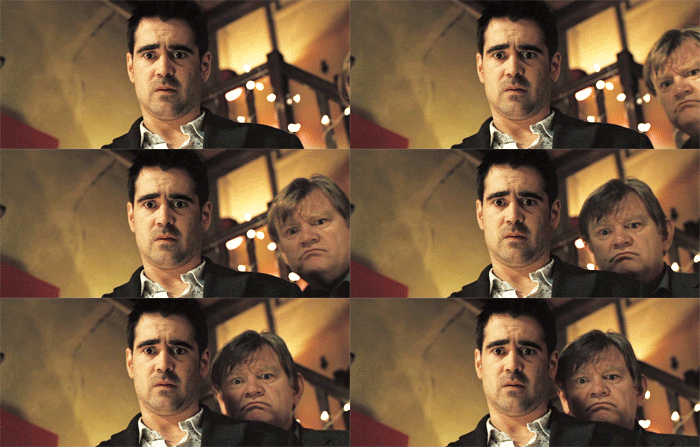 |
| This is either the characters reaction to much of the plot, or your reaction to that pun. Works either way. |
The short version is that this is what would have happened if His Dark Materials had grown up and run away to sea.
A lot of what makes that comparison so easy to make lies in the book's setting. There is the same collision point between an industrialising world and the spiritual, something of the same focus on the true nature of what goes beyond. Wigmore seems to approach the subject from a rather different view point and where His Dark Materials is provocative and maybe even a little angry, The Goddess Project seems more wry and amused by the subject. An example of this can be found in Otter, Orc's shamanic guide and arguably the best character in the book. The spirit manifestation of all things furry and fish munching takes an irreverent and cheerful approach with his charge, almost like Delboy and Rodney. Only with both of them having a clue what they're doing. Non-Brits, think... maybe Silk and Garion. Only better.
Nevertheless, there is something questioning and a bit iconoclastic here. Wigmore does not merely use the aesthetics of the early 1900s; he also engages with the nature of the beast in the way it divided humanity. There is something of a tendency in steampunk and other fantastical works drawing from the era to ignore these things in the name of adventure. Nor is it unknown for books to focus heavily on the darker side of those times. The Goddess Project walks the line. There are thoughts about the damage done by gender inequality and colonialism there if you want to read deeply and think but, if you're not particularly thinking about them, the subjects fade into the background in a way reminiscent of Pratchett. What it does do that will please everyone thought is create a deep, vivid, conflict-filled world for the story that really draws the reader in.
 |
| This is what happens when you let an Otter be the mentor, bruv |
The real theme of this story though is identity. As already mentioned, we've got two characters who can't even remember who they are and another two who give up their place in the world, but pretty much everyone in this book is looking for or questioning their identity somehow. Its like the marbling in quality beef. Of course, it would be very easy to overdo this and end up with a cast as whiny as the worst of The Wheel of Time. This doesn't happen largely because the characters are constantly active and when they stop to think, its usually to wonder how on earth they're going to repair the damage they've done. However, while they're always doing something, they're not action heroes. Much as I enjoy some bloodletting, its very refreshing to see some protagonists solving their problems with their brains. Or at least trying to.
The best things about the characters though are how central they are to the plot. They are stumbling across the great submerged evil because they're seeking the answers to their own problems, managing the neat trick of being reluctant heroes while being pro-active all at once. Also, because the character's problems are so central to the plot, we get to spend a lot of time with them. Pretty much everything that happens shines a light on their personalities. They're not always the most sympathetic, but they're always ones you can empathise with and this adds a real emotional weight to their actions. I can't really go into details without spoilers but Cass gets some great scenes with the new friends she makes, Orc's final shamanic journey is awesome, and pretty much everything Tashi does is really cool. But particularly his first appearance and his bit right at the end. That said, what makes them great characters isn't their epic scenes or witticisms, its how real they feel due to how how much we dwell in their thoughts and depths.
This is traditionally the part of the review where I tell you what's wrong with the book. Well, the problem here is I feel bad recommending it so wholeheartedly as surely I must be missing something. My friends will pick it up expecting genius and go away disappointed. I know other advanced copy readers agree with my assessment but I can't escape that nagging feeling. Nothing can really be this good. Well, I think it might just be. I would allow however that some people might think Orc and Cass quarrel too much. I disagree but can see people not enjoying it. Also, anyone looking for high octane action is in the wrong place, as are those looking for political intrigue in the halls of kings. These are everyday folk solving their own immense mystical problems. If that's what you're looking for, The Goddess Project fits this well:
In any case, I think either I've sold you or I haven't by now. What makes a book good or bad is how well it fits your tastes and the tastes of others. We've already established the former in my case. I really believe it'll do a great job with the latter too. I haven't read a book this good since the downright incredible Bridge of Birds early in 2016. So go check The Goddess Project out. Even if its just the Kindle sample. I know not everyone will love this book as much as I do. I'll be surprised though if most fans of intrigue-heavy character-led fantasy don't really like this though. I really will.
The Goddess Project is out now, published by Snowbooks. It can be pre-ordered on Amazon.co.uk or Amazon.com. I would like to thank Bryan and Snowbooks for my Advanced Review Copy. This does not affect my opinion of the book or the content of my review.
Saturday, 14 January 2017
My Modern Fantasy Challenge
This post would be a lot easier to introduce if I'd written when I'd actually had the idea.
Back in May last year, I decided that I don't know enough about modern fantasy. My tastes had calcified. I had a rough idea who was big and I'd read a few of them but, by and large, I was completely out of date. I didn't like this because:
a) As an aspiring author, I needed to know what was doing on out there
b) As a complete fantasy nerd, I hated the idea that I missing out on the good shit
My solution was to take myself off to a number of forums I'd recently joined back then - Best Fantasy Books, Fantasy Faction, and SFF Chronicles - and ask for recommendations on the best fantasy published within the last ten years. No preferences of any sort were given, although in some cases people knew me well enough to guess themselves. In the case of series, that meant those begun in that time span, not extending into it, although I wasn't being strict on time frame. My intention was to narrow down the feedback into a list of nine books by nine different authors - the best of the best. I picked the number nine because it seemed a nice number, large without being overwhelming, and of course if its good enough for Sauron its good enough for me. Then I'd read them all, review them all, and then have an idea how I felt about modern fantasy. That was the idea at least. Of course, the fact I'm writing this eight months after the fact means it hasn't quite gone to plan.
Anyway, what did I get in terms of recommendations? Well, for the first thing, I got the news that I'd read a bit more modern fantasy than I'd realised. I knew that Joe Abercrombie's The First Law fell in this time period - indeed, it celebrated its tenth birthday recently - but had forgotten that Jim Butcher's Codex Alera only just fell outside. I'd also forgotten about Paul Kearney's The Sea Beggars, a series that started very promisingly before getting wrecked on the rocks of publisher problems. Those three authors therefore don't appear below as I already knew about them.
Beyond that, I got recommendations for forty-nine different authors from twenty-one different people. Seven of those authors are self-published. The majority of those recommendations came from the highly talented GR Matthews, whose book 'The Stone Road' has sufficiently impressed me that I'll listen very closely to him. The only self-published author recommended by others was Allan Batchelder, a BFB favourite. In the event, I've decided not to put any of them on my list, because I wanted to concentrate more on what was popular. I will hopefully check out all of them at some point though.
Here's the whole list. I've arranged the recommendations by author rather than by book, and by the number of recommendations each received.
5 - Mark Lawrence, Scott Lynch
4 - Brandon Sanderson, Brent Weeks, Naomi Novik
3 - Brian McClellan, Peter Brett
2 - Adrian Tchaikovsky, Brian Staveley, R. Scott Bakker, Ben Aaronovitch, Allan Batchelder, Steven Erikson, Django Wexler, Chris Wooding, Michael Fletcher, Jen Williams, Neil Gaiman, Erin Morgenstern, Patrick Rothfuss, Daniel Abraham
1 - Nnedi Okorafor, Kirsty Logan, Kameron Hurley, Sarah Pinborough, Julia Knight, Emma Knight, Robert Redick, Miles Cameron, Michael Sullivan, Den Patrick, Kate Elliot, Robert Jackson Bennett, NK Jemisin, Alex Marshall, Jo Walton, Christopher Buehlman, Michael Livingston, Tad Williams, Jeff Salyards, Stella Gemmell, Laura Resnick, Ilona Andrews, T.O. Munro, J.P. Ashman, Matt Colville, James Cormier, Barbara Webb, Graham Austin-King (last 6 all SP)
Even before I picked, I was fascinated by the data. Some names came a great deal higher than I expected, others a great deal later. Given how much I'd heard about Patrick Rothfuss, I expected more than two recommendations for him, one of which said "I hated these books myself but they are extremely well regarded". Brian Staveley was another whose names pops up a lot, but who no one wanted to recommend to me. In the event, I read the intro chapters of The Emperor's Blades online and was impressed, then read them in a book borrowed from the library and was bored. No idea how that works!
I also can't help but notice that by and large, it's a fairly masculine list. Naomi Novik is the only woman in the top five recommended and there's only another two in the top twenty. There's sixteen total in the forty-nine, which is not bad, but if I was to remove just three of the people who nominated, I'd have five women nominated out of thirty-four. For whatever reason, the mainstream does not appear to be particularly thinking of women.
The top end of the list is generally dominated by those on the wrong side of the law or the right side if the battle field (or sometimes 'right') - something of a fantasy staple in many ways, but the tone seems much darker. Epic is in. Light-heartedness and adventure - well, there's a bit of it there, particularly among the urban fantasy authors, but it doesn't seem the norm.
Anyway, lets get to the picks. It being eight months after I asked and me being addicted to books, I've gone and read books by a few of the authors above before I ever drew up a list. Those are Scott Lynch, Brandon Sanderson, Ben Aaronovitch, Jen Williams and Miles Cameron. That leaves four slots just like that.
At this moment in time, I don't know who I'm adding to the list. Turns out sifting through 49 authors and making intelligent judgements is pretty difficult, even allowing for all the info out there these days. Also, I'm something of an impulse shopper. I do want to get a decent amount of the people at the top as that's who's really popular out there, but I also want to look at some of the odder concepts out there.
I'm pretty sure Naomi Novik's hitting the list. She's popular and she's doing something more than same old same old. I'll probably check out at least one of McClellan and Lawrence. McClellan I'm a bit reluctant about because he's compared so much to Sanderson and I'd like to spread out my sampling. With Lawrence, the issue is a lot of people I know and respect can't get on with his brand of grimdark. I suspect I'll be the same, particularly based on kindle samples.
Looking down the list, Wooding's books sound a whole lot of fun and I'm surprised I didn't receive more call outs for him based on conversations after asking. Tchaikovsky and Abraham both have talent, but I'm not sure I need to read more epic fantasy. Erin Morgernstern's The Night Circus has received a lot of praise and the kindle sample is beautifully written; not sure its quite my thing though. Right now, I suspect the last place or two will be filled out by someone from a shortlist of Jo Walton, NK Jemisin and Robert Jackson Bennett. They read beautifully and have intriguing ideas. Again, after the fact of me asking, I see a lot of praise for the latter two.
But I don't know for sure yet. Maybe I'll see someone on the list in a charity bookshop and snap them up, like I just did with Benedict Jacka and China Mieville. Or I'll spot them on kindle sale, which is how Miles Cameron made his way onto the list. In any case, its not like these are the last and only modern fantasy authors I'll ever read. That would be absurd. But these are the only nine I'm definitely reviewing. Once I'm done with those nine, I'll muse about where the genre is, although I'll be referring to more books than are just involved in this.
And I should at least be up to date by that point. And hungry for more books.
Back in May last year, I decided that I don't know enough about modern fantasy. My tastes had calcified. I had a rough idea who was big and I'd read a few of them but, by and large, I was completely out of date. I didn't like this because:
a) As an aspiring author, I needed to know what was doing on out there
b) As a complete fantasy nerd, I hated the idea that I missing out on the good shit
My solution was to take myself off to a number of forums I'd recently joined back then - Best Fantasy Books, Fantasy Faction, and SFF Chronicles - and ask for recommendations on the best fantasy published within the last ten years. No preferences of any sort were given, although in some cases people knew me well enough to guess themselves. In the case of series, that meant those begun in that time span, not extending into it, although I wasn't being strict on time frame. My intention was to narrow down the feedback into a list of nine books by nine different authors - the best of the best. I picked the number nine because it seemed a nice number, large without being overwhelming, and of course if its good enough for Sauron its good enough for me. Then I'd read them all, review them all, and then have an idea how I felt about modern fantasy. That was the idea at least. Of course, the fact I'm writing this eight months after the fact means it hasn't quite gone to plan.
Anyway, what did I get in terms of recommendations? Well, for the first thing, I got the news that I'd read a bit more modern fantasy than I'd realised. I knew that Joe Abercrombie's The First Law fell in this time period - indeed, it celebrated its tenth birthday recently - but had forgotten that Jim Butcher's Codex Alera only just fell outside. I'd also forgotten about Paul Kearney's The Sea Beggars, a series that started very promisingly before getting wrecked on the rocks of publisher problems. Those three authors therefore don't appear below as I already knew about them.
Beyond that, I got recommendations for forty-nine different authors from twenty-one different people. Seven of those authors are self-published. The majority of those recommendations came from the highly talented GR Matthews, whose book 'The Stone Road' has sufficiently impressed me that I'll listen very closely to him. The only self-published author recommended by others was Allan Batchelder, a BFB favourite. In the event, I've decided not to put any of them on my list, because I wanted to concentrate more on what was popular. I will hopefully check out all of them at some point though.
Here's the whole list. I've arranged the recommendations by author rather than by book, and by the number of recommendations each received.
5 - Mark Lawrence, Scott Lynch
4 - Brandon Sanderson, Brent Weeks, Naomi Novik
3 - Brian McClellan, Peter Brett
2 - Adrian Tchaikovsky, Brian Staveley, R. Scott Bakker, Ben Aaronovitch, Allan Batchelder, Steven Erikson, Django Wexler, Chris Wooding, Michael Fletcher, Jen Williams, Neil Gaiman, Erin Morgenstern, Patrick Rothfuss, Daniel Abraham
1 - Nnedi Okorafor, Kirsty Logan, Kameron Hurley, Sarah Pinborough, Julia Knight, Emma Knight, Robert Redick, Miles Cameron, Michael Sullivan, Den Patrick, Kate Elliot, Robert Jackson Bennett, NK Jemisin, Alex Marshall, Jo Walton, Christopher Buehlman, Michael Livingston, Tad Williams, Jeff Salyards, Stella Gemmell, Laura Resnick, Ilona Andrews, T.O. Munro, J.P. Ashman, Matt Colville, James Cormier, Barbara Webb, Graham Austin-King (last 6 all SP)
Even before I picked, I was fascinated by the data. Some names came a great deal higher than I expected, others a great deal later. Given how much I'd heard about Patrick Rothfuss, I expected more than two recommendations for him, one of which said "I hated these books myself but they are extremely well regarded". Brian Staveley was another whose names pops up a lot, but who no one wanted to recommend to me. In the event, I read the intro chapters of The Emperor's Blades online and was impressed, then read them in a book borrowed from the library and was bored. No idea how that works!
I also can't help but notice that by and large, it's a fairly masculine list. Naomi Novik is the only woman in the top five recommended and there's only another two in the top twenty. There's sixteen total in the forty-nine, which is not bad, but if I was to remove just three of the people who nominated, I'd have five women nominated out of thirty-four. For whatever reason, the mainstream does not appear to be particularly thinking of women.
The top end of the list is generally dominated by those on the wrong side of the law or the right side if the battle field (or sometimes 'right') - something of a fantasy staple in many ways, but the tone seems much darker. Epic is in. Light-heartedness and adventure - well, there's a bit of it there, particularly among the urban fantasy authors, but it doesn't seem the norm.
Anyway, lets get to the picks. It being eight months after I asked and me being addicted to books, I've gone and read books by a few of the authors above before I ever drew up a list. Those are Scott Lynch, Brandon Sanderson, Ben Aaronovitch, Jen Williams and Miles Cameron. That leaves four slots just like that.
At this moment in time, I don't know who I'm adding to the list. Turns out sifting through 49 authors and making intelligent judgements is pretty difficult, even allowing for all the info out there these days. Also, I'm something of an impulse shopper. I do want to get a decent amount of the people at the top as that's who's really popular out there, but I also want to look at some of the odder concepts out there.
I'm pretty sure Naomi Novik's hitting the list. She's popular and she's doing something more than same old same old. I'll probably check out at least one of McClellan and Lawrence. McClellan I'm a bit reluctant about because he's compared so much to Sanderson and I'd like to spread out my sampling. With Lawrence, the issue is a lot of people I know and respect can't get on with his brand of grimdark. I suspect I'll be the same, particularly based on kindle samples.
Looking down the list, Wooding's books sound a whole lot of fun and I'm surprised I didn't receive more call outs for him based on conversations after asking. Tchaikovsky and Abraham both have talent, but I'm not sure I need to read more epic fantasy. Erin Morgernstern's The Night Circus has received a lot of praise and the kindle sample is beautifully written; not sure its quite my thing though. Right now, I suspect the last place or two will be filled out by someone from a shortlist of Jo Walton, NK Jemisin and Robert Jackson Bennett. They read beautifully and have intriguing ideas. Again, after the fact of me asking, I see a lot of praise for the latter two.
But I don't know for sure yet. Maybe I'll see someone on the list in a charity bookshop and snap them up, like I just did with Benedict Jacka and China Mieville. Or I'll spot them on kindle sale, which is how Miles Cameron made his way onto the list. In any case, its not like these are the last and only modern fantasy authors I'll ever read. That would be absurd. But these are the only nine I'm definitely reviewing. Once I'm done with those nine, I'll muse about where the genre is, although I'll be referring to more books than are just involved in this.
And I should at least be up to date by that point. And hungry for more books.
Friday, 6 January 2017
State of the Delirium Address 2017
I started 2016 sublimely confident that I was ready to publish and be proud of my first book just as soon as I'd finished it.
I ended 2016 with that book written - and another one written too - and maybe a million miles away from publishing. Maybe I'm quite close. It is difficult to be sure.
When I started writing, I was a fool. I stepped blindly over the precipice, full of trust that things would be right. Plenty of reading and doing plenty of writing would be enough. It isn't. In hindsight that is obvious but the reality of my experience was quite humbling.
In a way though, the trust has been well placed. Through luck and through effort and through friends, I have learned a huge amount. I have created a huge amount. I could never have another idea for a story and yet still have enough for a lifetime. Most crucially, I have found support networks and new friends that will sustain me for a long way through this writing journey. I might be wrong about the tools I would use but I have been right that sitting down at the keyboard and writing has been the way to go.
That is not to say I will be successful. I may never write a book I am satisfied with, nevermind one that fulfils my dreams, bringing many people happiness and enlightenment while giving me the ability to work while completely naked. One of the things I've learned is that writing's not that sort of game.
Something I have learned though is that as long as you're having fun, you're winning. And what I learned in 2016 was a lot of fun. I also learned that writing isn't about waving a magic wand, its about doing the work again and again, and I have been doing the work. Possibly the greatest lesson I learned through is that most writers give up too quickly and that the only thing that can finish you as an author is stopping writing.
That said, my plan isn't just to keep having fun, keep working at it and never stop trying. That's what I tried last year, and the year before that, and before that too. It hasn't got me to where I am yet. If the heart and soul of writing are desire and discipline, imagination and perspiration, then the brain and muscle is skill and knowledge. I need more brain and muscle to move to where I want to be.
I've seen a lot of writing resolutions on the forums I use, most about the books people will write and release. I'm not going to say I don't have these resolutions, but they are not the goals I am pursuing first and foremost. Because after a conversation with Jo Zebedee sparked by a throw away comment, I have decided my resolutions are all to do with my writing processes. I will trust in the belief that it is performance that matters and if you get the performance right, the results will come.
The first resolution is that every day I will write or edit. I'll even try to learn and how do so without having a distraction at the same time.
The second resolution is to improve my knowledge of narrative structure and storytelling techniques. I'm currently doing my research for books to aid me in this while also searching for online articles such as this fabulous series by Jim Butcher.
The third resolution is to ask more questions. That's an idea that weirdly I didn't get because its simple common sense, but due to a book recommendation from Bryan Wigmore (of whom you will hear more shortly). The book deals with the story of the Fisher King, the crippled guardian of the grail in Arthurian legend who cannot be healed until Perceval is able to ask the right question. Its one of the great truths of human condition - that questions must be asked before things can get stronger - and that goes for writing as much as anything else.
Those are my resolutions. Maybe I'll discover they are the wrong ones and change them. No, wait. Maybe in time I'll discover I need different ones; they'll never be the wrong ones because today they are the right ones. If something is right in its time and place, then it is right.
If things go right, then I should self-publish my first book this year. That would be Eye of the Eagle, a military sci-fi adventure set in the same universe as Richard Tongue's Alamo series. I will also have another book to make decisions over, that being the fantasy murder mystery project currently known as Gumshoe Paladin. I'm still unsure over whether to submit it or go straight to self-publication. And there's a few short story ideas that are germinating and might become something, which would be nice, particularly as I've just joined a writing group focused on short stories.
There's a few fun blog things lined up too, like my first author interview (hopefully first of many) and my plans to do big weighty reviews for all the Discworld books. I'm also planning to chronicle my discovery of fantasy written this century and start throwing out the odd very short story here and there. And I'll even have a life outside of writing (Boo! Hiss!) as I'll be getting married in May (love you darling if you're reading this). A full year in other words but as they say, if you want something done give it to a busy person.
Whatever happens though, I will have fun, I will keep pressing forwards and I will keep learning. I hope you do the same.
Wibble.
I ended 2016 with that book written - and another one written too - and maybe a million miles away from publishing. Maybe I'm quite close. It is difficult to be sure.
When I started writing, I was a fool. I stepped blindly over the precipice, full of trust that things would be right. Plenty of reading and doing plenty of writing would be enough. It isn't. In hindsight that is obvious but the reality of my experience was quite humbling.
In a way though, the trust has been well placed. Through luck and through effort and through friends, I have learned a huge amount. I have created a huge amount. I could never have another idea for a story and yet still have enough for a lifetime. Most crucially, I have found support networks and new friends that will sustain me for a long way through this writing journey. I might be wrong about the tools I would use but I have been right that sitting down at the keyboard and writing has been the way to go.
That is not to say I will be successful. I may never write a book I am satisfied with, nevermind one that fulfils my dreams, bringing many people happiness and enlightenment while giving me the ability to work while completely naked. One of the things I've learned is that writing's not that sort of game.
Something I have learned though is that as long as you're having fun, you're winning. And what I learned in 2016 was a lot of fun. I also learned that writing isn't about waving a magic wand, its about doing the work again and again, and I have been doing the work. Possibly the greatest lesson I learned through is that most writers give up too quickly and that the only thing that can finish you as an author is stopping writing.
That said, my plan isn't just to keep having fun, keep working at it and never stop trying. That's what I tried last year, and the year before that, and before that too. It hasn't got me to where I am yet. If the heart and soul of writing are desire and discipline, imagination and perspiration, then the brain and muscle is skill and knowledge. I need more brain and muscle to move to where I want to be.
I've seen a lot of writing resolutions on the forums I use, most about the books people will write and release. I'm not going to say I don't have these resolutions, but they are not the goals I am pursuing first and foremost. Because after a conversation with Jo Zebedee sparked by a throw away comment, I have decided my resolutions are all to do with my writing processes. I will trust in the belief that it is performance that matters and if you get the performance right, the results will come.
The first resolution is that every day I will write or edit. I'll even try to learn and how do so without having a distraction at the same time.
The second resolution is to improve my knowledge of narrative structure and storytelling techniques. I'm currently doing my research for books to aid me in this while also searching for online articles such as this fabulous series by Jim Butcher.
The third resolution is to ask more questions. That's an idea that weirdly I didn't get because its simple common sense, but due to a book recommendation from Bryan Wigmore (of whom you will hear more shortly). The book deals with the story of the Fisher King, the crippled guardian of the grail in Arthurian legend who cannot be healed until Perceval is able to ask the right question. Its one of the great truths of human condition - that questions must be asked before things can get stronger - and that goes for writing as much as anything else.
Those are my resolutions. Maybe I'll discover they are the wrong ones and change them. No, wait. Maybe in time I'll discover I need different ones; they'll never be the wrong ones because today they are the right ones. If something is right in its time and place, then it is right.
If things go right, then I should self-publish my first book this year. That would be Eye of the Eagle, a military sci-fi adventure set in the same universe as Richard Tongue's Alamo series. I will also have another book to make decisions over, that being the fantasy murder mystery project currently known as Gumshoe Paladin. I'm still unsure over whether to submit it or go straight to self-publication. And there's a few short story ideas that are germinating and might become something, which would be nice, particularly as I've just joined a writing group focused on short stories.
There's a few fun blog things lined up too, like my first author interview (hopefully first of many) and my plans to do big weighty reviews for all the Discworld books. I'm also planning to chronicle my discovery of fantasy written this century and start throwing out the odd very short story here and there. And I'll even have a life outside of writing (Boo! Hiss!) as I'll be getting married in May (love you darling if you're reading this). A full year in other words but as they say, if you want something done give it to a busy person.
Whatever happens though, I will have fun, I will keep pressing forwards and I will keep learning. I hope you do the same.
Wibble.
Friday, 23 December 2016
The True Meaning of Christmas
I think a lot of people in long term relationships have that moment when the other person does something that makes you think "We've got a keeper folks!". One of mine was when my lady announced she hated Christmas.
I loathe Christmas. I despise Christmas. One of my great dreams is to someday spend Christmas in a hotel room with a giant pile of books and Chinese take away and pretend it isn't happening. People tell me I'll feel differently when I have kids of my own. I can't think of a better reason to never have kids.
Despite this, there are things to be admired about Christmas, and I'm not just talking about the opportunity to try and consume your own body weight. That's every day. Or that chance to fill your book shelves even more.
Look at Christmas - the date, the trappings, the everything. Look at - presuming a fair bit of cultural commonality here - the tree. Look at angel decorations. Look at the fat git in red with the smug expression who's everywhere. What do you see?
Syncretism. No blogger autocorrect, not cretinism, even if I think you're close to the mark there. Syncretism. Christmas as we know it, at least in the UK and many other parts of the Anglosphere, is a mixture of traditions from many different places. And those traditions - and the food stuffs, the drinks, the deities, and the everything else - are constantly evolving as people find ideas they like and drop ones they don't.
And syncretism - perhaps not the right word when talking about ideas - is very much evident in many of the great works of fantasy. They draw on a wide range of influences, just like real world traditions, and this is what gives them the depth and vividness of culture that makes people rave about books.
In contrast, there are books that give the impression of the author having read nothing but the genre for the last ten years. Sometimes I like those books. Occasionally I even love them. Sometimes I read a few pages and put the book back. What I never do is think "Here be one of the greats". Even with the most compelling writing, the most captivating characters, the tightest plotting... it just won't catch. Its like cooking. Incredible technique and imagination can only so do much with tired ingredients. In the case of fantasy literature, the best ingredients means a few ideas that aren't in every book already.
These don't have to be giant-sized idea or crazy combinations. Tolkien took his own experiences and beliefs, married them to a blend of northern European legend, and created a legend of his own. Martin got a mileage out of an unusually direct port of a very specific time in English history. And JK Rowling stuck gold with British boarding schools + Wizards. Neither of the latter two were the first to go there either; the ideas don't have to be completely new. There just has to be something fresh about it.
So I urge all of the writers reading this to embrace the true spirit of Christmas and keep blending ideas together in that quest to find the perfect whole, beloved by nearly everyone.
Maybe its not such a bad holiday after all. Hmm... nah. Bah humbug everyone!

I loathe Christmas. I despise Christmas. One of my great dreams is to someday spend Christmas in a hotel room with a giant pile of books and Chinese take away and pretend it isn't happening. People tell me I'll feel differently when I have kids of my own. I can't think of a better reason to never have kids.
Despite this, there are things to be admired about Christmas, and I'm not just talking about the opportunity to try and consume your own body weight. That's every day. Or that chance to fill your book shelves even more.
Look at Christmas - the date, the trappings, the everything. Look at - presuming a fair bit of cultural commonality here - the tree. Look at angel decorations. Look at the fat git in red with the smug expression who's everywhere. What do you see?
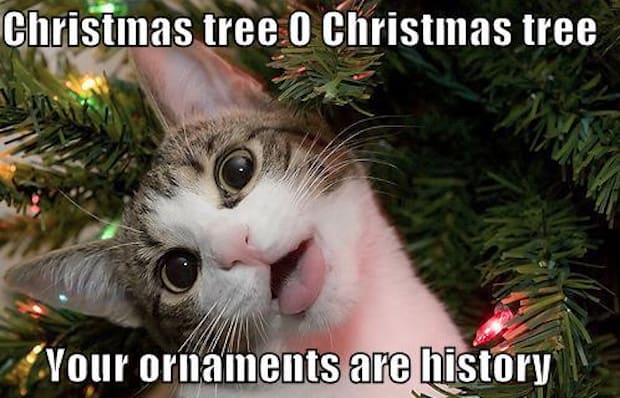 |
| Okay, so that's what I see, but everyone else... |
Syncretism. No blogger autocorrect, not cretinism, even if I think you're close to the mark there. Syncretism. Christmas as we know it, at least in the UK and many other parts of the Anglosphere, is a mixture of traditions from many different places. And those traditions - and the food stuffs, the drinks, the deities, and the everything else - are constantly evolving as people find ideas they like and drop ones they don't.
And syncretism - perhaps not the right word when talking about ideas - is very much evident in many of the great works of fantasy. They draw on a wide range of influences, just like real world traditions, and this is what gives them the depth and vividness of culture that makes people rave about books.
In contrast, there are books that give the impression of the author having read nothing but the genre for the last ten years. Sometimes I like those books. Occasionally I even love them. Sometimes I read a few pages and put the book back. What I never do is think "Here be one of the greats". Even with the most compelling writing, the most captivating characters, the tightest plotting... it just won't catch. Its like cooking. Incredible technique and imagination can only so do much with tired ingredients. In the case of fantasy literature, the best ingredients means a few ideas that aren't in every book already.
These don't have to be giant-sized idea or crazy combinations. Tolkien took his own experiences and beliefs, married them to a blend of northern European legend, and created a legend of his own. Martin got a mileage out of an unusually direct port of a very specific time in English history. And JK Rowling stuck gold with British boarding schools + Wizards. Neither of the latter two were the first to go there either; the ideas don't have to be completely new. There just has to be something fresh about it.
So I urge all of the writers reading this to embrace the true spirit of Christmas and keep blending ideas together in that quest to find the perfect whole, beloved by nearly everyone.
Maybe its not such a bad holiday after all. Hmm... nah. Bah humbug everyone!
Thursday, 8 December 2016
Legend by David Gemmell
As 2016 comes to an end and we reflect on just how miserable a year it was, we should also take time to remember the good things that happened. Even the darkest cloud has a silver lining somewhere. Take cancer. Now, in the words of the great prophet Deadpool, el cancer is a shit-show. But without David Gemmell getting a terminal cancer diagonsis, we may never have had the legend that is, er, Legend.
Of course, Gemmell would have probably tried publishing something else if he hadn't had that experience. It would have probably have included a gruff old warrior of a father-figure because he has relived that part of his childhood many, many times in his book. It might have even been a story about a siege given his interest in the Alamo.
But it wouldn't have about the continual focus and meditation on what its like to face death right in the face. And that's what makes this book great right there.
The basic plot of Legend is that an undermanned citadel has to stop a Not-Mongol horde. That's it. Pretty much all of the characters agree its only going to end in failure and yet they do it anyway. The story is mainly told from the perspective of Rek, a somewhat cowardly wanderer and veteran who wants nothing to do with to do with this. However, Fate/Gemmell pisses all over him, he falls in love with the wrong/right woman, and into the blender he goes. Yes, just like Deadpool, this is a love story.
It is not just Rek's tale though. Many many characters get PoVs, often just one or two before their inevitable death. That really shouldn't be a spoiler by now. In the process, we get to know a little about their dreams, their fears, and everything that makes them human. The result is a war story with an unusual and compelling empathy. Yes its a war story as well as a love story. Its a really good one too; even in the first book of his career, Gemmell knew how to write an action scene. And he knew violence, and he knew what it was like to stare death in the face.
He doesn't dwell on these things. He doesn't dwell on anything really. Its a fast paced book and sometimes you wish he'd gone deeper into the things he brought up. Like Rek's romance or his fear, the latter of which feels particularly unfollowed by the end. That is just the nature of the beast though. Gemmell makes a statement, then he makes another one, then another, often setting them against each other. I might wish he'd done it differently at times but it certainly works. Its like a great big thematic drum, simple but powerful.
Simple but powerful is a good way of describing this book. In the author's own words, it has "all the flaws you expect in a first novel". The prose is best not closely examined although it more than does its task for readers who let the pace of the book sweep them away. Characterisation is done in broad strokes. The plot is straightforward and some of the death scenes are lacking emotional resonance - although perhaps that is simply a result of how much death is in the book. For some people, there might not be enough going on, or they'll find the style jarring. But for those who aren't too bothered by such things, I reckon plenty will read it and agree with me in exclaiming at the end:
As people will have noticed from this blog, my tastes are pretty old fashioned. I started working my way through a big old pool of authors when I was 16 and have only recently run out of material. These reviews aren't just to entertain you lovely people reading, they're also a way to look at my influences and work out what they did and what I took from them. In doing so, I've found a lot of things that irk me about these authors as well, reasons why modern authors have supplanted them as titans of the genre.
The only reason I can see for Gemmell not still being considered one of the big boys is that he's dead. Its hard to stay relevant when you're no longer publishing regularly and even harder to keep publishing regularly when part of the Choir Invisible. A few authors see their name and reputation last beyond that inevitability. I would not be surprised if, twenty years down the line, David Gemmell was one of them. I certainly hope so.
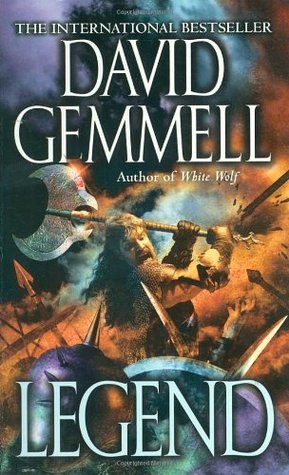 |
| Once upon a time, there was a man with a very big axe... |
But it wouldn't have about the continual focus and meditation on what its like to face death right in the face. And that's what makes this book great right there.
The basic plot of Legend is that an undermanned citadel has to stop a Not-Mongol horde. That's it. Pretty much all of the characters agree its only going to end in failure and yet they do it anyway. The story is mainly told from the perspective of Rek, a somewhat cowardly wanderer and veteran who wants nothing to do with to do with this. However, Fate/Gemmell pisses all over him, he falls in love with the wrong/right woman, and into the blender he goes. Yes, just like Deadpool, this is a love story.
 |
| Like this... only with more killing... and more mystic voyeurs... okay, nothing like this |
He doesn't dwell on these things. He doesn't dwell on anything really. Its a fast paced book and sometimes you wish he'd gone deeper into the things he brought up. Like Rek's romance or his fear, the latter of which feels particularly unfollowed by the end. That is just the nature of the beast though. Gemmell makes a statement, then he makes another one, then another, often setting them against each other. I might wish he'd done it differently at times but it certainly works. Its like a great big thematic drum, simple but powerful.
Simple but powerful is a good way of describing this book. In the author's own words, it has "all the flaws you expect in a first novel". The prose is best not closely examined although it more than does its task for readers who let the pace of the book sweep them away. Characterisation is done in broad strokes. The plot is straightforward and some of the death scenes are lacking emotional resonance - although perhaps that is simply a result of how much death is in the book. For some people, there might not be enough going on, or they'll find the style jarring. But for those who aren't too bothered by such things, I reckon plenty will read it and agree with me in exclaiming at the end:
 |
| Expect a lot more Deadpool references in the future |
The only reason I can see for Gemmell not still being considered one of the big boys is that he's dead. Its hard to stay relevant when you're no longer publishing regularly and even harder to keep publishing regularly when part of the Choir Invisible. A few authors see their name and reputation last beyond that inevitability. I would not be surprised if, twenty years down the line, David Gemmell was one of them. I certainly hope so.
Wednesday, 9 November 2016
General Update
Well its been rather silent here recently. And no one likes an awkward silence. Therefore, I will waffle a bit to break it.
You have been warned.
Here's what I've been doing.
1) Hating everything I've been reading
Well, not everything. But most things. And in fairness this has been going on for a while.
What happens is I pick up a new book, read for a bit, then put it down, disappointed in some thing. Its happened with indie authors, its happened with Sanderson, its happened with everyone in between. I'm not sure why its happening - writing leaving me hypercritical? A side effect of my less than stellar outlook on the world in other issues? Sheer bad luck? Who knows. It is quite irritating though, not least because I do have to go back and give some of these authors a second go.
I'm not going to list everything I've bounced off - that would take a hella long time - but I did think I'd shout out the two new books that have pierced my armour of hatred.
Those are Heart of Granite by James Barclay and The Lies of Locke Lamora by Scott Lynch. Very different books, but if there is a link, I would suggest it is that neither is taking itself completely seriously. Which is a very underrated trait in fiction if you ask me.
2) Eating at Bar Shu
I don't know how many people reading this blog will have much of an interest in high end Sichuan cooking in London. It should be everyone but people are odd sometimes. Or have no interest in going to London.
In any case, a friend dragged me out there the other day. The original plan had been to eat around London Bridge, but she decided I need some exercise and she'd route march us to Soho instead. I wasn't complaining as getting a good meal around London Bridge can be a bit of a trial and I love Chinese food. This was my first time in a restaurant concentrating on the Sichuan region. I know of the cuisine; I know enough not to order anything considered hot by the menu.
And it was an incredibly big menu, covered with pictures of not your standard Friday night takeaway. Generally I have a rule about eating at places which show you pictures of the food (try not to) but I didn't mind on this occasion. It did make ordering very slow. Eventually I ordered the Muxu Pork and some whelks. The pork was not at all hot, but rather silky and comforting and downright delicious. The whelks weren't as good but did provide a nice counterpoint between mouthfuls of pork. My friend got the Gong Bao prawns with cashew nuts. I stole a few - they were some of the best prawns I've had in a while.
Googling the place finds plenty of less than glowing consumer reviews online. This surprised me a little although upon reading further, the main objection seemed to be to the service. Bad service in restaurants is of the devil tis true, but I had no problems. They even brought me a fork when it was clear I am horribly inept with chopsticks.
Me and the friend are already planning a return visit with a big posse so we can try more of the menu.
3) Playing dumb computer games
This has occupied far too much of my time.
Dumbest of all is an online idle browser game called Midas. The idea is you're Midas, gathering ever greater sums of money. At some point you get more diamonds than there are atoms in the universe. It is strangely compelling despite the fact pretty much nothing happens.
Slightly less dumb but still dumb is Freecell. I tell myself I'm using it as a mental warm up but the reality is I play it as a way of doing something to avoid being bored when I can do nothing more challenging.
Only kinda dumb is Mount & Blade: Warband, where I frequently spend my evenings yelling at other people not to die so quickly. They don't listen but that's okay as I'm usually being a little hypocritical when doing so.
4) Doing an internship
My return to the job market has featured a detour through internship land. I'm currently acting as a sorta digital copywriter/editor to Healthwatch Camden, updating and improving their Start Here guide to health in the borough.
Its been pretty interesting actually. There is a huge array of bodies offering some form of health or care to the public, or oversight of those, or the ability to complain about them. If someone wants to be actively informed about what they do with their health problems, they face overload. One of the things I've been doing is trying to make sure all the options are there for them to pick from without it being too overloading.
The weird thing is I've found having the structure of work actually helped with my writing. That is until...
5) Not writing like I should
Well, you knew that. There's been no writing on the blog.
Eventually, the whole hating everything I read thing got to my own writing. I hit a tough point in the plot where a lot happens in a short space and found I couldn't edit it for love or money because everything I wrote sounded awful. There's only one thing to do when that happens and that's to put the project aside for a little. Either clear your head of writing, or work on something else, or anything else at all. I'm all for writing crap to hammer out a draft but once you get to the editing stage, either do it right or not at all.
Anyway, since then I've cleared the head and yesterday on the train finally started tearing into that difficult little scene. It isn't done yet but we're on the way again to finish that book and putting it out for all you people. So time to finish this filler blog post and get back to work on the book.
You have been warned.
Here's what I've been doing.
1) Hating everything I've been reading
Well, not everything. But most things. And in fairness this has been going on for a while.
What happens is I pick up a new book, read for a bit, then put it down, disappointed in some thing. Its happened with indie authors, its happened with Sanderson, its happened with everyone in between. I'm not sure why its happening - writing leaving me hypercritical? A side effect of my less than stellar outlook on the world in other issues? Sheer bad luck? Who knows. It is quite irritating though, not least because I do have to go back and give some of these authors a second go.
I'm not going to list everything I've bounced off - that would take a hella long time - but I did think I'd shout out the two new books that have pierced my armour of hatred.
Those are Heart of Granite by James Barclay and The Lies of Locke Lamora by Scott Lynch. Very different books, but if there is a link, I would suggest it is that neither is taking itself completely seriously. Which is a very underrated trait in fiction if you ask me.
2) Eating at Bar Shu
I don't know how many people reading this blog will have much of an interest in high end Sichuan cooking in London. It should be everyone but people are odd sometimes. Or have no interest in going to London.
In any case, a friend dragged me out there the other day. The original plan had been to eat around London Bridge, but she decided I need some exercise and she'd route march us to Soho instead. I wasn't complaining as getting a good meal around London Bridge can be a bit of a trial and I love Chinese food. This was my first time in a restaurant concentrating on the Sichuan region. I know of the cuisine; I know enough not to order anything considered hot by the menu.
And it was an incredibly big menu, covered with pictures of not your standard Friday night takeaway. Generally I have a rule about eating at places which show you pictures of the food (try not to) but I didn't mind on this occasion. It did make ordering very slow. Eventually I ordered the Muxu Pork and some whelks. The pork was not at all hot, but rather silky and comforting and downright delicious. The whelks weren't as good but did provide a nice counterpoint between mouthfuls of pork. My friend got the Gong Bao prawns with cashew nuts. I stole a few - they were some of the best prawns I've had in a while.
Googling the place finds plenty of less than glowing consumer reviews online. This surprised me a little although upon reading further, the main objection seemed to be to the service. Bad service in restaurants is of the devil tis true, but I had no problems. They even brought me a fork when it was clear I am horribly inept with chopsticks.
Me and the friend are already planning a return visit with a big posse so we can try more of the menu.
3) Playing dumb computer games
This has occupied far too much of my time.
Dumbest of all is an online idle browser game called Midas. The idea is you're Midas, gathering ever greater sums of money. At some point you get more diamonds than there are atoms in the universe. It is strangely compelling despite the fact pretty much nothing happens.
Slightly less dumb but still dumb is Freecell. I tell myself I'm using it as a mental warm up but the reality is I play it as a way of doing something to avoid being bored when I can do nothing more challenging.
Only kinda dumb is Mount & Blade: Warband, where I frequently spend my evenings yelling at other people not to die so quickly. They don't listen but that's okay as I'm usually being a little hypocritical when doing so.
4) Doing an internship
My return to the job market has featured a detour through internship land. I'm currently acting as a sorta digital copywriter/editor to Healthwatch Camden, updating and improving their Start Here guide to health in the borough.
Its been pretty interesting actually. There is a huge array of bodies offering some form of health or care to the public, or oversight of those, or the ability to complain about them. If someone wants to be actively informed about what they do with their health problems, they face overload. One of the things I've been doing is trying to make sure all the options are there for them to pick from without it being too overloading.
The weird thing is I've found having the structure of work actually helped with my writing. That is until...
5) Not writing like I should
Well, you knew that. There's been no writing on the blog.
Eventually, the whole hating everything I read thing got to my own writing. I hit a tough point in the plot where a lot happens in a short space and found I couldn't edit it for love or money because everything I wrote sounded awful. There's only one thing to do when that happens and that's to put the project aside for a little. Either clear your head of writing, or work on something else, or anything else at all. I'm all for writing crap to hammer out a draft but once you get to the editing stage, either do it right or not at all.
Anyway, since then I've cleared the head and yesterday on the train finally started tearing into that difficult little scene. It isn't done yet but we're on the way again to finish that book and putting it out for all you people. So time to finish this filler blog post and get back to work on the book.
Subscribe to:
Posts (Atom)