Jade City by Fonda Lee
Jade City is described most commonly as a wuxia version of the Godfather for good reason. It packs all the scope and heft of Coppola's classic and echoes the twisted family loyalties of the Corleones. It is also filled with the breathtaking action and high mythic feel associated with wuxia. And, really, who doesn't want to read something that hits both of those points?
Unfortunately, Jade City doesn't quite do its concept justice. The sheer size of the story feels too big for the page count as arcs build up then sizzle out with characters suddenly going with the flow of events. As a result, I felt rather neutral on the characters and their struggles, neither hoping nor fearing for them. Hopefully over the course of the series, I end up thinking the opposite.
Because, despite the rather large flaw I find in Jade City, I do want to read the rest and find out how the story ends. Lee writes well, particularly when doing action scenes, and presents a beautifully vivid world, intriguing me where the characters and story do not. And the characters do have potential - they just need more words to realise it - and the story has been set up for a potentially breathtaking sequel. I'd recommend it for those reasons alone, as I believe Lee will deliver, but any fans of, well, wuxia and the Godfather would do well to check in.
The Straight Razor Cure by Daniel Polansky
When I started searching for fantasy noir, this was the book most recommended to me. It doesn't take more than a few pages to realise why. The Straight Razor Cure is saturated with sardonic style and is definitely the closest thing I've found to Chandler giving fantasy a go. Polansky has more than a noir voice though; he has the knack for making the dark and seedy feel non-gratuitous.
His narrator, the Warden, is swiftly thrown into a murder investigation that threatens the whole city as well as his very personal well-being. The storyline progresses nicely with an entertaining cast of secondary characters - that is, until it hits the murky middle. For reasons I can't quite put my finger on, it became a struggle to push through, uninteresting and a bit confusing. It is perhaps not a coincidence that the middle is about where I began to tire of the voice too; there can be too much of a good thing.
Nevertheless, I liked it enough to struggle through to the end, thanks to some wonderful set-pieces. Tell the truth, I can't even really remember whether I liked the ending, although I do remember heavily disliking certain elements. I did start reading the next one though (until I needed to give it to the library) so it can't have been that bad. And I will, murky middle or no, echo the people I asked; this is the book to start with for Noir fantasy.
Night Watch by Sir Terry Pratchett
Yes, yes, I'm reviewing the last (or more or less last) first. That's because its the best, a masterpiece in its own right elevated by the series worth of character development that went into Sam Vimes and the streets he treads. Books like these are why readers cling grimly to series even when the author seems to have murdered their creative muse for the life insurance and buggered off to the Bahamas.
Crime books sometimes undersell their characters, when arguably they need to be sold harder than any other genre. They must be vulnerable enough - human enough - for empathy, yet tough enough to belong to the mean streets that very few of us willingly choose. Pratchett nails both parts of the equation. He does an equally fine job with the supporting cast, who are invested with a lot of humanity in a very short period of time, and greatly add to the book's tension as a result.
Not that this is a tense book. I struggle to think how I'd characterise the book's story actually. But what tension exists is mostly cut with background gallows humour, until right at the end itself. Those looking for a tight mystery are in the wrong place (although many of the earlier Guards books do have them) as are those looking for something bleak. For everyone else, this series - and eventually this book - would be where I'd recommend starting with fantasy crime.
The Thief Who Pulled on Trouble's Braids by Michael McClung
There's a big gap between Polansky and Pratchett when it comes to tone; those looking for something in the middle might try McClung. His eponymous thief, Amra Thetys, has something of the Warden's grimness and moral laxity, while also having something of Vimes' world-weary humanity and humour.
This results in a book with fantastic voice and plenty of charm, albeit spoiled by a few anachronistic phrases. The mystery itself is well plotted and revealed, although the most memorable moments tend to come from the action scenes than the big reveals. Big fights are something McClung does very well though, so it's somewhat understandable.
Unfortunately, he relies a lot on powerful magicians who do somewhat unravel the plot. That, plus the odd slips of mood and a few tedious repetitions, were enough to seriously dent my enjoyment levels of this book. Which is a shame because at his best, McClung shows he gets everything that goes into a fantasy crime book and just how to do it. Here's hoping the rest of the series is a bit more refined.
Servant of the Underworld by Aliette de Bodard
Servant of the Underworld features one of my favourite concepts ever; an Aztec priest who fights crime. Well. Solves a murder. I'm still annoyed I wasn't able to buy a new paperback copy and show De Bodard my support the old fashioned way. I'm even more annoyed that despite all the vivid myth and detail surrounding the Aztecs and their neighbours, there is so little fantasy literature honouring them. I've heard some criticise De Bodard's depiction of the Aztecs here; I am no expert, but I found nothing to fault here.
Sadly I can't say the same of the plot, which was more intent on digging through the tangled worries of the priest's home and political life than the crime itself. To an extent, I understand; De Bodard gave her protagonist an interesting background that I wanted explored. But the result did justice to neither as far as I'm concerned.
Which isn't to say this is a bad book. I finished it after all. The characters and central premise of the murder are great. Its certainly worth exploring if you stumble across it. It may even be worth chasing down, if, like me, you love mythology and crime and all that good stuff. You may find it less uneven than me and think its downright excellent. I hope many do, but for me, it remains a case of squandered potential.
Wednesday, 21 February 2018

Friday, 16 February 2018
Feasting Friday
Because I'm unable to concentrate on any one topic, I've decided to start using this blog to keep a semi-regular account of my gastronomic adventures.
Well. I say adventures. I'm pretty sure going to a Chinese supermarket isn't actually an adventure.
But gods does it feel like its magic.
The magic shop is one of the nicknames me and my wife have for Wing Yip, the Chinese supermarket down in Croydon. It's also known as the happy place.
I wasn't quite sure what to expect when we first went there. I'd been there, a long time before, but without knowing quite how to take full advantage. We went there mainly to stock up on sauces but I quickly realised the best way to take proper advantage. And that is starters.
The starters section is undoubtedly the best part of any Chinese menu, which is undoubtedly the best type of takeaway menu. Unfortunately, that stuff gets expensive very fast.
Enter Wing Yip and its big freezer full of takeaway starters.
I forget just how much the big box of sesame prawn toast was, but it was three portions worth for about one portion's worth of a takeaway. What's more, eating them fresh from the oven meant they tasted a hell of a lot better. Ditto with the duck spring rolls. Its made celebrating Chinese new year - by which I mean eating all the Chinese food - a hell of a lot better in every possible way.
I think the only way to get sesame prawn toast better is to be in a good restaurant and get them done really well. That's what we did last time we went to the happy place and popped into Tai Tung, the restaurant next door. The sesame prawn toast there was perfectly crunchy and succulent at the same time. The real big discovery there was cheung fun, a steamed rice noodle roll that was beautifully seasoned and with just the right amount of resistance.
Anyway, that's it for now. In future, there will be recipes, the Jamie Oliver 15 minute meal drinking game, meals around London, all the rest of it... but for now, happy Year of the Dog.
Well. I say adventures. I'm pretty sure going to a Chinese supermarket isn't actually an adventure.
But gods does it feel like its magic.
The magic shop is one of the nicknames me and my wife have for Wing Yip, the Chinese supermarket down in Croydon. It's also known as the happy place.
I wasn't quite sure what to expect when we first went there. I'd been there, a long time before, but without knowing quite how to take full advantage. We went there mainly to stock up on sauces but I quickly realised the best way to take proper advantage. And that is starters.
The starters section is undoubtedly the best part of any Chinese menu, which is undoubtedly the best type of takeaway menu. Unfortunately, that stuff gets expensive very fast.
Enter Wing Yip and its big freezer full of takeaway starters.
I forget just how much the big box of sesame prawn toast was, but it was three portions worth for about one portion's worth of a takeaway. What's more, eating them fresh from the oven meant they tasted a hell of a lot better. Ditto with the duck spring rolls. Its made celebrating Chinese new year - by which I mean eating all the Chinese food - a hell of a lot better in every possible way.
I think the only way to get sesame prawn toast better is to be in a good restaurant and get them done really well. That's what we did last time we went to the happy place and popped into Tai Tung, the restaurant next door. The sesame prawn toast there was perfectly crunchy and succulent at the same time. The real big discovery there was cheung fun, a steamed rice noodle roll that was beautifully seasoned and with just the right amount of resistance.
Anyway, that's it for now. In future, there will be recipes, the Jamie Oliver 15 minute meal drinking game, meals around London, all the rest of it... but for now, happy Year of the Dog.
Wednesday, 7 February 2018
My top 10 writing articles from last year
Being super on the ball, I decided that towards after the end of January is about the right time to get my top 10 9 10 lists from last year out. I could defend this on grounds of belief that the process of judging should only occur once the very last day of the year has gone and that it takes time to judge properly. Sadly, this is more a case of extreme untogetherness.
But all good things in all good time and hopefully this is good. In a year full of seeking enlightenment as to writing better stories, I've read a lot of articles, a lot of tips. These are the ones that I've gone "huh" at, reread, pondered. The ones I've taken things from and think have something others can take from as well.
With no further ado, and with only the loosest order:
When We Try to Sort Writers Into ‘Plotter’ or ‘Pantser’ by Ada Palmer
This one has been pivotal to me. The order is loose but it's no accident this one ended up on top. People go on about the idea of a toolbox (as advanced by King) but not many talk about what it should contain. Palmer does a fantastic job of telling me about the tools I always had without knowing - and also needed without knowing.
But all good things in all good time and hopefully this is good. In a year full of seeking enlightenment as to writing better stories, I've read a lot of articles, a lot of tips. These are the ones that I've gone "huh" at, reread, pondered. The ones I've taken things from and think have something others can take from as well.
With no further ado, and with only the loosest order:
When We Try to Sort Writers Into ‘Plotter’ or ‘Pantser’ by Ada Palmer
This one has been pivotal to me. The order is loose but it's no accident this one ended up on top. People go on about the idea of a toolbox (as advanced by King) but not many talk about what it should contain. Palmer does a fantastic job of telling me about the tools I always had without knowing - and also needed without knowing.
Death To Readers by Terry Rossio
Rossio's site is jampacked with useful advice for storytellers but this is the article of his I read first and took most from. Writing often becomes complex because we are juggling so many tasks, but most of the tasks are quite simple. Death To Readers is the best reminder of that I've found and the best aide memoire for whether you're getting that right or missing the details in the big picture.
Rossio's site is jampacked with useful advice for storytellers but this is the article of his I read first and took most from. Writing often becomes complex because we are juggling so many tasks, but most of the tasks are quite simple. Death To Readers is the best reminder of that I've found and the best aide memoire for whether you're getting that right or missing the details in the big picture.
Screenplay Techniques by M.D. Presley
The man who introduced me to Rossio. There's a lot of screenplay writing advice thrown about in the fantasy community (see above) but Presley is the only one I've seen so far that treats that advice in terms of what is applicable to literature and what is not. The result is a lot of solid pragmatic advice on story structure.
The man who introduced me to Rossio. There's a lot of screenplay writing advice thrown about in the fantasy community (see above) but Presley is the only one I've seen so far that treats that advice in terms of what is applicable to literature and what is not. The result is a lot of solid pragmatic advice on story structure.
Seventeen important things I've learned about writing and publishing by Teresa Edgerton
So far I haven't taken that much from Edgerton's article in terms of writing - although it is clear and intelligent there - or the writing industry, which I have yet to properly encounter. But in terms of why people write and whether we should or shouldn't, I find it incredibly reassuring and wise. Its something that rewards me every time I come back.
So far I haven't taken that much from Edgerton's article in terms of writing - although it is clear and intelligent there - or the writing industry, which I have yet to properly encounter. But in terms of why people write and whether we should or shouldn't, I find it incredibly reassuring and wise. Its something that rewards me every time I come back.
Five Thoughts About Beginnings by Toby Frost
Sometimes I feel like I think about beginnings too much. As such, I like articles about them. Admitedly, sometimes I like them mainly because I can argue with them. Frost's article is a bit of both for me. It pinpoints some of the common elements of a good traditional opening - good to absorb, good to also try and avoid.
Michael Moorcock's Rules for Writers by Michael Moorcock
Moorcock's advice is very succinct and personally, very good. It is particularly relevant for a writer seeking to build their style and storytelling chops. A good one to revisit for grounding.
How to Write a Story by Gav Thorpe
A long history of GW fanboyism left me somewhat disinclined to listen to what Thorpe had to say, but I liked the way he makes the case for theme here. Some people see it as the enemy of action fiction; Thorpe sees it as the basis. I'm inclined to agree.
Jade City, An Anti-Nanowrimo Case Study by Fonda Lee
I found the link to this on the Writing Process thread on SFFWorld. Its one of my favourite threads ever and this is my favourite link from there because it provides a great counterbalance to the write fast then edit orthodoxy out there. Other methods work too and this is one case of how.
Sometimes I feel like I think about beginnings too much. As such, I like articles about them. Admitedly, sometimes I like them mainly because I can argue with them. Frost's article is a bit of both for me. It pinpoints some of the common elements of a good traditional opening - good to absorb, good to also try and avoid.
Michael Moorcock's Rules for Writers by Michael Moorcock
Moorcock's advice is very succinct and personally, very good. It is particularly relevant for a writer seeking to build their style and storytelling chops. A good one to revisit for grounding.
How to Write a Story by Gav Thorpe
A long history of GW fanboyism left me somewhat disinclined to listen to what Thorpe had to say, but I liked the way he makes the case for theme here. Some people see it as the enemy of action fiction; Thorpe sees it as the basis. I'm inclined to agree.
Jade City, An Anti-Nanowrimo Case Study by Fonda Lee
I found the link to this on the Writing Process thread on SFFWorld. Its one of my favourite threads ever and this is my favourite link from there because it provides a great counterbalance to the write fast then edit orthodoxy out there. Other methods work too and this is one case of how.
"Infodump," "Mary Sue" And Other Words That Authors Are Sick Of Hearing by Charlie Jane Anders
Speaking of counter balance, the world is full of advice on why not to use commonly derided and seemingly outdated techniques. A lot of its good. But its not the whole of the story and here's a lot of spot on words about why its not the whole story and why these techniques still have their place. I don't agree with all of them - Kushner in particular seems to didactic - but they all provoke thought.
Philip Pullman: Rules of writing from man behind His Dark Materials by Philip Pullman
I'm not sure having a favourite pen is going to help me and I definitely favour music over white noise. But his words on tone reinforced what I read in Palmer's article and helped get me thinking about writing in a new way. I like the relatively unstructured way he approaches the craft.
Monday, 22 January 2018
"A Whole Other Level of Writing": An Interview with Juliana Spink Mills
Last year, I took a rare excursion into YA fiction and found myself enjoying it a lot more than I'd have expected. The only obvious thing to do was to drag Juliana Spink-Mills in for a chat about it all...
PL: What gave you the original idea for the Blade Hunt chronicles? I know it started as a short story that required more thanks to your interview with Kim Briggs, but what gave you the short story idea and what inspired you to take it the direction you did?
JSM: The short story was about a group of girls on a survival-style camping trip who have a run-in with a demon who picks them off one by one (with a plot twist, of course, because I love a good plot twist). At the time, I was taking a break from a longer project, and thought I'd try the old saying 'write what you know'. Not that I've met many serial-killing demons! (Or have I?...) But I did grow up camping in the Brazilian jungle, so there's that. And the jungle can get creepy sometimes, especially when all the chirping and cheeping critters go silent all at once!
PL: And then you took it to somewhere else you know - Connecticut. Do you draw a lot of inspiration from the places around you? Or is it just laziness and looking for something you already know? I promise not to tell (apart from the part where I publish this interview where you tell, you know...)
JSM: 'Draw inspiration from' sounds a lot fancier, so we'll go with that. To be honest, part of it was how charmed I was — and still am — by Connecticut. When we moved here in 2013, I expected endless miles of suburbia, not woodlands, rivers, and gently rolling hills all over the place. It just felt right, setting a story here. And it's definitely easier when I can drive over and check I got the highway turnoff right for a certain scene, or use my own memory of specific places I've visited.
So from local inspiration to other forms of inspiration - why demons?
Huh, speaking of short stories, that's another piece of work I should probably take another look at and revise...can you sense a theme?
So Heart Blade wasn't your first novel - how long have you been writing, and what would you say is the biggest change in you as a writer?
Getting Heart Blade published was a real eye opener for me; it was my first time working with a professional editor (the wonderful Teresa Edgerton) and it really changed the way I approach the editing and revision process. I think you inevitably mature in terms of craft as long as you keep writing, and also take time to beta and critique other writers' stuff (seriously, critique groups work for a reason – they're a great training tool for all those involved!). But learning to take my work from passable to publication standard has taught me to push myself into a whole other level of writing.
What draws you to writing Middle Grade and Young Adult aimed works?
What was the process of getting published like for you?
As for publishing, it's been an interesting ride. One of the advantages of dealing with a small press like Woodbridge, is that authors are more involved in all steps of the process. I was consulted for cover input, at all stages of pre-publication, etc. I got previews of everything that went into the books, and frequent updates on all of it. I know from friends who have been published with large presses that this isn't always the case, so I'm glad that my first experience in the book world ended up being such a close working relationship with my publisher.
I have queried agents in the past, though, and once I've finished my current project (something brand new and unrelated to my Blade Hunt Chronicles series), my plan is to get back to querying again. I know plenty of people who have ended up going both routes in their path to publication – agented and unagented – and both have their merits depending on what you want from publishing. But personally, I like the idea of having someone in your corner, looking out for you.
Okay - obviously getting and giving advice has been a big part of writing for you - what's the best advice, and the worst advice, you've been given?
Best was probably: read/listen to all the writing advice, sift through to see what works for you, and disregard the rest. So true! Everyone is different, and different things work for each. There is no 'one size fits all' when it comes to writing advice!
Worst, hmm... I can't think of a specific example, but probably every time I'm told I can't do a particular thing when it comes to writing, or that I have to do things a specific way. It immediately makes me want to play with the loopholes and find the exceptions!
Different tangent - judging from your blog, you seem pretty big on your characters, getting art done for them, introducing them and so on. Where do you get your inspiration for your characters?
As for the characters, I love looking at fan art, and I decided it would be fun to get art drawn for some of my main characters. I actually found the artist I use, Corinna Marie, on Tumblr. She did a great job! I'm not really sure what to say in terms of inspiration – I think there are bits of me in a lot of my characters, and bits of other people I know. I have a lot in common, personality-wise, with my character Camille (although I can safely say I'm NOT an immortal succubus). Oh, and I have a soft spot for brown-haired female main characters. I'm a brunette and, back in my 80's teen days, it seemed as if there was a surplus of blonde females in fiction. This is payback, Juliana style!
As for reluctant heroes, one of my favorite arcs is Kaladin's in Words of Radiance, Brandon Sanderson's second Stormlight book. Lila Bard in Victoria Schwab's Shades of Magic trilogy is great, as is Han Alister in Cinda Williams Chima's Seven Realms books (although at first he falls under the thief-hero banner, too). Julia Knight, who also writes as Francis Knight, writes fantastic shades of grey characters.
PL: High Five on the Locke Lamora love! Shame that events are keeping him from getting the next one out there, I want to know how it ends. You've got book 2 of your own series out at the moment - what can we expect from the rest of the Blade Hunt Chronicles?
It's been interesting working on a series – trying to find the balance between writing a self-contained plot for each book with a satisfying ending, and spinning out the longer arcs that span the series. It's certainly a challenge, but a fun one. Hopefully I'll be able to keep up momentum, and not let readers down! Feedback I've had so far from book 2, Night Blade, has been positive, so I'm feeling pretty confidant at the moment.
One nice thing about working with multiple books is being able to spend time deepening the core series characters, as well as the worldbuilding. With a standalone book, you're constantly treading a fine line between not enough info and throwing everything but the kitchen sink at the page. With a series, you can take your time, and add more to the world with each book.
Another fun part to write was the ballroom scene, swishy dresses, tuxes and all. But all in all, I think the heist sequence is what I'm proudest of.
PL: What gave you the original idea for the Blade Hunt chronicles? I know it started as a short story that required more thanks to your interview with Kim Briggs, but what gave you the short story idea and what inspired you to take it the direction you did?
JSM: The short story was about a group of girls on a survival-style camping trip who have a run-in with a demon who picks them off one by one (with a plot twist, of course, because I love a good plot twist). At the time, I was taking a break from a longer project, and thought I'd try the old saying 'write what you know'. Not that I've met many serial-killing demons! (Or have I?...) But I did grow up camping in the Brazilian jungle, so there's that. And the jungle can get creepy sometimes, especially when all the chirping and cheeping critters go silent all at once!
PL: And then you took it to somewhere else you know - Connecticut. Do you draw a lot of inspiration from the places around you? Or is it just laziness and looking for something you already know? I promise not to tell (apart from the part where I publish this interview where you tell, you know...)
JSM: 'Draw inspiration from' sounds a lot fancier, so we'll go with that. To be honest, part of it was how charmed I was — and still am — by Connecticut. When we moved here in 2013, I expected endless miles of suburbia, not woodlands, rivers, and gently rolling hills all over the place. It just felt right, setting a story here. And it's definitely easier when I can drive over and check I got the highway turnoff right for a certain scene, or use my own memory of specific places I've visited.
PL: A lot of America is a lot more charming than people anticipate, particularly in New England.
So from local inspiration to other forms of inspiration - why demons?
JSM: I'm actually not sure! I'd just finished a SF-ish novel about super genes (which I should probably get back to at some point and revise!), and I guess I just needed a change of pace. Moving from vaguely hand-wavey science to fantasy felt right at the time. I wanted a horror vibe for the short story, and demons seemed to fit in well, although I surprised myself in the end with where that story ended up. When I decided to expand the world into a novel, it was only natural that angels, vampires, werewolves and pixies would decide to show their faces.
Huh, speaking of short stories, that's another piece of work I should probably take another look at and revise...can you sense a theme?
PL: Its nice to know I'm not the only person out there with a TBC mountain.
So Heart Blade wasn't your first novel - how long have you been writing, and what would you say is the biggest change in you as a writer?
JSM: I started writing 'for real' just over five years ago. My first few attempts were all middle grade novels (for the 8-12 age group), so a lot shorter than your average epic fantasy doorstopper! Eventually I moved up to young adult novels, though I still love my earlier MG work and want to go back and revise some of it now that I've grown as a writer.
Getting Heart Blade published was a real eye opener for me; it was my first time working with a professional editor (the wonderful Teresa Edgerton) and it really changed the way I approach the editing and revision process. I think you inevitably mature in terms of craft as long as you keep writing, and also take time to beta and critique other writers' stuff (seriously, critique groups work for a reason – they're a great training tool for all those involved!). But learning to take my work from passable to publication standard has taught me to push myself into a whole other level of writing.
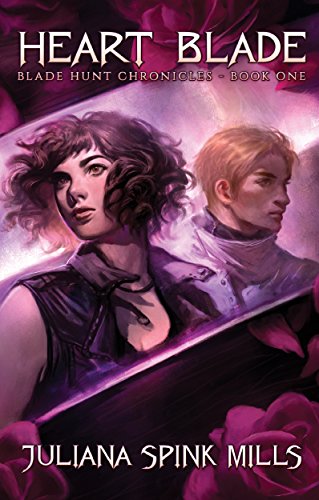 |
| Heart Blade - the first book in the series |
PL: Two questions for the price of one -
What draws you to writing Middle Grade and Young Adult aimed works?
What was the process of getting published like for you?
JSM: Why write kid lit? I think it's partially because it's something I've always wanted to do – children's and teen fiction fascinates me. But also, my 'writer voice' tends to be a little on the young side, even when I'm trying to write 'proper grownup fiction'. I always tell people I'm around 12 or 13 years old inside...
As for publishing, it's been an interesting ride. One of the advantages of dealing with a small press like Woodbridge, is that authors are more involved in all steps of the process. I was consulted for cover input, at all stages of pre-publication, etc. I got previews of everything that went into the books, and frequent updates on all of it. I know from friends who have been published with large presses that this isn't always the case, so I'm glad that my first experience in the book world ended up being such a close working relationship with my publisher.
PL: What was the submitting process like? Did you use an agent? If not, have you ever thought about going through that process in future?
JSM: Heart Blade was a direct submission – my publisher, horror and sci fi author Nathan Hystad, is a writing friend and we often do critiques for each other's work. Nathan had been one of my beta readers for Heart Blade, and when he opened up Woodbridge Press he got in touch to ask if I'd be interested in publication. So I kind of dodged the entire submission process on that one.
I have queried agents in the past, though, and once I've finished my current project (something brand new and unrelated to my Blade Hunt Chronicles series), my plan is to get back to querying again. I know plenty of people who have ended up going both routes in their path to publication – agented and unagented – and both have their merits depending on what you want from publishing. But personally, I like the idea of having someone in your corner, looking out for you.
PL: That's true - just really helps when that person is the publisher!
Okay - obviously getting and giving advice has been a big part of writing for you - what's the best advice, and the worst advice, you've been given?
JSM: Wow, tough question!
Best was probably: read/listen to all the writing advice, sift through to see what works for you, and disregard the rest.
So true! Everyone is different, and different things work for each. There is no 'one size fits all' when it comes to writing advice!Worst, hmm... I can't think of a specific example, but probably every time I'm told I can't do a particular thing when it comes to writing, or that I have to do things a specific way. It immediately makes me want to play with the loopholes and find the exceptions!
PL: I sometimes find there's a lot to be said for the creative stimulus of being put in a box and having to look for loopholes - did anything in the Blade Hunt Chronicles come from finding the exceptions?
Different tangent - judging from your blog, you seem pretty big on your characters, getting art done for them, introducing them and so on. Where do you get your inspiration for your characters?
JSM: In regards to the first question, it's not really a loophole, but before Heart Blade got picked up by Woodbridge, I took the first pages to one of those agent query sessions. Both agents I talked to told me that 'vampires and angels and all that stuff, that's old, we can't sell that, no one wants to read that stuff anymore.' Which of course made me all the more determined not to give up on my story! (I think all writers need a good dose of stubborn in them...)
As for the characters, I love looking at fan art, and I decided it would be fun to get art drawn for some of my main characters. I actually found the artist I use, Corinna Marie, on Tumblr. She did a great job! I'm not really sure what to say in terms of inspiration – I think there are bits of me in a lot of my characters, and bits of other people I know. I have a lot in common, personality-wise, with my character Camille (although I can safely say I'm NOT an immortal succubus). Oh, and I have a soft spot for brown-haired female main characters. I'm a brunette and, back in my 80's teen days, it seemed as if there was a surplus of blonde females in fiction. This is payback, Juliana style!
 |
| Corinna Marie's drawing of the main cast |
PL: Do you have favourites among your characters? Also, which character would you say you have the least in common with? My money's on one of the angels, buuuut...
JSM: Argh, don't make me choose!! Camille, of course. Del and Diana in book 1, and Ben and Raze in book 2. But there are things I like about all of them, even my 'bad boy' Jude Raven... As for least in common, probably one of the sentinels, Jordan. He's Ash's cousin (one of my main characters), and although he has angel blood in his veins, he's not particularly nice or angelic. Writing nasty people is hard! Jordan has very little to redeem him, and it's been hard trying not to fall into cliché bully tropes.
PL: I had a feeling you'd say Jordan. What do you think are the traps to avoid when it comes to not writing cliche bully tropes?
JSM: Having great critique partners? Seriously, I have a lovely group of writers who I can always count on to flag things like that. It's far too easy sometimes to fall into traps of the sort (the cliché bully character, for instance), and having other sets of eyes on it to call me out on my mistakes is worth pure solid gold. (But I don't have any gold. Sorry.)
PL: Always comes back to the community! When it comes to other authors' characters, who do you admire - bully boys or otherwise?
JSM: I do love a well-written anti-hero, and any sort of 'grey area' and complex character. They're a lot more fun to read about! Reluctant heroes are also great. Give me all those nuances, please!
PL: Gimme examples! Name me some of your favourite anti-heroes. And reluctant heroes too.
JSM: They might not be exactly anti-heroes, but I have a weakness for accidentally heroic thieves, like Locke Lamora in Scott Lynch's Gentlemen Bastards series, or Kaz, Inej and company in Leigh Bardugo's Six of Crows duology.
As for reluctant heroes, one of my favorite arcs is Kaladin's in Words of Radiance, Brandon Sanderson's second Stormlight book. Lila Bard in Victoria Schwab's Shades of Magic trilogy is great, as is Han Alister in Cinda Williams Chima's Seven Realms books (although at first he falls under the thief-hero banner, too). Julia Knight, who also writes as Francis Knight, writes fantastic shades of grey characters.
 |
| We can all agree that Deadpool is another great example of this sort of character and generally fantastic. Here's a photo Juliana took of Lego Deadpool riding a dinosaur because why the hell not. |
PL: High Five on the Locke Lamora love! Shame that events are keeping him from getting the next one out there, I want to know how it ends. You've got book 2 of your own series out at the moment - what can we expect from the rest of the Blade Hunt Chronicles?
JSM: I have two more books planned to finish out the Blade Hunt Chronicles, named for the two last swords in the prophecy the series takes its title from: Star Blade and King's Blade. I don't want to say much because #spoilers, but I can tell you that book 3 centers around a murder mystery, a blizzard, and a trip to Yorkshire...
It's been interesting working on a series – trying to find the balance between writing a self-contained plot for each book with a satisfying ending, and spinning out the longer arcs that span the series. It's certainly a challenge, but a fun one. Hopefully I'll be able to keep up momentum, and not let readers down! Feedback I've had so far from book 2, Night Blade, has been positive, so I'm feeling pretty confidant at the moment.
One nice thing about working with multiple books is being able to spend time deepening the core series characters, as well as the worldbuilding. With a standalone book, you're constantly treading a fine line between not enough info and throwing everything but the kitchen sink at the page. With a series, you can take your time, and add more to the world with each book.
PL: All things are better with Yorkshire - well, all things but beach holidays. Very well, I shan't pry too much. But what is the one thing you're proudest of with Night Blade and think readers will love most?
JSM: One of the main plotlines in Night Blade is a heist, and I had a blast writing it. I'd been wanting to try my hand at a heist story for a while, and it was every bit as fun to do as I'd imagined. Tricky, though, trying to get all the elements right, but I really like the way it all turned out. I hope readers will enjoy it, too!
Another fun part to write was the ballroom scene, swishy dresses, tuxes and all. But all in all, I think the heist sequence is what I'm proudest of.
So if heists, ballrooms, demons and nuanced heroes sound your thing, Juliana Spink Mills has your back. Night Blade, the second book of the Blade Hunt Chronicles is out now, and is available at Amazon US and UK. To read more by Juliana, visit her website at https://jspinkmills.com/.
Merilliza Chan did the cover art for Heart Blade and her art can be found at http://www.merilliza.com/
Corinna Marie did the character sketches and her art can be found at http://corinnamariedrawsstuff.tumblr.com/
Juliana does her own Lego Deadpool photos but inexplicably does not have a website dedicated to it. Yet.
Saturday, 6 January 2018
State of the Delirium Address 2018
At the start of last year, I was pretty bubbly about how 2017 would go, despite having spent most of 2016 learning how mistaken I was in about where I stood in terms of writing.
Heh. heh. heh.
Looking back at it, it all seems very sensible. I was going to write every day. Given I knew I was also going to job hunt, get married, prepare a visa, house hunt, and stress about all four of those, that maybe wasn't so practical a goal. Throw in a second job hunt, adopting a cat, giving back a cat, finding everything I needed for the new house, and so on... yup. Writing every day went south.
Although, being honest, what really got the writing habit was
a) Lengthy periods of depression
b) Trying to edit existing works
Doing that fine detail polishing is hard. Just about anyone can write, particularly if they're willing to let themselves write badly. Taking that first draft and turning it into something you'd be genuinely willing to ask money from people to have is probably not for anyone. Trying to do it got me in some extremely lengthy periods of paralysis.
The other two resolutions - learn more about structure, question more - they went better. I don't have structure nailed, but I am no longer in a blind panic when trying to write something and wondering what comes next. And I learnt a lot in general, although I could probably question more. One of the problems with asking questions about writing is that, after a while, the answers often become very specific to the book itself. That makes asking the questions pretty difficult unless the audience has read your work. Its possible I need to find a writing group and stop relying on forums so much.
It will surprise no one - particularly as everyone reading these posts knows me and has already heard it - that all the goals that were meant to come from doing the process properly were missed. They went so far south that they became anti-Santa.
This, however, is only important in terms of what I can take from it. What's important is what happens now.
I think I'm right to keep structuring my goals about doing the right things and trusting that if I put in the performance, the result will come.
I'm still going to try and write every day. I probably won't but that doesn't mean I shouldn't be trying to do that. In terms of making sure these sessions are as productive as possible, I want to finish each writing session by writing down my lead-in to the next session. I write a lot better when I know what I'm writing as I sit down to it.
I'm going to edit something every week. That's been a weak point, so I need to practice it more, learn about it more. Besides, I've got a lot of words written that do me no good without the final polish.
And I want to be able to point to one new thing learnt about writing every week. There's no such thing as too much knowledge, too much information about writing and storytelling. Not that I've got anything to point for this first week, although I'm still musing about how Wicked started as a comedy and ended up as a tragedy
If I keep doing these things then, at some point, hopefully this year but maybe later, my dreams will come true.
And if not, then at least I shall enjoy myself in the process. Or shall are my delirious thoughts at the start of this year.
Wibble.
Heh. heh. heh.
Looking back at it, it all seems very sensible. I was going to write every day. Given I knew I was also going to job hunt, get married, prepare a visa, house hunt, and stress about all four of those, that maybe wasn't so practical a goal. Throw in a second job hunt, adopting a cat, giving back a cat, finding everything I needed for the new house, and so on... yup. Writing every day went south.
Although, being honest, what really got the writing habit was
a) Lengthy periods of depression
b) Trying to edit existing works
Doing that fine detail polishing is hard. Just about anyone can write, particularly if they're willing to let themselves write badly. Taking that first draft and turning it into something you'd be genuinely willing to ask money from people to have is probably not for anyone. Trying to do it got me in some extremely lengthy periods of paralysis.
The other two resolutions - learn more about structure, question more - they went better. I don't have structure nailed, but I am no longer in a blind panic when trying to write something and wondering what comes next. And I learnt a lot in general, although I could probably question more. One of the problems with asking questions about writing is that, after a while, the answers often become very specific to the book itself. That makes asking the questions pretty difficult unless the audience has read your work. Its possible I need to find a writing group and stop relying on forums so much.
It will surprise no one - particularly as everyone reading these posts knows me and has already heard it - that all the goals that were meant to come from doing the process properly were missed. They went so far south that they became anti-Santa.
This, however, is only important in terms of what I can take from it. What's important is what happens now.
I think I'm right to keep structuring my goals about doing the right things and trusting that if I put in the performance, the result will come.
I'm still going to try and write every day. I probably won't but that doesn't mean I shouldn't be trying to do that. In terms of making sure these sessions are as productive as possible, I want to finish each writing session by writing down my lead-in to the next session. I write a lot better when I know what I'm writing as I sit down to it.
I'm going to edit something every week. That's been a weak point, so I need to practice it more, learn about it more. Besides, I've got a lot of words written that do me no good without the final polish.
And I want to be able to point to one new thing learnt about writing every week. There's no such thing as too much knowledge, too much information about writing and storytelling. Not that I've got anything to point for this first week, although I'm still musing about how Wicked started as a comedy and ended up as a tragedy
If I keep doing these things then, at some point, hopefully this year but maybe later, my dreams will come true.
And if not, then at least I shall enjoy myself in the process. Or shall are my delirious thoughts at the start of this year.
Wibble.
Saturday, 23 December 2017
I'm excited for the stories of the future: An interview with T. Eric Bakutis
I first picked up T. Eric Bakutis' work with his fantasy debut Glyphbinder, and was delighted and intrigued when I saw he was doing cyberpunk police procedural too. That meant there was only one thing to do, so I hauled him in for some interrogation...
PL: Fantasy trilogy to cyberpunk police procedural - that's a big shift. What led to you writing Loose Circuit?


PL: Fantasy trilogy to cyberpunk police procedural - that's a big shift. What led to you writing Loose Circuit?
TEB: I’ve always been fascinated by and written both scifi
and fantasy, so hopping back over to cyberpunk wasn’t so much a shift as just
moving onto my next project. I’d written many stories (and even older novels!)
in both genres, and it just so happened that my fantasy book was the first one
to be published. When I knew I wanted to do a trilogy, that set up two more
fantasy books, which led to three fantasy books in a row. Had I gotten a scifi
book published first, I may very well have been doing scifi for the last few
years.
Ultimately I enjoy both genres, but I think I actually
have more fun doing scifi, as it allows me to spend less time worrying about
anachronisms and just writing fun prose, whether it be dialogue or author’s
voice. Since scifi allows me to use modern language, I feel like my voice comes
through more clearly in scifi than in fantasy, where I’m more reserved and
formal. I just have a great time writing it.
My writing of Loose Circuit (the aforementioned
cyberpunk police procedural!) was actually inspired once I finished watching
one of my favorite anime series, Psycho-Pass. Psycho-Pass is
incredibly dark, twisty, addicting, and thought provoking, especially in how it
deals with one of my favorite concepts, which could be summarized as “Should we
allow everyone to have free will?” I wanted to explore that in a story of my own.
It sounds like an easy answer at first, doesn’t it? Of
course we should allow people to have free will. It allows us to do good things
... and also, allows us to do some of the most horrific things imaginable to
one another. Things that are evil in the purest sense of the word. Think of the
worst, most horrific, most terrifying story you’ve heard about what one person
has done to another (or many). Someone chose to do that. Free will allowed that
to occur.
So given free will allows as much bad as it does good
(if not more so) would it be acceptable to limit free will? What if we could
take away free will, or at least ... the free will to *harm* other
people? Would it work? And even if we did do it, how would society change?
Ultimately, that led to the idea of PBAs (Personal Brain
Assistants, which forbid us from harming or killing other human beings), which
are central to Loose Circuit – my protagonists (cops with the CID,
or Cybercrimes Investigation Division) are responsible for dealing with cases where
PBAs don’t do what they’re supposed to, which is stop violent crime. I had a
ton of fun coming up with ways people could still commit crimes despite PBAs,
and then exploring how each crime occurred (and how my protagonists “solved”
each case) in detail. Fun!
At its core, Loose Circuit was me wanting to
write my own anime, essentially, about a world where mind control exists ...
and whether that’s okay. The episodic format was a natural fit for that.
Multiple self-contained stories that build a larger narrative.
PL: So you're an
anime fan - where else do you draw your inspirations from, both fantasy and
sci-fi?
TEB: My interest in anime started young (though it wasn’t
necessarily marketed as anime at the time) with the serialized stories of Robotech
(Macross in Japan) and Starblazers (Space Battleship Yamato
in Japan), which I watched in 30 minute blocks every afternoon. Despite being
watered down and edited for American audiences, they were still groundbreaking
as far as “children’s television” was concerned, particularly in how they
featured a large cast of interesting characters (instead of just one “main”
character with sidekicks) and characterization and plot that developed over
seasons, rather than resetting at the end of each episode. As a child, having a
story that played out over such a long period of time unlocked an interest in
extended narratives.
I enjoyed many of the 80s cartoons so many other kids
did (G.I. Joe, Transformers, He-Man, etc) but while I
found them interesting, I think it was Robotech and Starblazers
that truly inspired me to write both short fiction and long. Looking back, I
think this is because of the depth of the character roster and the introduction
of characters who weren’t clearly cut “good” or “bad”, but just people fighting
for what they believed in.
Other than Psycho-Pass, which I’ve mentioned
previously, Ghost in the Shell (the episodic series, Stand Alone Complex and 2nd
Gig) was what really got my mind fired up in regards to cyberpunk and how
many cool stories you could tell in the genre. Standard science fiction
(particularly space opera) was cool, but cyberpunk added a dimension of
grittiness and interest that grabbed me more than anything I’d seen before,
likely due to my fascination with computer programming and videogames.
Of all the anime I’ve enjoyed, Ghost in the Shell
and Psycho-Pass are the two most direct inspirations that inspired Loose
Circuit, and much of their DNA is ingrained in the story. Loose Circuit
is also the first time I’ve tried to tell a long story in an episodic fashion
(with 12,000~ word episodes that stand alone while also building a larger
narrative) and it’s been really fun in that regard.

PL: The best part
about doing these interviews sometimes is all the recommendations I get. So let’s
fish some more! What about the Tales of the Five Provinces, your fantasy trilogy that starts with Glyphbinder? What inspirations lay
behind that?
TEB: Glyphbinder actually started with a
single idea for a scene that isn’t even in the book! It involved a mage and a
warrior who had been fighting some sort of difficult campaign against a devious
enemy (very, very basic – just an inkling of an idea). I had the idea that the
warrior had lost his memory and been told his wife was dead.
During the book, the warrior and the mage had started to
develop feelings for each other over the course of their adventures. Just when
they are close to giving into those feelings, they would camp at a town with
the rest of their party and discover the warrior’s wife was living there, still
alive, having survived the burning of his village. She would remember him (he
wouldn’t remember her) and turn everyone’s world view upside down. It was
literally just imagining that scene and thinking how dramatic it would be,
without the context of any larger book or even much about the characters.
This scene, of course, never takes place in Glyphbinder
or the other two books – it didn’t even make it into the first draft. But the
idea of a warrior who’d had his memory erased by magic (Trell) and a scrappy
young female mage who is determined to help him (Kara) remained, which planted
the seeds for the rest of the book. The first actual scene I wrote with Kara
and Trell (still in the book, but in a much different form) had Kara
reminiscing about her time learning glyphs in Solyr’s library while enjoying a
hike through the woods, at the end of which she finds Trell’s bloody body and
protects him from attack. That scene survived all the way to the final draft,
though in a dramatically different form.
The biggest improvement in Glyphbinder’s final draft came from adding Kara’s
quest to find a cure for her mother’s terminal disease. My editor at McBryde
Publishing, which released the first version of the book, was unsatisfied with
Kara’s motivations and insisted I answer the age old question “What does your
character want?” Saving her mother was
the answer. It was a far more personal quest than “saving the world” and informed
so much of the final draft. It allowed all Kara’s choices to make much more
sense, and as I see it, allowed me to make her an even more compelling
character.
Coincidentally, incorporating Kara’s quest to save her
mother was the last of many changes that fully flipped the narrative
relationship between Trell and Kara. In very early drafts, I’d envisioned Trell
as the main character with Kara supporting him, but by the middle drafts (and
certainly by the end) those roles had flipped entirely, with Kara taking the
lead.
As far as inspiration, it’s safe to say that JRPG plots (and, of course, the plots of literally
hundreds of fantasy books I’d read growing up) all mixed together to form the
plot of Glyphbinder. The inspirations are likely too many (and too
mushed up in my head) to pick out clearly, but JRPGs are definitely in the mix.
As far as revisions go, Glyphbinder is probably
my most revised book (not uncommon with an early novel) having gone through no
less than 6 complete revisions, several of which were total rewrites. Though
elements remain that came all the way from the first draft (and the main
characters stayed the same throughout) the final draft is dramatically
different from the original draft that started it all.
PL: You mention the
JRPGs and I know your day job is in the gaming industry. How much of a gaming
influence in the Spec Fic worlds we see being created today?
TEB: Most of the influence on my written work actually comes
from playing other people’s games, rather than the work I do in my day job. I’d
easily admit that videogame plots and storylines all the way back to Crystalis
and The Legend of Zelda (NES) have had a heavy influence on my writing,
because those were the stories that had the most impact on me when I was young.
I played games before that, of course (my first console was an Atari 2600) but
the limitations of those early games meant actual plots were non-existent. It was
more about mechanics, bleeps, and boops.
It’s fair to say that the plots of a number of RPGs
(which, themselves, were often derived from fantasy and science fiction books
of the era) have influenced (and still influence) my work, and continue to do
so. So books and movies inspire videogames, which I play, which inspire me to
write more books. It’s the circle of inspiration! (or theft, depending on how
you look at it).
As far as Tales of the Five Provinces (my
completed fantasy series) the biggest influences would be the early Final
Fantasy games on the SNES, particularly Final Fantasy II (IV in Japan).
I can point to three specific ideas that I stole (*cough* I mean, was inspired
by!) in that particular game.
First, the idea of a magic academy where magic is taught
like anything else. The city of Mysidia (the mage city where you meet magic
students Palom and Porom) gave me the idea for Solyr (Kara’s magic academy) *long*
before Hogwarts was a twinkle in anyone’s eye. The Magic Academy of Vane, from Lunar:
Silver Star Story, was also an inspiration.
The second thing I borrowed (er, was inspired by!) was
the magic/elemental system of the Final Fantasy games, using Lit/Ice/Fire/Quake
as my base. These changed to Fire, Water, Earth, and Air up until the very last
draft of Glyphbinder, at which point I saw Avatar: The Last Airbender
for the first time (I was introduced to the series by a friend) and just about
had a conniption.
Avatar had the exact same idea as my book (characters
wielding fire, ice, air, and earth in cool ways) except Avatar’s characters
wielded elements while doing martial arts,
which was ten times cooler than blood glyph magic. Dammit. It was a bit of a
kick in the gut, honestly.
Eventually, I got over it (there are no original ideas
out there, after all), but I did end up doing a find/replace on my elements,
turning Fire, Water, Earth, and Air into Life, Heat, Breath, and Land, in the
hopes of not being seen as *completely* derivative of Avatar: The Last Airbender. But,
for the record, I officially stole my ideas from Final Fantasy, not Avatar!
(Wait, that doesn’t sound much better)
The final element that’s stuck with me through decades
is Kain’s arc in Final Fantasy II,
where he is turned against his allies (through mind control) not once, but
several times, and then feels incredibly guilty as a result. He was a tragic
(but awesome) character, and the game ends with him on a “journey of
redemption” to try to make up for the wrongs he did while under Golbez’s
influence.
That plotline was a *huge* inspiration for
Jyllith (the lead in Demonkin) and pretty much the entire origin of her
arc. I wanted to present a character tricked into going against her better
impulses who, upon being shown the error of her ways, set out not to redeem
herself (which she sees as impossible) but to do as much good as she can before
she willingly goes to her inevitable punishment. Jyllith (like Kain) has no
hope of being forgiven for her crimes, but wants to do all she can to atone
anyway.
The idea of a regretful character atoning with no hope
of forgiveness was a noble, melancholy, and interesting idea I wanted to
explore, and comes directly from seeing Kain’s journey in Final Fantasy II.
PL: Since before
Hogwarts was even a twinkle! That's a long time to nurture a story. How much
about your technique and approach to writing has changed in that time?
TEB: I’d like to say I’ve improved as a writer since I
finished the first draft of Glyphbinder (in 1998). I’ve been writing
pretty consistently since middle school, but I didn’t actually start selling
work until 2013, when I finally sold my first story, a horror short called “The
Mumber”, to a small horror market. I do feel that my writing today is tighter
and more entertaining than my writing from 20 years ago, so there’s that!
As far as my approach to writing, it’s remained basically
the same – I get a scene or pivotal plot point in my head, then write a story
that gets to that point, does it, and shows the aftermath. For novels, I do
outline in bullet point style from start to end, which allows me to avoid
writing myself into a corner and also, if I’m stuck, even write scenes out of
order. For short stories, however, I still mostly improvise.
As far as writing technique, I’d say my “author’s voice”
(and a snarky one, at that) has more prominent in the past five years or so, and
that my writing has become less dry as a result. I can’t take sole credit for
this, as I’ve been submitting my stuff to (and having it improved by) one
critique group or another for decades now.
So, in all those years since 1998, I don’t think my approach
or technique has changed drastically ... I’ve just gotten generally better at
writing clean and interesting prose.

PL: Nothing beats a
good critique group - how did you find yours?
TEB: Conventions, actually! I met my first critique group
when I was still in Texas at a local writer’s convention. We started chatting
about our shared interest in writing, and all three of them were local to my
area. This was my first exposure to editorial style critique, and while it was
initially depressing (what? How can you not believe my story is the best in the
world?) I soon found that their critiques were making my stories *better*.
Once I realized my stories were improving every time I
took advantage of author insights given to me for free, a switch flipped. I
suddenly became hungry for feedback (does this work? How about this? How can I
make it better?) instead of being “hurt” that my story wasn’t perfect.
The challenge many young writers face is separating
their craft (their ability to tell a story) from their identity as a “good”
writer. You can write a terrible story and still be a talented writer and an
awesome person. When people in a critique group say your story isn’t working,
it’s not an attack on *you* ... it’s them providing feedback as to what
might work better, for them, as a prospective reader.
Feedback is how we learn, and writers new and
experienced should remain hungry to learn. Even today, having been writing for
30 years, I still get stuff critiqued and consistently find ways to improve it.
I currently have two active critique groups (one that
meets every two weeks, and one that meets every few months) and both have
combinations of other writers at various levels of experience and success,
ranging from fledgling authors to folks who’ve published multiple books through
traditional press. Often, the feedback from the new writers (things that bother
them, or that they point out) is as valuable as that from the seasoned pros.
As of now, I would never send out *anything* that
hadn’t been critiqued at least once, not even as a rough draft. I just get too
much valuable feedback.
PL: Also, what's
the best piece of writing advice you've received, and the worst?
TEB: I would say the best piece of writing advice I’ve
received is to use a “scratch” file when editing a short story or novel. I keep
an open file when editing, and ruthlessly snip and cut stuff that doesn’t work
out of the current draft. The feeling of safety a scratch file provides (the
words are simply moved, not gone) helps me be a much better editor of my own
work, trimming and cutting as needed.
As writers, we have a tendency to cling to our hard
fought words, and fear deleting anything because we can never come up with
something “so brilliant” again (or maybe that’s just me). That’s why a scratch
file is so useful ... it lets you feel safe removing anything from your story. If
you decide later in the editing process that you want to bring that
idea/scene/dialogue back, you can paste it right back in.
As far as the worst advice I’ve ever heard? That would
be tough, as I’ve never actually heard anyone say to do this ... but I’d warn
against it anyway.
The flipside of critique groups (for those who don’t
know how to best use them) is to treat outlying opinion as gospels, and treat *all*
feedback as valid. Writing is incredibly subjective, and what one person likes,
another person may loathe with every fiber of their being. When listening to
feedback, writers must look for the reasons *why* things don’t work, rather
than simply taking feedback verbatim. It could be that it’s not your idea
that’s the problem, for example, but how you’re presenting it in the story.
Always analyze feedback carefully before making any huge story change.
This is why critique groups are so valuable (to me). I
get feedback from multiple advance readers whose reactions I can compare and
contrast. If one person hates something, and one person likes it, I use my best
judgment. If eight people hate something, and only one person likes it, that’s
incredibly useful, as I can be very confident something doesn’t work, even if I
personally don’t have a problem with it.
So, some really bad writing advice would be “do
everything your critique group tells you.”
Your critique group provides insight, feedback, and data
on what is working and not working for
them, but it up to you as a writer to interpret that feedback and filter
out the noise. Critique is data, not a mandate. Ultimately, you need to write
the story you want to write, so while you should always seriously consider
feedback from critiques, you should never feel compelled to act on *everything*,
especially if the suggested change comes from one person rather than multiple
people.
 |
| Sketch art of Kara from Tales of the Five Provinces |
PL: Okay - final
question - well, questions - what future plans have you got for your books? And
what do you see in the future for the various Spec Fic genres?
TEB: As far as future plans, I’m really excited about doing
more writing in the worlds I created for Supremacy’s Shadow and Loose
Circuit (my two most recent novels).
Right now, my plans are to continue to write books in
the world of Supremacy’s Shadow (with its dueling planets, spies vs
spies, bounty hunters, overbearing space government, and ruthless resistance).
These books were *heavily* inspired by the Star Wars Expanded Universe,
except without the clear cut lines of good and evil, so it’s really like having
my own EU to play around with. It’s a huge amount of fun.
My Supremacy is similar to the Galactic Empire, but with
actual good folks mixed in with the bad (instead of everyone down to the
janitors being pure evil, like in the movies). Opposing them are the Patriots
of Ceto, who are like the Rebellion, except many have accepted collateral
damage as an acceptable price of freeing their planet from occupation.
Neither side is exactly evil, and neither side is
exactly good. The world and situations that result from their conflict (and
forcing my characters to navigate those situations) are a joy to write. I have
a lot of fun poking fun at classic sci-fi tropes, including my own, which
allows for comedy in both prose and dialogue. There’s a reason I’ve dubbed the
books “grimsnark”.
Between writing more Supremacy books, I’ll also take
breaks to diverge into short fiction set in the universe of Loose Circuit
(which is basically Ghost in the Shell meets every police procedural
ever). While I have no plans for a “Season 2” of Loose Circuit right
now, I’m sure I will at some point. At the moment, however, my plan is to
publish new Supremacy books the same way Marvel does movies – each book will
stand alone with a different central character, but those characters all exist
in the same universe and occasionally cross over. I’m looking forward to
writing my version of The Avengers one
day.
As far as the future of speculative fiction, I think
it’s here to stay. New nerds are created every day, and with all the great IPs
now flourishing (more Star Wars, the Marvel universe, a dozen great
videogame worlds, and hundreds of fascinating fantasy and sci-fi worlds in
print) I think we’re lucky to live in a time where there’s so much cool stuff
to view/read/play. I feel like twenty years from now, the current generation
will look back on all the cool stuff we have now as fondly as many of us older
folks look back on the 80s/90s.
If there was one thing I’d change about today’s
speculative fiction audience, it would be excising the toxicity that has
emerged as our fandom has expanded. Excluding people sucks, and my hope is that
the folks who currently expend all their effort trying to chase off those they
consider “other” with either cut that shit out (no, seriously, cut it out,
guys) or that it will grow so culturally unacceptable to harass your fellow
fans that the repercussions will force our current crop of trolls to either
accept newcomers, or at least stop trying to chase them off.
Also, I would love to see the “stop liking what I don’t
like!” crowd chill out a bit. Entertainment is subjective, and everyone likes
different stuff. There’s too many fans these days who see it as their mission
to tell others what is “good” or “bad” spec fic. It’s unhealthy, and seems
increasingly common now that social media has us all closely connected. As fans
who are all in this together, we should let each other enjoy what we enjoy and
spend time boosting the stuff *we* like, instead of expending so much
effort tearing down the stuff we don’t like (and, quite often, the people who
enjoy it).
Ultimately, however, I think speculative fiction of all
sorts will continue to grow and thrive, and future stories will be even more diverse
and interesting as new fans turned creators contribute work based on a wider
pool of experiences, viewpoints, and interests. I’m excited for the stories of
the future, and I can’t wait to find the next one I really enjoy.
PL: Am I a complete doofus or is this the first you've
mentioned Supremacy's Shadow to me?
Okay, actual final question, just tell me a little about it!
TEB: My elevator pitch? “Half Han Solo, half Deadpool, Hayden
Cross tries to stop an interplanetary war while relentlessly mocking everyone
involved.”
Supremacy’s Shadow
is book one of my new Dueling Planets series, a “grimsnark” sci-fi espionage
thriller set on two habitable planets, the larger, temperate, and water-rich
Phorcys (where all the rich people live) and its smaller sister planet, Ceto,
where the working class and poor make do.
These two planets are locked in a barycentric orbit
(meaning they rotate like a bolo as they orbit their star together) and human
settlers have colonized both planets in the far, far future. This setup let me
do an interplanetary story without the scientific headaches of calculating
planetary orbits and month long journeys, and without resorting to impossible
tech like endless fuel or faster-than-light travel.
At the time my book starts, tension is high between the
natural-born (the first human colonists to arrive in the system and stake their
claim) and the Advanced, a second wave of colonists who arrived fifty years
later and soon took over the government of both worlds. This tension gives me
an excuse to blow things up.
The worlds of Phorcys and Ceto have clunky spaceships
(tech closer to Firefly than Star Wars), hover bikes, smart
rifles that fire smart bullets (basically, bullets that can aim themselves),
powered armor with jetpacks and stuff, brain-mounted computers known as
Personal Brain Assistants (stolen from my other sci-fi work, Loose Circuit)
and one character that wears black powered armor and a creepy mask, who uses
his giant heatsword to slice people in half when he’s not mimetically cloaked.
So basically, every cool sci-fi trope I ever loved,
mashed together in what I hope is an interesting story with compelling gray
characters and a decent number of unexpected twists.
The book’s protagonist, Hayden Cross, gets caught up in
the cold war between these factions while trying to find out if his wife faked
her death, and as a result basically everyone tries to kill him. Subsequent
books will focus on other characters in the same universe, including a talented
bounty hunter, a ruthless assassin, and the aforementioned black armored
heatsword-wielding cloaked guy. All of this is delivered with a healthy sprinkling
of snark and genuine love for the many sci-fi shows that inspired it, including
Star Wars, Babylon 5, Firefly, Cowboy Bebop, and
about a dozen others.
I have a great deal of positive feedback on the book so
far from fellow authors and advance readers, and I hope people will enjoy it!
The book will be released at Farpoint Convention’s Book Launch Festival in
February 9, 2018, and then (hopefully) going on tour after that.
Also, it’s got a cover. Which we’re revealing for the
first time here, on this blog. How about that?
 |
| Its a pretty sweet cover alright. Thanks to Eric for revealing here! And kudos to Shen Fei for making it. |
Thanks to Eric for taking part. If you want to know more about his books, visit his website or buy them on Amazon US and UK, where the Tales of the Five Provinces are on sale for the rest of the year.
Art credits:
Loose Circuit cover - Mat Yan https://thebookcoverdesigner.
Glyphbinder cover - Greg Taylor http://gregtaylorart.com
Kara sketch - Jin Kim http://www.jinkimart.com/
Supremacy’s Shadow cover - Shen Fei https://shenfeic.deviantart.
Subscribe to:
Posts (Atom)