When Angry Robot tweeted about this book a few weeks ago, I jumped up and down in excitement and was delighted when I got a NetGalley ARC. The idea of a detective in a dream-land of ideas and stories? Gold. And the detective is a fluffy Triceratops, greatest of the dinosaurs?
I was, and am, actively jealous of Tyler Hayes for having the idea first.
What I didn't know at the time was that the book is written in present tense, which would have cooled my excitement no small degree. That's my one big irrational turn-off. I feel a little guilty writing a review of it now, for I am about as suited to this task as a vegan is to reviewing a steakhouse, but I read the book so here comes the review. Take it as you will.
Hayes dreamland - the Stillreal - is a cool place. It's like Toy Story meets Sandman. It is also a big place, ranging from kids' toys to conspiracy theories and everything in between. Detective Tippy covers most of it and between that and the need to lay down the logic of the Stillreal, a lot of The Imaginary Corpse is taken up by exposition. Sometimes I actively cheered that choice. Sometimes I felt a little let down; not everything about the Stillreal excited me, which is likely with such a big palette being used.
Either way though, the size of the setting impacted the story itself. Tippy's investigation is straight forwards and there wasn't much of a subplot, with Tippy staying focused on the case. The case itself seemed to be as much about the setting as anything, being more Howdunnit than Whodunnit or Whydunnit. And while that is cool, I think the lack of Who and Why led to a loss of hook in story and in development of the characters. I enjoyed reading about Tippy, Miss Mighty, Spiderhand and all, but none of them are characters I'm gagging to read about again (although a book about Miss Mighty and Doctor Atrocity squaring off would be good value).
Tone wise, it's a slightly dissonant blend between the classic gumshoe "Tough Guy with a Big Mouth" narrator and Disney-esque Power of Friendship moments. The first half of that didn't quite work for me and I think that's partially on a lack of situations to work his big mouth on, but the emotional moments hit home, particularly near the end. But then, when looking back, I see that I liked this story most when it was about the crazy place called the Stillreal and less when it was a detective story. SO that might be why.
All in all, The Imaginary Corpse is (for me) one of those books that tries to do everything and has a lot of near-misses on the satisfaction count as a result. It is a pleasant read, but doesn't achieve the sort of hyper-fun romp you get from the best Fantasy Detective stories as a result. But all the elements are there where it will be that romp for someone who does connect with Parsons on what he tries. And there'll be a lot of people who enjoy The Imaginary Corpse simply because it tries something new and larger than life even if they don't enjoy everything in the book. After all, I did, and that's with one of my most hated narrative choices in there.
So if anyone's looking for something different, something whimsical and imaginative and fun, step this way.
(I received an ARC of this book through NetGalley from Angry Robot in exchange for an honest review - thanks peeps!)
Saturday, 18 May 2019

Wednesday, 15 May 2019
What I See When I Look At Game Of Thrones
As we near the finale of Game of Thrones, I think I've reached the point where I'm more interested in the conversation about the show rather than the show itself. That is not intended as an insult of the show mind; its more a state of wonder at the volume and variety of opinions surrounding it. I've never seen anything like it in fantasy. I'm not sure I've seen anything like it in entertainment full stop.
It has reached the point where I think Game of Thrones as a Rorschach Test, for everyone seems to be seeing something different. And while I mostly consider that a bad thing, as I sit here typing this I'm considering whether it might be good. Its certainly interesting from a storytelling point of view
The reasons for this are mostly obvious. The size of the story. The expectations. The strange case of the book that ended as a TV show written by someone else. One that I think is critical, and obvious, but not mentioned as much as it should be, is the extent to which the premise of the TV show itself as changed. It started in the vein of the great drama/soap operas, seeking viewer satisfaction through violent plot twists, gradual reveals and tense confrontations. Nobody was safe. The signature moment was the Red Wedding.
Over the last few seasons though, it has felt more like something from Marvel. The action scenes seemed to be the most important. The Battle of the Bastards seems as good an example of a signature moment as any; maybe the moment where Jon is standing in front of an entire army and doesn't end up dying, which is in itself a far cry from the corpse count of the early seasons. Arya's experience caught up in the crush of the sack of Kings' Landing was amazing to watch, but it is hard to imagine that many near-death experiences happening for anyone in Season One.
I am a big believer that there is an unspoken, unofficial contract between artist and fan when it comes to big series. "Support me and there'll be more of it just like this". That comes completely undone when you get a tonal shift like that. Worse, the internal logic of the show ends up in an even bigger state than the Iron Fleet. The result is that each fan ends up with a slightly different view of what exactly it is that's good about the show and what makes sense.
Multiply that by the number of meaningful arcs that GRRM left in and you get the Rorschach Test we have in front of us.
As I said, I do consider this a bad thing. A few exceptions aside, stories are meant to communicate a narrative so clearly we all know what happened and agree that was the way it should have happened. That doesn't happen with Game of Thrones. The break in internal logic is never repaired. It will be interesting to see what happens with the spin-offs and other planned fantasy TV programmes, because I suspect that's the true test of just how annoyed people are with Game of Thrones; whether they come back for more.
But can it be good? Has the show's ambiguity helped draw in more fans? I've no idea how you'd even go about proving that causation but Game of Thrones is a monster and the change in tone hasn't dented that at all. The 'Will She, Won't She' arc of Dany has probably generated a lot of attention for the show. Now that we are here and many (including myself) don't like either the outcome or the execution it may seem like a bad idea, but for most of the show's history it's been excellent.
More over, can a story that is looking to be deliberately ambiguous study Game of Thrones for lessons on how to do it? I suspect the sheer scale isn't repeatable for every story but maybe careful breaking of internal logic can be the missing ingredient for some. I mean, lets be honest; there's a lot of advice for fantasy writers out there to be rigorous with their internal logic, but its not hard to find moments that jump the shark in most of the recent big fantasy releases. Maybe a willingness to go light touch once one has gained the fans' trust is actually a good thing.
I think time will tell how much they got right and wrong in the ending of Game of Thrones. I think there are some people who hate it now who'll come round and that there will also be people happy to go with the flow for now who'll look back and ask "What was I thinking" if they re-watch. I don't think the controversy will go away, but a million opinions might go down to about a thousand or so. Right now I'm disappointed because a lot of the Chekhov's Guns I expected to go off have failed to hit the mark. But maybe in time, it'll all make sense. That's the thing about a Rorshach Test; almost anything can be seen there.
It has reached the point where I think Game of Thrones as a Rorschach Test, for everyone seems to be seeing something different. And while I mostly consider that a bad thing, as I sit here typing this I'm considering whether it might be good. Its certainly interesting from a storytelling point of view
The reasons for this are mostly obvious. The size of the story. The expectations. The strange case of the book that ended as a TV show written by someone else. One that I think is critical, and obvious, but not mentioned as much as it should be, is the extent to which the premise of the TV show itself as changed. It started in the vein of the great drama/soap operas, seeking viewer satisfaction through violent plot twists, gradual reveals and tense confrontations. Nobody was safe. The signature moment was the Red Wedding.
Over the last few seasons though, it has felt more like something from Marvel. The action scenes seemed to be the most important. The Battle of the Bastards seems as good an example of a signature moment as any; maybe the moment where Jon is standing in front of an entire army and doesn't end up dying, which is in itself a far cry from the corpse count of the early seasons. Arya's experience caught up in the crush of the sack of Kings' Landing was amazing to watch, but it is hard to imagine that many near-death experiences happening for anyone in Season One.
I am a big believer that there is an unspoken, unofficial contract between artist and fan when it comes to big series. "Support me and there'll be more of it just like this". That comes completely undone when you get a tonal shift like that. Worse, the internal logic of the show ends up in an even bigger state than the Iron Fleet. The result is that each fan ends up with a slightly different view of what exactly it is that's good about the show and what makes sense.
Multiply that by the number of meaningful arcs that GRRM left in and you get the Rorschach Test we have in front of us.
As I said, I do consider this a bad thing. A few exceptions aside, stories are meant to communicate a narrative so clearly we all know what happened and agree that was the way it should have happened. That doesn't happen with Game of Thrones. The break in internal logic is never repaired. It will be interesting to see what happens with the spin-offs and other planned fantasy TV programmes, because I suspect that's the true test of just how annoyed people are with Game of Thrones; whether they come back for more.
But can it be good? Has the show's ambiguity helped draw in more fans? I've no idea how you'd even go about proving that causation but Game of Thrones is a monster and the change in tone hasn't dented that at all. The 'Will She, Won't She' arc of Dany has probably generated a lot of attention for the show. Now that we are here and many (including myself) don't like either the outcome or the execution it may seem like a bad idea, but for most of the show's history it's been excellent.
More over, can a story that is looking to be deliberately ambiguous study Game of Thrones for lessons on how to do it? I suspect the sheer scale isn't repeatable for every story but maybe careful breaking of internal logic can be the missing ingredient for some. I mean, lets be honest; there's a lot of advice for fantasy writers out there to be rigorous with their internal logic, but its not hard to find moments that jump the shark in most of the recent big fantasy releases. Maybe a willingness to go light touch once one has gained the fans' trust is actually a good thing.
I think time will tell how much they got right and wrong in the ending of Game of Thrones. I think there are some people who hate it now who'll come round and that there will also be people happy to go with the flow for now who'll look back and ask "What was I thinking" if they re-watch. I don't think the controversy will go away, but a million opinions might go down to about a thousand or so. Right now I'm disappointed because a lot of the Chekhov's Guns I expected to go off have failed to hit the mark. But maybe in time, it'll all make sense. That's the thing about a Rorshach Test; almost anything can be seen there.
Monday, 6 May 2019
A Brightness Long Ago by Guy Gavriel Kay
Shortly before reading A Brightness Long Ago, I was wondering whether something like Line of Duty could work as a book. Whether if, once removed from the soundtrack of awkward pauses, slight tonal inflections and shifting facial expressions, a story built on the slowest and most thorough accumulation of details can work. It is a foolish question; Line of Duty is Tinker Tailor Soldier Spy for the modern age.
I mention this because while reading A Brightness Long Ago, I often considered the similarities between John le Carre and Guy Gavriel Kay, and that consideration started with their shared willingness to write as slowly as they like in the sure knowledge their fans are enraptured regardless.
Mind you, the main person Kay reminded me of is himself. It reminded me most of Tigana, both for the renaissance Italy inspired setting and the main overarching plot of ordinary people caught between the millstones of two enemies. But the nature of the rivalry reminded me more of The Lions of Al-Rassan; the sudden fierceness of love of The Last Light of the Sun.
The main character, Danio Cerra, does feel rather original though. The story chronicles his youth and early rise in the time of these two millstones, great mercenary captains seeking to secure their power in a land of greater powers. The story concentrates mainly on a few main key events and from there on, follows the unpredictable ripples of those events.
Some of it is told as a first person narrative by Danio; other parts are told in the third person from the perspective of the characters involved. Most parts are told in the past tense, a few in the present; most often the mercenary Folco and his niece Adria, but it is also used when recording the thoughts of the souls of the recently slain. This variety of approaches allows for a huge amount of nuance and shade to be brought to the said few main key events, which is something I believe Kay shares with Le Carre.
Of course, the origin of the recognition of things shared is the slowness. Kay quite deliberately puts the cart before the horse, relaying page after page of scene setting and back story before getting to the actual incident. The effect is to layer the plot with tension; both that of the slow build up and nervous questioning of when something terrible will happen, and that which comes with the empathy we build for people we spend so long with. I put this book down frequently, but often it was only for five or ten minutes to just let the ideas sit within me. Others will disagree, say that this book is too slow and too devoid of action. That will be a very fair criticism from those to whom it matters highly, but such is the skill that Kay works with, the majority of those who are willing to read slow books will not agree with it.
The biggest similarity though is the underlying theme of ordinary people changed and crushed by the powers that be, their own drive and desires, and sheer dumb luck. The angle of approach is somewhat different for in A Brightness Long Ago, the changes are positive more often than negative, and more about how one moment can stick with you forever and change who you are. Sometimes the changes are huge, forcing characters to notice the world how it really is and what power they have. Sometimes the changes are small, more a matter of the character's circumstances than their thoughts, although that too will change them. But there is something of Le Carre's exacting pressures and psychological maiming here too, although here the pressure comes from warfare and societal pressures. That pressure mostly affects the female characters, or men affected by the injustices inflicted on them; there is a quiet but clear feminist strand to this book.
It is very difficult to find anything negative about A Brightness Long Ago. The extremely unrushed quality of the story does at times go further than it should and leave me a little bored, but that never lasted long. In more or less every other facet - characterisation, storytelling, prose - it is excellent. At times it is sublime. Too many times for be to pick out a favourite. However, I do have one mild critique, and that is the final dramatic point is not the most satisfying and that after it, the story meanders around for a little more as it establishes the consequences. I suspect that, given how A Brightness Long Ago is a story of the power of the memories those formative moments of our youth, that is somewhat the point. The moments happen and Danio's memories become less clear. His life becomes less dramatic. And when that got me to consider how my brightest memories are increasingly long ago, I did feel very emotional. And is it right to criticise an ending that does that?
Some might be put off by the relatively minor use of supernatural elements compared to the rest of the genre. I hope not but it is possible. I sometimes think Kay's sparing usage is the reason he is not routinely mentioned as one of the genre's titans of today. Sometimes I think it is because of the literary nature of his writing compared to the action-adventure thrust of so much of fantasy. Maybe it is simply a perception brought on by the Atlantic. In any case, A Brightness Long Ago proves that Kay should be considered among the titans and that books built on the slowest and most thorough accumulation of details can work.
(An ARC for this book was provided by Hodder & Stoughton in an exchange for an honest review; I thank them for giving me this opportunity)
I mention this because while reading A Brightness Long Ago, I often considered the similarities between John le Carre and Guy Gavriel Kay, and that consideration started with their shared willingness to write as slowly as they like in the sure knowledge their fans are enraptured regardless.
Mind you, the main person Kay reminded me of is himself. It reminded me most of Tigana, both for the renaissance Italy inspired setting and the main overarching plot of ordinary people caught between the millstones of two enemies. But the nature of the rivalry reminded me more of The Lions of Al-Rassan; the sudden fierceness of love of The Last Light of the Sun.
The main character, Danio Cerra, does feel rather original though. The story chronicles his youth and early rise in the time of these two millstones, great mercenary captains seeking to secure their power in a land of greater powers. The story concentrates mainly on a few main key events and from there on, follows the unpredictable ripples of those events.
Some of it is told as a first person narrative by Danio; other parts are told in the third person from the perspective of the characters involved. Most parts are told in the past tense, a few in the present; most often the mercenary Folco and his niece Adria, but it is also used when recording the thoughts of the souls of the recently slain. This variety of approaches allows for a huge amount of nuance and shade to be brought to the said few main key events, which is something I believe Kay shares with Le Carre.
Of course, the origin of the recognition of things shared is the slowness. Kay quite deliberately puts the cart before the horse, relaying page after page of scene setting and back story before getting to the actual incident. The effect is to layer the plot with tension; both that of the slow build up and nervous questioning of when something terrible will happen, and that which comes with the empathy we build for people we spend so long with. I put this book down frequently, but often it was only for five or ten minutes to just let the ideas sit within me. Others will disagree, say that this book is too slow and too devoid of action. That will be a very fair criticism from those to whom it matters highly, but such is the skill that Kay works with, the majority of those who are willing to read slow books will not agree with it.
The biggest similarity though is the underlying theme of ordinary people changed and crushed by the powers that be, their own drive and desires, and sheer dumb luck. The angle of approach is somewhat different for in A Brightness Long Ago, the changes are positive more often than negative, and more about how one moment can stick with you forever and change who you are. Sometimes the changes are huge, forcing characters to notice the world how it really is and what power they have. Sometimes the changes are small, more a matter of the character's circumstances than their thoughts, although that too will change them. But there is something of Le Carre's exacting pressures and psychological maiming here too, although here the pressure comes from warfare and societal pressures. That pressure mostly affects the female characters, or men affected by the injustices inflicted on them; there is a quiet but clear feminist strand to this book.
It is very difficult to find anything negative about A Brightness Long Ago. The extremely unrushed quality of the story does at times go further than it should and leave me a little bored, but that never lasted long. In more or less every other facet - characterisation, storytelling, prose - it is excellent. At times it is sublime. Too many times for be to pick out a favourite. However, I do have one mild critique, and that is the final dramatic point is not the most satisfying and that after it, the story meanders around for a little more as it establishes the consequences. I suspect that, given how A Brightness Long Ago is a story of the power of the memories those formative moments of our youth, that is somewhat the point. The moments happen and Danio's memories become less clear. His life becomes less dramatic. And when that got me to consider how my brightest memories are increasingly long ago, I did feel very emotional. And is it right to criticise an ending that does that?
Some might be put off by the relatively minor use of supernatural elements compared to the rest of the genre. I hope not but it is possible. I sometimes think Kay's sparing usage is the reason he is not routinely mentioned as one of the genre's titans of today. Sometimes I think it is because of the literary nature of his writing compared to the action-adventure thrust of so much of fantasy. Maybe it is simply a perception brought on by the Atlantic. In any case, A Brightness Long Ago proves that Kay should be considered among the titans and that books built on the slowest and most thorough accumulation of details can work.
(An ARC for this book was provided by Hodder & Stoughton in an exchange for an honest review; I thank them for giving me this opportunity)
Wednesday, 24 April 2019
The Empyreus Proof by Bryan Wigmore
I haven't fallen completely in love with many new books over the last few years. Age of Assassins was one and so was Three Parts Dead. Another was The Goddess Project. I'll add the disclaimer that Bryan is a friend here, but I've a lot of friends who write books and I love none of those books so completely. It hit so many sweet notes for me, including ones I didn't even realise I have, like wanting fantasy books that borrow the modern day thriller's Grand Occult Conspiracy. The name even sounds a bit like one.
So does The Empyreus Proof. This is appropriate as this is a sequel that doubles down on everything that made The Goddess Project great. The mix of Edwardian technology and society with primal Shamanistic magics. The heavy focus on the theme of "Who am I?" The desperate quests for revelation and safety in a treacherous world. My go to comparison was The Northern Lights trilogy grown up and run away to sea but as the series has grown, it has become more of its own thing.
The book opens with the Orc, Cass and Hana at the end of their great voyage, hoping to have some time to unravel the mysteries they found and save a friend. But they don't have that time. They seize the power needed to solve their problems, but that only creates bigger problems and deeper mysteries, and before we know it we're back to questing against the Grand Occult Conspiracy. Their travels take in ancient mystic monasteries, eerie castles, seats of power and repression, airplanes, mutated creatures, creepy twins and some intense vision quests. The Empyreus Proof is a rollicking good adventure read.
It is more than that though. The musings on identity become sharper, each arc more contrasted with its fellows, as the cast become more aware of how other people have shaped them, made them. This isn't that unusual for the fantasy genre, which often has a big focus on mistaken identities. My tentative thesis on that would be that this theme has endured in the genre thanks to the many bildungsromans that have resonated with younger readers grappling with the fact that they're the person their parents created and how to be create themselves. In any case, Wigmore pushes the issue further than most. The effects of magic and power in terms of shaping identities; the extent to which these forced identities make them unhappy; the number of arcs to which it is central; all of these things are greater in magnitude than in most other books.
This is one of the things that I think could put readers off of The Empyreus Proof and The Fire Stealers series as a whole. It might remind them a little of Rand's extended angst in WoT, or any other number of somewhat annoying teenagers. And yes, there is an element of that here. The characters are young, they do navel gaze and complain and take their frustrations out on others. I personally believe that element is not overdone and adds just the right amount of verisimilitude and drama to proceedings. But caveat emptor for those with a pet hate for that aspect of coming of age stories.
For me though, that aspect has to be there, for without it how do we appreciate the journey from powerlessness to power (one we take in a lesser form as we age ourselves?). And something I very much appreciate about Wigmore's work is the way he sorts through types of power. The protagonists of The Empyreus Proof have been weaponised and at times do stunning things but at other times, that very weaponised nature works against them. Orc in particular has some fantastic scenes for both in his arc. He looks at the way its done with social mores too, as Cass struggles to find an edge in the misogynistic societies in which she travels. As above, so below.
The writing and storytelling are mostly in what I would consider the Le Guin/GGK/De Bodard strand of the genre. They are lucid and stately, unhurried and unafraid of poetry and melodrama. Sometimes I wish the pace was livelier but I find the pay-off worth it. The poetic touches result in a few awkward phrases, but one a few. I think more readers are likely to struggle with the prose when it comes to the dissonance that can be produced by the contrast of the grand, formal tone that is most of the book and the more down to earth nature of some of the dialogue. I struggled with it myself at times.
The challenge presented to authors by second books is nothing new. I listed three books I loved at the start of this; I didn't love the sequel to either Age of Assassins or Three Parts Dead. But The Empyreus Proof satisfied me just as much as The Goddess Project, even with a few minor gripes. It adds an epic note to the world that expands the story yet stays very close to its themes. And the ending is particularly satisfying, shedding light on the Grand Occult Conspiracy and setting things up for the next book in such a way that I want it now.
Alas, I can't have it yet. But for anyone who is intrigued by the sound of epic fantasy adventures full of Conspiracy, Shamanism and Questions, The Empyreus Proof is here.
So does The Empyreus Proof. This is appropriate as this is a sequel that doubles down on everything that made The Goddess Project great. The mix of Edwardian technology and society with primal Shamanistic magics. The heavy focus on the theme of "Who am I?" The desperate quests for revelation and safety in a treacherous world. My go to comparison was The Northern Lights trilogy grown up and run away to sea but as the series has grown, it has become more of its own thing.
The book opens with the Orc, Cass and Hana at the end of their great voyage, hoping to have some time to unravel the mysteries they found and save a friend. But they don't have that time. They seize the power needed to solve their problems, but that only creates bigger problems and deeper mysteries, and before we know it we're back to questing against the Grand Occult Conspiracy. Their travels take in ancient mystic monasteries, eerie castles, seats of power and repression, airplanes, mutated creatures, creepy twins and some intense vision quests. The Empyreus Proof is a rollicking good adventure read.
It is more than that though. The musings on identity become sharper, each arc more contrasted with its fellows, as the cast become more aware of how other people have shaped them, made them. This isn't that unusual for the fantasy genre, which often has a big focus on mistaken identities. My tentative thesis on that would be that this theme has endured in the genre thanks to the many bildungsromans that have resonated with younger readers grappling with the fact that they're the person their parents created and how to be create themselves. In any case, Wigmore pushes the issue further than most. The effects of magic and power in terms of shaping identities; the extent to which these forced identities make them unhappy; the number of arcs to which it is central; all of these things are greater in magnitude than in most other books.
This is one of the things that I think could put readers off of The Empyreus Proof and The Fire Stealers series as a whole. It might remind them a little of Rand's extended angst in WoT, or any other number of somewhat annoying teenagers. And yes, there is an element of that here. The characters are young, they do navel gaze and complain and take their frustrations out on others. I personally believe that element is not overdone and adds just the right amount of verisimilitude and drama to proceedings. But caveat emptor for those with a pet hate for that aspect of coming of age stories.
For me though, that aspect has to be there, for without it how do we appreciate the journey from powerlessness to power (one we take in a lesser form as we age ourselves?). And something I very much appreciate about Wigmore's work is the way he sorts through types of power. The protagonists of The Empyreus Proof have been weaponised and at times do stunning things but at other times, that very weaponised nature works against them. Orc in particular has some fantastic scenes for both in his arc. He looks at the way its done with social mores too, as Cass struggles to find an edge in the misogynistic societies in which she travels. As above, so below.
The writing and storytelling are mostly in what I would consider the Le Guin/GGK/De Bodard strand of the genre. They are lucid and stately, unhurried and unafraid of poetry and melodrama. Sometimes I wish the pace was livelier but I find the pay-off worth it. The poetic touches result in a few awkward phrases, but one a few. I think more readers are likely to struggle with the prose when it comes to the dissonance that can be produced by the contrast of the grand, formal tone that is most of the book and the more down to earth nature of some of the dialogue. I struggled with it myself at times.
The challenge presented to authors by second books is nothing new. I listed three books I loved at the start of this; I didn't love the sequel to either Age of Assassins or Three Parts Dead. But The Empyreus Proof satisfied me just as much as The Goddess Project, even with a few minor gripes. It adds an epic note to the world that expands the story yet stays very close to its themes. And the ending is particularly satisfying, shedding light on the Grand Occult Conspiracy and setting things up for the next book in such a way that I want it now.
Alas, I can't have it yet. But for anyone who is intrigued by the sound of epic fantasy adventures full of Conspiracy, Shamanism and Questions, The Empyreus Proof is here.
Thursday, 18 April 2019
I would probably choose a giant anteater: An interview with RJ Barker
In search of fresh victims, I decided to try asking one of the best new authors from the last couple of years and funniest men on Twitter, RJ Barker whether he'd like to answer some questions. Here's the results...
PL: Greetings Dread Antlered Overlord of Leeds! One of the things that's struck me most in your interviews is how important music is to your writing (and how much you like Fields of the Nephilim). Are there any particular influences or parts of the story that come from the music, or is it more of a general thing?
PL: That makes perfect sense. Speaking of influences, I notice you've cited a wide range of inspirations and what not - English folk traditions, the Welsh naming, the Assassins being like ninjas. Is that deliberate, or do you just of things and the ideas come from everywhere?
RJB: I steal mercilessly from everywhere and anywhere I find interesting. I'm a huge fan of Arthurian myth and there's a lot of that mixed up in there, which is partly where the Welsh sounding names come from. And I find a lot of ancient Japan interesting, there's a lot of Samurai stuff slid in there and then we have more Norman castles. I'm sort of a frustrated history writer in some ways. The great thing about fantasy is that I can nearly write history but don't have to do the research. And I joke about being lazy but the truth of researching history is it's far too interesting and I;d spend all my time reading and get nothing done. Queen Adran is largely based on Margaret of Anjou who I'd been writing a script about. I'm a magpie.
PL: I hadn't caught the Arthurian influences - what's your favourite Arthurian myth? And are there any parts of history you're particularly interested in that you've yet to plunder for your writing?
RJB: Oh it's there. The handing over of the 'king's sword' and (SPOILER) the overlooked boy who becomes a king but they are quite fantasy tropes anyway. There's also a nod to the Fisher King in there which really fascinates me. And a really silly joke no one has worked out yet but one day someone will notice. I really like sort of post roman Britain right up to the Norman invasion, that's a time I find really fascnatiing because there was a huge amount going on. And then there's the classic age of sail which has always fascinated me.
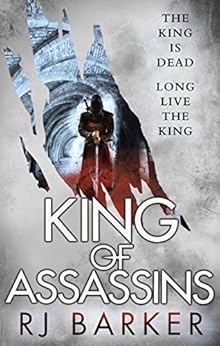 |
| There's totally going to be a review of this book on this blog soon |
RJB: I can't tell you much. It's very different to The Wounded Kingdom books and is much more of a 'new' world where the WK books are quite a familiar fantasy place this is a bit less so. It's a matriarchal society, it's not a mystery, it's more of an adventure and it's a book very much about second chances. I've also moved from first person to third person for this one as it fitted the book better. There's magic too but it's not sort of wizardy magic, it's quite subtle and world specific. There, i said a lot without saying much. Oh, MASSIVE DRAGONS. Though not dragons as you kind of expect.
PL: Well that'll have to keep us readers going for now! Does writing it feel any different now that you've finished and published a trilogy? Or does the process feel the same?
RJB: The process is the same. Everything else is just sort of stuff flying about around me sitting on the couch trying to write two thousand words of whatever nonsense comes into my head every day. I really enjoy writing, it's a thing I've done for years and now I'm lucky enough to get paid for it (and I totally know how lucky I am to be in that place). But in the end, I'm still just sat here on the couch writing things that I'm not sure make much sense. I mean I'm very lucky that my agent and everyone at Orbit just let me get on, so I don't really feel like there's any pressure.
PL: I'm jealous enough of reliably doing 2k words a day, nevermind getting paid for it! What's the best and worst pieces of writing advice you've heard over those years?
RJB: The best piece is 'what works best is what works for you.' And the worst is, well, nothing is necessarily bad, but maybe it would be truer to say that maybe the more absolutely sure someone is that their way is the right way the less you should listen. But no one knows how you should write, I would definitely not advise anyone do things the way I do. But maybe something I do might be of use to someone so pick and chose. Mostly I would say find things that help you enjoy writing, because if you're enjoying something you're never wasting your time. And if you enjoy something you'll want to do it more and the more you do it the better you get at it.
PL: Amen to that. Kinda backtracking a little - in a few interviews you've talked about how the Wounded Kingdoms are mysteries, and that Girton being a not-so-great detective allows you to have the reader a step ahead. Do you think its easier/more fun to write a Girton than a Sherlock?
RJB:Well, yes and no? A Sherlock is basically a trick (I love Holmes BTW this isn't a criticism) but what you do is set up a crime that is hugely unlikely so the reader stand no real chance of working it out then work back. And cos you know the trick you can drop in things the reader will never see and have your Sherlock notice them so he appears hugely clever. And once the reader knows the trick it seems really clever but it's actually a cheat. But you're not really reading stories like that to work it out, you're reading to find out how it was done. And I do do this a bit, in Age of Assassins, you can't work out who is actually behind it until the moment I want it to click because I just don't give you enough information. So it's balancing it, wanting you to be a bit ahead of Girton so you feel tension (and a bit clever) and not wanting to give you too much either. But I love that, re-read and find stuff thing. So if you re-read Age of Assassins after King of Assassins you'll find things and think 'oh...' Because I knew when I was writing it where I was going.
PL: I think that ability to keep the reader unsure until you put down the last piece of the puzzle and for it to then seem completely obvious and inevitable is one of those things that really makes or breaks mystery books (if that makes sense). Are there any authors who you feel do that particularly well?
RJB: Well, Christie and Doyle. And I like Edmund Crispin and marjorie Allingham. We don't tend to see that sort of puzzle box writing as much now, though I'm sure there are people doing it. Partly cos it's much harder to do because people know the tricks. Stuart Turton has done a very clever twist on it with The Seven Deaths of Evelyn Hardcastle.
 |
| The real and unmentioned hero of these books; Xus the Warmount, as painted by Tom Parker |
PL: I've seen you talk about Girton/Merela being intended as a counterpart to Adran/Aydor. Is there are any character who you think particularly parallels Girton's arc in King of Assassins?
RJB: Well yes. More than one actually (i'm being very wary about spoilers here). There's Boros and Barin and of course, by the time of the events of KoA Girton has become who Merela was in the first book. And REDACTED SPOILER. (His redaction, not mine - PL).
PL: I do see what you mean about Girton and Merela, although obviously Girton isn't as cool. Have you ever considered doing some Merela-centred prequels?
RJB: I have considered writing a book about Merela and have a rough plan for one. I'm kind of 50/50 about whether I want to. I think it's a good idea for a story and would be fun to do. On the other hand, should we ever go back? It's a finished and complete story and does what i wanted it to. And it depends on whether Orbit would want to do it as well. And I have ideas about what I would like to do after The Bone Ships.
PL: The curse of an author - so many ideas, so little time. And speaking of which, thank you for your time Dread Antlered Overlord but before you go - a few random questions for funsies. Favourite bassline to play?
RJB: Oh, it would have been Mountain Song by Jane's Addiction.
PL: If you could pick one animal to have as a pet, regardless of impracticalities, which animal would it be?
RJB: THIS IS THE HARDEST QUESTION I HAVE EVER BEEN ASKED.
PL: Imagine I'm doing the Doctor Evil pinkie expression right now
RJB: It comes down to two really. My wife really loves anteaters and my son really loves tigers. Now I know MrsRJ would give up her anteater for our son. But he is 9, and he wouldn't really look after a Tiger properly so we would end up looking after it. And also, an anteater is probably less common as a pet than a tiger. So I would probably choose a giant anteater knowing the boy would come round and it would make my wife incredibly happy.
PL: You, sir, are a good man. Who'd win in a fight - Sayda Halfhand or Quohrin Halfhand?
RJB: Sayda. The thinking behind the assassins was that they were evolved specifically to take down an armoured opponent. Also, ALWAYS CHOOSE YOUR OWN CHARACTER. :)
PL: Damn right! Back your girl. Finally - if you magically woke up a King in the Tired Lands and could pick any other author as your heartblade, who would you pick?
RJB: Oh, now quite a lot of authors do sword things. Anna Stephens does martial arts and swords, Ed Mcdonald and Sebastien Castell are also excellent swordsmen. Ed Cox would definitely die for me and Gavin G Smith, well, Gav would probably poison my drink actually. But I think Stuart Hotston (whose novel Tangle’s Game is out quite soon) is the most dangerous of them. It's best to be completely mercenary about this type of thing so I'd go with him.
Thank you Mr Barker! The Wounded Kingdoms trilogy is completed and available at all good book stores and it sounds like the Bone Ships will soon be ready for launch. To find out more about RJ Barker, visit https://rjbarkerblog.wordpress.com/
Tuesday, 16 April 2019
Wyrd Sisters by Sir Terry Pratchett
So there I was at the library t'other day when I decided to check out Witches Abroad as a good 'refocus' read - something I can use as a lodestone of what good writing is and a nice comfortable re-read to give me a hit of happiness.
It wasn't until I was outside that I realised I'd taken out Wyrd Sisters instead by accident.
Now, I am a huge Sir Pterry fanboy. A list of my favourite books would feature his name over and over, more than any other author I've encountered. But I have to admit that when it comes to the early Discworld books, I'm somewhat ambivalent. I find them the works of an author whose storytelling talent had yet to match his imagination, who had yet to learn that less sometimes had better impact than more when it came to humour, and who was more parodist than satirist and humanist.
As such I wasn't too sure whether I'd done a good thing. I couldn't remember whether this was a book I truly loved reading.
Wyrd Sisters, for those who don't know, is a rather loose parody of Macbeth told from the perspective of the three witches - but here they don't encourage the paragon of vaulting ambition, but rather oppose him when they manage to stop bickering with each other.
It is also where the Witches sub-series truly begins. Oh, I know that Granny Weatherwax and the Kingdom of Lancre appears in Equal Rites, but it starts as one idea and becomes another one here. The introduction of Nanny Ogg and Magrat Garlick automatically change Granny's character by introducing different, better dynamics to her interactions. Lancre itself becomes a defined world.
And it is a very good book.
What makes it good for me is how much I cared about the characters and, even in a re-read, how much I enjoyed the tension of what would happen to them. This isn't a book that can deliver huge twists - the general shape of the plot is very obvious to anyone with a nodding acquaintance with the Scottish play - but it can deliver splendid characterisation and that is nowhere more apparent than Granny Weatherwax and Nanny Ogg.
Every time I see a complaint about the lack of roles for older actresses, I wistfully wish that some one would give the Witches series the screen treatment and normally I don't want to know about my favourite books getting such a mangling. But the contrast and chemistry between is so fantastic that I want everyone to experience it. Its like a buddy cop movie, except featuring very cranky, very powerful old ladies instead. And arguably they are at their best here.
A lot of my thoughts about Sir Pterry's first ten books remain the same after re-reading Wyrd Sisters. I laughed at some of the jokes, but not all. I think it could have been a better story if it had strayed further from its inspiration and had done more with the Felmets (the Macbeth expies). But some of them have changed. I think I'd state that the clear premise of Pratchett's later career is "We all have terrible urges for that is being human but we can rise above them because that is also being human, and fuck those who won't." And that is so very clearly evident here.
So in sum totality, what do we have here? Wyrd Sisters is a comedy, although it is more than that. It is a story about ambition and power, about female friendship and rivalry, about stories themselves. I think it still lacks something when put next to the later books, but then Snowdon would lack something if put next to Everest. Its still a mountain.
And this is still a very good book.
Sunday, 14 April 2019
If Fantasy Books were Rugby Teams: Game of Thrones
Hello all three of you reading this blog! I've decided that I should celebrate the imminent return of TV's greatest fantasy series, and in what better way with some silliness? A classic tradition among rugby fans everywhere is to hypothesise what the best XV would be out of some group that has nothing to do with rugby (you haven't lived until you've argued loudly over whether a bear or a tiger would be a better flanker). And so I'm going to bring this tradition to Game of Thrones, which is rich of material when considering which sort of nutter goes where. So rich in fact, that I feel like I could do two teams, which in proper GoT fashion I'll split into sorta-good guys and not-at-all good guys, or to put closer to the approved terminology - Non-Cunts vs Cunts.
I even got a ref for it - Jon Snow. After all, he knows nothing, which makes him perfect match official material. I'm putting this one up top as I'm fairly sure its the one joke that'll work for all sports fans.
And with no further ado:
I even got a ref for it - Jon Snow. After all, he knows nothing, which makes him perfect match official material. I'm putting this one up top as I'm fairly sure its the one joke that'll work for all sports fans.
And with no further ado:
Non-Cunts
|
Cunts
|
|
Yara
Greyjoy – Full-backs should be dependable and tough enough to be the
last line of defence, and ambitious and quick enough to attack from anywhere;
Yara fits the bill here
|
15
|
Nymeria Sand - I want a lot of chemistry in the back three, so I'm going with the Sand Snakes en bloc; Nymeria is the most sensible, so she gets the most responsibility. |
Gendry
– Wings are where you want speed and as a friend pointed out,
the speed with which Gendry makes the wall maybe makes him the fastest man in
Westeros. He’s also a unit so in he goes.
|
14
|
Obara Sand - A daring risk-taker who'll attack out of nowhere, Obara's game fits perfectly on the wing. Mightn't be the most defensively secure but should make up for it in tries. |
Jaime
Lannister – Irrepresible confidence and all round skill make for great
outside-centres. Jaime would be able to go straight through opposition
defenders or around them with equal ease.
|
13
|
Karl Tanner - A minor villain maybe, but a very capable one with fantastic footwork; he'd be able to break the defensive line with no space at all. Also just really aggressive. Can't go wrong with that. |
Robb
Stark – I worry that he’s too honest for rugby, but his nous and
lead from the front style are too much to pass up on; he’d be a fine playmaking,
ball-carrying centre.
|
12
|
Lancel Lannister - This backline is going to play with pace, so I want someone young with a lot of drive here. Lancel seems as good a shout as anyone. |
Arya
Stark – Sure she’s small, but probably no smaller than Shane
Williams. She also has fantastic footwork and is a deadly finisher.
|
11
|
Tyrene Sand - The final of the Sand Snakes, picked in the hope that she'll get under the opposition's skin and work hard to link up with her sister. |
Grey
Worm – The fly-half is the team’s general, and Grey Worm is one
hell of a general, not to mention his toughness and speed would make him a
formidable individual
|
10
|
Tywin Lannister - Can there be any other choice for this team's mastermind? Everything turns to shit for his side when he's forced off |
Ygritte
– Scrum-halves are meant to be quick-thinking high-skilled
individuals; they’re usually gobby gits with anger management issues. Ygritte
fits both requirements admirably.
|
9
|
Roose Bolton - This team needs some wise old heads making the decisions, so Bolton in at 9 - he does also have the ability to surprise defences. |
Barristan
the Bold – Technically proficient and indomitable, Barristan’s
advanced age would prove no bar to him continuing to dominate in the front
row.
|
1
|
Meryn Trant - A big strong man who'll do what you tell him to, no matter how repugnant. That makes him a decent choice for loosehead. |
Davos
Seaworth – Another ultra-reliable and tough operator, Davos would be
another fine scrummager in the front row and he definitely knows a thing or
two about the dark arts.
|
2
|
Ramsey Bolton - Tradition dictates a strong chance that the hooker is the biggest psycho on the pitch. So Ramsey Bolton it is. |
Robert
Barethon – Sometimes you just have to respect tradition and pick the
strongest fattest person you can find for tighthead prop. Step forwards
Robert.
|
3
|
Xaro Xhoan Daxos - Another big guy, but this one's picked for his willingness to do anything needed to do to win. He'll need that attitude in the scrum. |
Hodor
– Yes he’s a bit passive, but get Bran to warg into him for
the full 80 minutes and that’s no issue, and every rugby club in the land
wishes they had someone his size in the second row.
|
4
|
Styr - The Magnar of Thenn is a big old nutcase who's willing to take a bite out of any challenge. In other words, perfect lock material. |
Sandor
Clegane – Another big unit for the second row, Sandor’s all round
aggression and skill will be invaluable on the field.
|
5
|
The Mountain - Expect Ser Gregor to be at the heart of everything good with this team; or at least everything brutal. |
Brienne
of Tarth – A non-stop motor, never say die attitude and huge physicality; these are the things
that make a great blindside flanker.
|
6
|
Alliser Thorne - A wily veteran who you can imagine wreaking havoc at the bottom of a ruck; I see him as being this team's poor man's version of Richard Hill. |
Bronn
– Cunning and mobile opportunist with little respect for
the laws of the game or regard for others' physical wellbeing; this description fits both
Bronn and openside flankers to a tea
|
7
|
Locke - Another tenacious wily cheat who gets everywhere; you can trust him to track the ball well. And won't let anyone keep their hands on it. |
Tormund
– To round out my pack, I need another big unit who’ll carry
all day long and make an impact in anything. That’s Tormund.
|
8
|
Khal Drogo - A fearsome athlete and gloryhound with no particular respect for others' feelings, Drogo is perfect 8 material. He'll never pass but be worth it anyway. |
So who would win? Have I even got the right people picked? And have I even got people on the right teams anyway?
The classic truism of rugby is that the packs decide who wins and the backs decide by how much. The Cunts pack has some of the stand-out names - good luck tackling the Mountain or Drogo - but I'm not sure the quality levels are consistent enough. Most of Martin's memorable villains are schemers, not skullsmashers. In particular I think the Non-Cunts have a big edge in the front row. I wish I'd had time to do a subs bench as I think that's where the difference would really come through, but even just going to 80 I think the Non-Cunts look fitter and stronger all round. Plus you just know Sandor's going to do a great shutdown job on his brother - that's hatred as a motivator for you.
If the Cunts do get ball, I think the combination of experience at half-back and trickery and pace out wide could do real damage. I sort of wish I'd given them a power runner now, but none of them will shy away from physicality. That said, the Non-Cunts have lots of pace and trickery themselves, and players like Gendry and Jaime will bring the power game. A particular mismatch might be asking an old git like Tywin to tackle Grey Worm - he'll spend the game clutching air if he's no careful.
But they won't get enough ball and that should be the end of them.
Should players be in different spots, or different players selected? You could argue for swapping the Bolton boys, as Roose is far more willing to face actual danger (scrum-half is a very good position for cowardly agitators). I originally had Brienne as a crash 12 before deciding it'd be a better game with a running playmaker there. Yes, I am capable of extrapolating playing styles from the characters' attributes.
I wish I'd found a spot for Oberyn Martell - he'd definitely be the supersub here. Ned Stark would have made a good hooker if not so honest, the Blackfish would make a great maverick fly-half, Daario and Syrio would be fine outside-backs... the list is endless for the nice folk. For the Cunts, well, slimmer pickings. Although arguably they should have Jaime. And you could probably fit Stannis in, although I imagine opinions might be split as to where he should be.
So let me know what I've got wrong and who you think would win.
p.s. I decided against including Giants/the Night King because that'd be too silly. But if you do include them, the winner is the side with the Night King. Hard to beat a player whose hand-off can kill you...
Subscribe to:
Posts (Atom)