Tuesday, 4 September 2018

"I wanted High Magic and Hideous Monsters": An Interview with Cameron Johnston

I used to only know Cam as another amiable face round the Fantasy Faction forum. Then I found out he was releasing a book full of Murder, Gods, Grumpy Antiheroes and, well, just all the things that make life worth living, so there was only one thing to do. The book was ordered (review here) and Cam was pestered for an interview - and here's that interview:

PL: Congratulations on being published with shiny physical copies and everything. I've told a few people about your book and the thing that always comes up first is just how physical and, uh, earthy the magic is. And how many setting wide ramifications it has. What made you pick such a depiction of magic? 

CJ: Cheers! It's super cool and a little gobsmacking to have thousands of copies out there all over the world.

Hah, because I thought it would be cool to write about. It might sound like a simplistic answer but it's true for all that. It started out as a reaction to all the low-magic human-centric settings that were all the rage a few years back and exploded from there. Me, I wanted high magic and hideous monsters, and I wanted in embedded in a gritty physical reality instead of saying some magic words and hey presto. As magic is an external source of power in this novel, it seemed to me that rather than getting drained through use it would instead flood through all of them and it was more of a problem of addiction and degradation of their magical Gift through overuse than anything else.

Normally in fantasy you don't use magic without costs: you get tired or drained etc, but that's not the case here and there are no costs exactly, but what I came up with are the consequences if you use too much too quickly. It's a little like deciding to sunbathe around an unshielded nuclear reactor, and as Bowie said: Ch-ch-ch-ch-changes. Turn and face the strange...

Too much magic does things to a magus, but if you are careful you can gradually build up an increased resistance. If you are not careful then you change in body and mind, consumed by magic's need to be used.

PL: Well nothing says gritty physical reality like being so magical you produce the best fertiliser! A lot of what you're saying reminds me of the place tech holds in good cyberpunk - the sort that worries about all that power in the hands of so few - and I certainly saw similarities in the book itself. Is that an accident, or were you deliberately looking at the cost of magic to society as well? Should I start calling The Traitor God MagePunk?

CJ: These days I don't even know what the punk suffix is meant to mean. It's tagged on to more or less everything.

I suppose you could say that in this world magic is a much more visceral part of society than in a lot of things. The sort of pervasive influence that megacorp tech companies might bring in a cyberpunk setting instead trickles down from a magic elite.

I was indeed deliberately considering the effects on society of a magic that seeps into blood and bone. When you can use blood to power magical effects (especially if acquired from magi) that has a lot of ripple down effects. Surgery for instance is rare and looked upon with great suspicion.
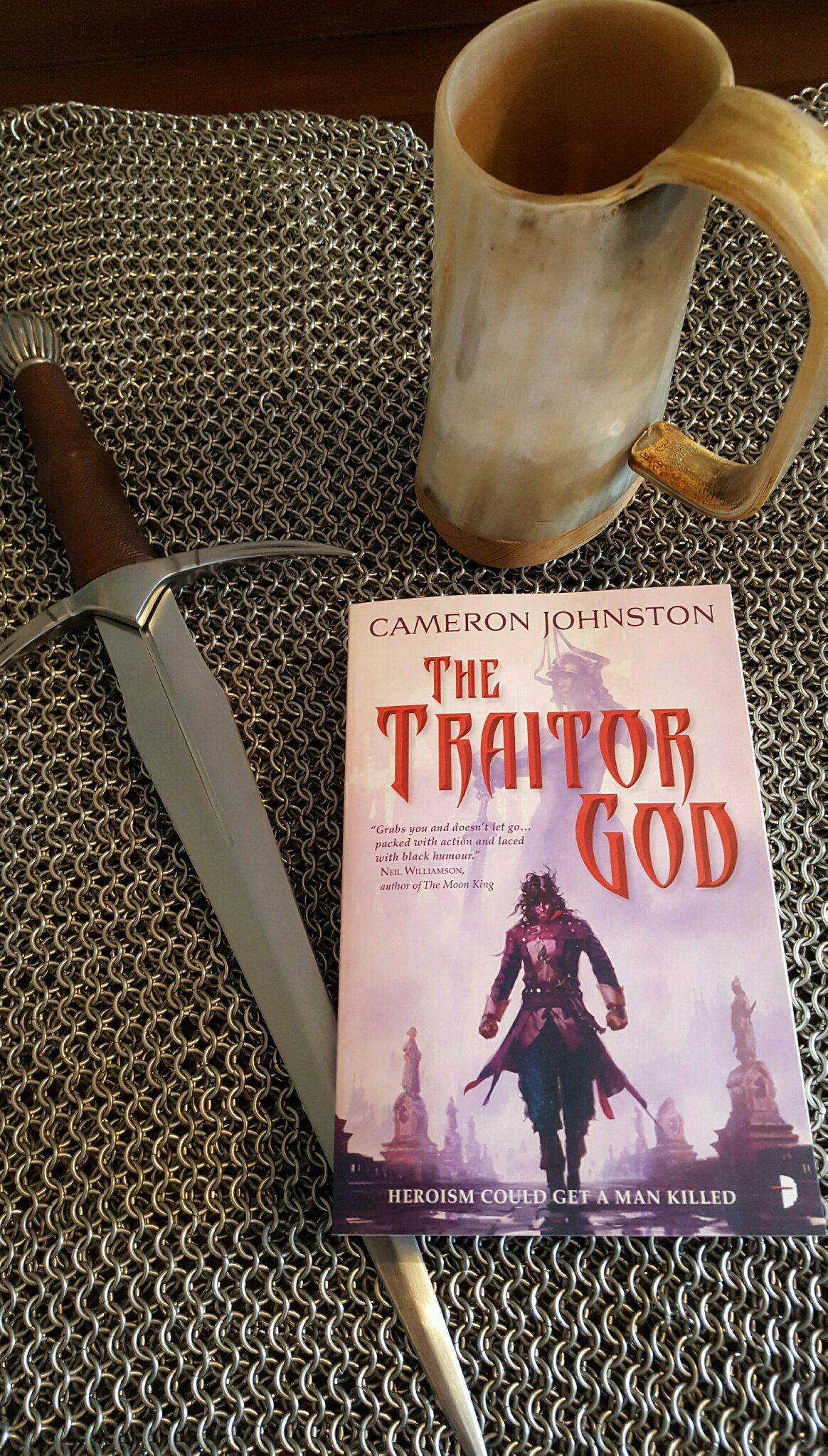
The only truly appropriate way to advertise your book

PL: *crosses out magepunk label* I can only approve of that sort of level of ripple down effect.

So what made you look for a grizzled cranky antihero as the vehicle for all this? Or did Edrin come first? Or would I know the answer if I'd finally got round to reading Head Games?

CJ: It's all down to film noir and Cast a Deadly Spell (if you haven't seen that film, you really should). I fancied writing about a grizzled down-on-his-luck detective in a secondary world full of magic. Something a little different than the usual urban or grimdark/epic fantasy but bearing blood from both.

It did evolve away from that idea to become its own thing, but that was the original idea and that concept is a little more obvious from the short story.

PL: I'd never heard of that film but will watch it imminently.

I have to say, when I first heard you were having a book published, that wasn't the direction I was expecting. Partly because there's not a lot of fantasy like that in general, but also because I'm a horrible stereotyper and expected someone into swords and archaeology to write a book full of duels and archaeology. It is very classic fantasy territory after all! Are there any parts of the Traitor God that you'd say are influenced by those interests?

CJ: There only a smattering of detective fantasy set in a secondary world but very little that approaches that gritty film-noir kind of feel. The Low Town series by Daniel Polansky is probably the closest thing I can think of. 

There's very little of The Traitor God influenced by my interest in swords, being as the main character does not have any interest in being a warrior, but if we expand that to all things medieval and weaponry it does feed into the siege breakers later on - magi skilled in body-enhancing magic wearing extra-heavy enchanted armour. They are living tanks and handweapons bounce off, much like how knights in plate armour were on the battlefield.

As for archaeology the main thing I took from that is that Setharis is an ancient city built atop itself for thousands of years. Down below ground level there are lost mines, tunnels and forgotten temples and rooms filled with the detritus of thousands of years of human occupation, well, mostly human...
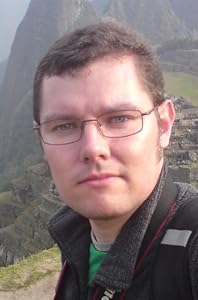
The author, busy looking all intrepid and stuff

PL: As in it was mostly humans down there, or the people were mostly human? Nah, that's probably too big a spoiler. Do we get to go down there in the sequel? Tell us all about it!

*off the record chat reveals Cam was working on this back when Polansky's Low Town came out* Also - wait, were you submitting this back in 2011? How long has it taken for The Traitor God to go from seed to mighty tree?

CJ: Some secrets will be revealed but most of the sequel it is set outside of Setharis, venturing into the snow-blasted hills of the Clanholds to where Walker got his extensive facial scars.

Publishing is not a quick business. I wrote the short story Head Games in 2012 and then began developing it into a novel in 2013. I finished the rough draft of what came to be called The Traitor God in late 2013 and I finished various drafts and revisions in mid 2015 and then began sending it out to agents. It took about a year before I signed with my agent, and after a few more rounds of edits and polishing of the manuscript we sent it out to publishers and Angry Robot snapped it up in mid 2017, and published it in June 2018. All in all, it was about five years from beginning to publication.

PL: And how much longer than that time have you been writing with the hope and intent of one day being a published author? Has how you go about writing changed in that time?

CJ: I've dabbled with writing on and off since I was ten or so, and have many old beginnings of novels trunked in dusty files somewhere. I wrote two complete books in the mid-late 2000s and to be honest, they were pretty poorly written. I decided to 'get good' around 2010, joined a kick-ass writing group and seriously worked at improving my writing with a series of short stories and writing exercises before I tried another novel.

PL: My obligatory question for everyone - what's the best and worse pieces of advice you've received?

CJ: The best piece of advice: First drafts are ungainly and awkward things verging on the horrible. Don't worry if it seems that way when you read it back to yourself. The real magic is in the editing, rewriting and polishing.

The worse piece of advice: Write what you know - pfft. I guess I know all about dragons, wizards, ancient eldritch horrors and the like then? It's a nonsense statement when what it should really say is 'Do your research'.

PL: And finally - who are your favourite cranky antiheroes other than Edrin?

CJ: Oh, favourite cranky antiheroes is it? Well, I'll opt for Hellblazer's John Constantine, Deadpool if he's not been fed his chimichanga's on time, Sand dan Glokta from Joe Abercrombie's First Law books, and Calvin from Calvin and Hobbes.

Thanks to Cam for his time! You can find more of his writing at his own site. His books, The Traitor God and recently announced sequel God of Broken Things, are published by Angry Robot. You can buy them there, at Amazon UK and US, Waterstones, and a bunch of other places.

Sunday, 2 September 2018

Five quick fantasy thoughts from the week

1) Working through my backlog of as yet unread kindle books, I came across the sampler from Sigil Independent. I've been meaning to check out some of their authors but never really got round to it, so I cracked it open little expecting to find some really awesome Choose Your Own Adventure fiction right at the front. I'm not sure everyone else reading this will have the same deep nostalgia for CYOA and Fighting Fantasy that I do, but anyone who does should get the sampler for those reasons alone.

2) A few posts here and there on various forums have made me start wondering what sort of reader I am. Some people view skim readers with suspicion, yet I know I definitely indulge in that from time to time. I'm fairly sure I'm not really that suspicious. I've also been told I should take more than a few pages before deciding whether I like a book - maybe, but I know that when I ignore my gut instinct that the author's vision won't match my preferences, I'm usually wasting my time. What do my readerly instincts up to? Has anyone tried to classify readers, working out what makes them tick and what styles marry up to those preferences? And would it even be a good idea.

3) Back to theme of kindle backlogs, and I've got a good idea on how to make yours even bigger. Eli Freysson is giving away his entire The Call series for the next few days, so if anyone's looking to grab some bloodsoaked monster hunting fantasy for their reading list, now is a very good time to do so.

4) And speaking of northern strongmen, I was recently reminded of a post on Best Fantasy Books (by Allan Batchelder, I believe) that nailed the real true overused trope in fantasy: northern barbarians. I think I'm going to do a bunch of posts in the future looking at these sorts of trope. If anyone thinks they've noticed another overused trope that somehow flies under the radar, please let me know!

5) Final shout out for a friend. Bryan Wigmore's The Empyreus Proof was released on kindle recently (with paperback to come). I was lucky enough to beta the book and its a very worthy sequel to one of my favourite books of last year. I'll be reviewed it here soon, but if anyone here trusts me (hahaha, you fools!), I'd go get it now rather than waiting for the review.

p.s.

6) Shortly after publishing this, I found out RJ Barker's Age of Assassins is *still* available for 99p. This makes no sense to me. None. I urge you all to take part of this act of foolishness now. Scroll down to the recent review to see why.

Thursday, 30 August 2018

Age of Assassins by RJ Barker

I think most readers are familiar with the feel of instant love for an author's work. Its rare but, every now and again, something about an author's voice and vision instantly clicks with your own desires.

I recently had that experience with RJ Barker and his book Age of Assassins.

Wry dark humour. An eye for detail executed with a sketcher's touch. A deft hand with drama and a defter one with tension. And as Age of Assassins went on, I discovered his idea of what makes a good character is incredibly closely with mine too. Plus there's a big mystery, which makes everything better, and cynicism was balanced just right with heart. In fact, the experience was so good that I went full fanboy and tweeted that Barker "writes in more or less the exact way I wish everyone wrote".

On the off-chance people are still reading this and haven't either gone to buy it immediately/be sick due to sycophancy, I should probably tell you what the book is about. Girton is an assassin's apprentice (surprise innit) who, along with his mentor, must foil an assassination by going undercover at a King's castle. Along the way he'll learn lessons about life, love, trust, truth, and batshit crazy. You know the drill.

This is one of two criticisms I have. I love genre fiction and its stereotypes for what they are but when an author's adhering to them, they're treading a fine line. There's some really easy and specific comparisons to make with other famous series. I've already subtly made one, but there's also a particular set of character dynamics that really recall A Song of Ice and Fire. Its a very subjective criticism but once seen, it doesn't get unseen. 

It's also a criticism of something that didn't detract from the experience. Barker's use of the stereotypes feels fresh and lively and to me, that's the main thing that matters. What the similarities did was make me think of how the book could have been even better with more prominent use of the rare and original.

The other criticism? Well, they say in a good mystery the reader should always be one step ahead of the detective. In Age of Assassins I was two or three, which had the unfortunate effect of making Girton look a bit of a clod when he really isn't. Again, the close relationship with fantasy's conventions was somewhat in play, as a few things were easy to guess less because of information provided and more from knowing narrativium's standard tolerances.

These are tiny flaws, flaws that I don't think will detract from the experience for any but the most jaded of genre readers. They certainly didn't for me. I loved this book so much I kinda want to read it again already; I'll definitely be continuing the series.

In Age of Assassins, I found an author who matches Scott Lynch and prime-Dresden Files Butcher for sheer damn fun. And so will you. 

Monday, 27 August 2018

X-Com 2

Stephen Bush recently wrote an article on 'Bothism' - where a political party responds to an either/or choice by trying to do both and accomplishing neither. It's a simple concept, but elegantly expressed and it has stuck with me. Particularly when playing X-Com 2.

The designers are on the record as wanting the player to play aggressively and take risks. But they also wanted to preserve the tense, punishing nature of X-Com. Well, that's Bothism at work there.You can either encourage gamers to take risks or you can punish them for taking them.

The end result of this is a game that is, while a lot of fun, just a little more irritating than I like.

You can play X-Com 2 aggressively well. I've seen plenty of it on YouTube. But what you notice quite quickly is that the people who do it manage it because they've got such a huge level of game knowledge in terms of how line of sight works that really, they're also playing quite conservatively at the same time.

I don't have that same instinctive knowledge. I can play that way, but I've got to be pretty bloody tightly focused. And of course, I'm often playing computer games when I'm not all that focused. So I play conservatively, enjoying the challenge and a little irritated at the artificial (and usually ineffectual) constraints trying to force me to do elsewise. And every now and again I get impatient and bored at myself, and that usually ends up with me ragequitting quite fast.

Taken for what it is - a serious challenge that requires a lot of self-education to play well, a game a that rewards meticulousness and caution - X-Com 2 is as good a game as is on the market. But the fact the designers themselves can't do it mars the game.

Wednesday, 15 August 2018

Echoes of the Great Song by David Gemmell

Echoes of the Great Song has always been one of my favourite Gemmells - possibly because of how different it is to the others - but I’d forgotten until my most recent read just how dark it was.

In the first few pages we’re introduced to some of the members of the Avatars, a race who founded a global Empire on the back of immense mystical power but are now frantically clinging onto their last scraps of power after a global cataclysm. There’s Ro, a fussy and proud racist who gives little thought to what others are worth save in their use to him. There’s Rael, the general whose eagerness to protect what’s left results in him giving immense license to his soldiers, for good and bad. And there’s Viruk, an insane sociopathic monster. They’re a pretty unflinching examination of the evils of Empire, if not all that deep.

And through them, we begin to meet the people opposing them. Some are members of the Vagars, some are members of near by unrelated tribes such as the Mud People, and all of them are murderous in an unpleasant way. Their hate is very understandable but it is more than the Avatars who suffer for it. Each of Merana, Ammon and Boru are responsible for deaths on their own side. Echoes of the Great Song quickly shapes up into being a case of Evil vs Evil.

But there is a third and even nastier player in the Almecs - an alternate reality version of the Avatars who escaped the cataclysm by shifting dimensions. Incidentally, the grandiose high fantasy nature of this book is one of the many reasons I hold it in high regard. Every now and again I want some fantasy that goes all the way down the wormhole of what is possible. Bonus marks for the little snippets at the head of each chapter, telling us how the events we read in time became legend. A story within a story.

The presence of the Almecs forces the two sets of violently opposed bigots to work together if any of them are to survive. Their main hopes rest on the handful of genuinely reasonable and nice characters - the Avatar Talaban; the Vagar Sofarita; and the Native American-expy Touchstone. They help guide the others through the evolutions they must make and also undertake the desperate quest to stop the Almecs (while everyone else tries not to die).

I almost wish they weren’t there. They’re enjoyable characters, but watching Rael and Merana struggle towards mutual respect and understanding is the most interesting part of the book. Which is unusual for me. I hate authors who place me in the mind of the prejudiced and ask me to have sympathy. But Gemmell does it as nearly as well as Pratchett.

Echoes of the Great Song features wonderful fantasy conceits and intensely human challenges. It’s a book by Gemmell, so you know the action scenes will be good (at the very least), with Viruk hogging most of the best. It has just about everything, including a rich vein of tragedy that ties it all together. The only thing its missing is depth - this book could easily have been a trilogy and as a result, some things are dealt with swiftly. Part of me likes the tautness but there are events that would have been better for going slower.

That is a minor quibble though for Echoes of the Great Song is a humdinger. Highly recommended for anyone looking for high fantasy and low humanity.

Sunday, 12 August 2018

Feet of Clay by Sir Terry Pratchett

Warning - This rambling discourse about the themes and character development of Feet of Clay will contain a few spoilers about the plot, more or less by accident.


About three-quarters of my way through Feet of Clay, I found myself wishing we'd seen more of Angua - both as a lead character and as a sidekick to Vimes. Not only is she one of my favourite characters in general but she's also Vimes' true protege in terms of cynicism and suppressed instincts. It would have been nice to see them paired up more often, instead of using her mainly as support cynicism for Carrot and various naive rookies. 

One does understand why Pratchett went that way. Vimes needs extended time with other cynics like whisky requires a drop of absinthe. Or at least this version of the man does. I have not been the greatest believer in Vimes' character evolution but on re-reading, it seems clearer.

Perhaps it is the themes of the book that make things so much clearer. Between the two attempts to make a king, the presence of Carrot as probable heir to the throne who doesn't want to be, and the absence of Vetinari's sharp direction, there's an awful lot of lines about what does and doesn't make a leader. The simplest definition is probably found with Mr Sock's yudasgoat - a leader is anyone whom people expect to be better off for following, regardless of whether they right or wrong. It is typical of Pratchett to pick an example of just how wrong it goes.

At this point in Vimes' career, he's just learning to be a leader, to be someone who people pay attention to. He's no longer just some drunk in charge of a pitifully small band of watchmen. Rich men claim to be his friend to gain advantage. The poor are no longer comfortable with his company. From a certain viewpoint, this book is about Vimes learning how to deal with that change and accompanying identity crisis, and how to be the watch commander he wishes to be.

Of course, Feet of Clay is about a huge amount more than Vimes, including all the other identity crises that fill the book. If there is a central theme to the book, it is the question "If I am not X, what am I?" Those crises range from the mainly comedic arc of Cheery's desire to express her feminity to the tragic rage of the Golem King and give us a book rich with subplots and intriguing characters. 

Cheery, whose story this is in no small part, is arguably Pratchett's greatest creation. Sometimes she's an everywoman and great comedic straight person; at other points she's a totem pole for transgressive behaviour, although done in a way artfully removed from real world transgression. The juxtaposition only enhances each facet of her character, as does the fact she's one of his most pleasant characters. Pratchett does a fantastic job of portraying the messed up, so its nice to see him do people who are, well, nice.

Not perfect though. Cheery - like just about every character in the book - is severely prejudiced in some ways. That's the flipside of the identity theme and Pratchett gives it no less voice. Some characters move on past their prejudice - others move on a little, albeit in a somewhat crabbed way - while for others its unresolved. That mightn't be as uplifting as some might wish but it feels real. And it feels kind. Pratchett accepts that prejudice is human and not something necessarily something that makes you a bad person. He doesn't demand that we be saints, pure in every thought and deed.

Instead, he sets the case for trying to be better than our flaws. That we don't have to be ruled by ingrained negative instincts. The answer to "If I am not X, what am I" is that we choose our own identity and that we write our words. That's best shown in the golem Dorfl's very literal example but both Angua and Cheery end up deciding their desires to be happy overrule their internal pictures of who they should be and are.

The most complicated resolution is Vimes. He moves past some of his prejudices, but partially out of spite. Many of his actions lack a certain legal legitimacy. I'd love to ask Pratchett whether the Vimes we see in Feet of Clay would be able to shake off the same supernatural compulsion towards revenge that he does in Thud!. But his actions are in pursuit of justice, at least as he perceives it. It might be somewhat contradictory for the Commander of the Watch to have a vigilante streak but contradiction is what Vimes is made of at this point. The point couldn't be made plainer by Vetinari:

“Commander, I always used to consider that you had a definite anti-authoritarian streak in you.”
“Sir?”
“It seems that you have managed to retain this even though you are authority.”
“Sir?”
“That’s practically zen.”

Being able to reconcile the contradictory parts of who we are is a huge step towards answering "What am I?". The Golem King couldn't. He has too many expectations on him that he can't escape or meet; too many ambitions he couldn't meet. But that makes him as much victim as villain. The true villains are those who seek to force those expectations on others and mould them. Even then, there are thin lines between those who set expectations and those who force them. Is Vetinari a villain? After all, he's been shaping and manipulating Vimes. Arguably yes, although of such a charismatic and altruistic nature to escape condemnation.

But in truth, I haven't thought enough about that question. That's something to watch for in the next read through - and with Feet of Clay, there's always another read through.

Wednesday, 1 August 2018

X-Com Files 2

Back to X-Com. For anyone hoping to read something about fantasy books or writing here anytime soon again, I’m doing an interview with Cam Johnston, so it won’t be too long. But for now I must get this obsession out of my system.

I finally got that strong start on Long War 2 I was looking for and am now a few missions in. This has confirmed some of my suspicions about the class and tactical layout of the game while dispelling others.

The game has a squad function, allowing you to group soldiers together for easy reference. I’ve yet to use it as I’m constantly running hither and thither, and have an orbat that’s changing too fast to make hard decisions on who fights together. Nevertheless, I plan to use the system in the fullness of the time, if only because the game gives you a squad and named mine Sandman. Well, that’s just too good an invite to a geek like me. Sandman has been joined by Watchmen and Invisibles. Future squad name possibilities include Slaine, Lucifer, Inferno and Asterix. It tickles me pink to imagine an anti-alien resistance using comic book code.

That’s down the line but I’m trying to figure out now what make-up I want these squads to have. Here I have been influenced by D&D tactical theory, which tends to measure power by the number of different threats a character/party can take out, and Warmahordes tactic articles, that often talk about a roster’s ability to handle the different kind of threat.

As such, I’m developing my own X-Com scenario list - situations I want my squad to have a chance of covering. So far that list includes: numerous mechanical enemies, numerous biological enemies, soldier bleeding out/panicking, unexpected enemy activations, removal of very dangerous enemy in hard cover (spot removal), guaranteed finishing of wounded enemies, hacking remote systems and scouting enemy positions. Its a long list to stick on a small group of soldiers but that’s the job in front of us.

And to do a quick and dirty class break-down of the classes and where they fit in this:

Assault - The Run and Gun perk makes them good at dealing with unexpected enemy activations and spot removal. They’re also decent at finishing enemies, even if its overkill. They can be built to attack numerous times and have a decent anti-mechanical option down the line. I thought Assault wasn’t all that useful coming into the game but am dead wrong.

Grenadier - Their grenades make them great at dealing with numerous enemies and also spot removal and finishing, as grenades don’t roll to hit (and sometimes destroy cover too). Long range makes them decent for unexpected enemy activations too.

Gunner - I thought they were weak and I think I might be right. They’re great at numerous biological enemies and a decent anti-armour option, but they lack flexibility and accuracy compared to other classes.

Ranger - Strong at dealing with numerous enemies - the strongest in the early game - and their sawn off shotgun is surprisingly useful for dealing with armoured enemies too. Better than I was led to believe.

Sharpshooter - Extreme range makes them decent-ish for engaging unexpected enemy activations (can’t really do enough) and a decent executioner. I don’t think their perks make them better than their lack of mobility.

Shinobi - The only unit guaranteed to start in concealment and stay there once the unit is spotted. Strong spot removal thanks to running closer and hitting them with the sword. Maybe not as essential as I thought, but very useful.

Specialist - The only unit with a wide medkit reach and the only unit with hacking. Essential.

Technical - The rocket is fantastic for everything but you only have one. The flamethrower is awesome spot removal/crowd control if you can get if close enough (good luck with that).

I’ve started thinking in terms of a basic team of 4 with additional members added permanently or temporarily to slant the group a particular way. One member will be a Specialist. One member will be a Shinobi. I want the skills they offer that only they have. One member will be selected for their ability to make really big booms, which means a Grenadier or a Technical. I’m leaning towards Grenadier as they have more booms that are more accurate, but I’ll use a mix. The fourth member is for utility offensive power, which to me says Ranger or Assault.

5 seems to be the default squad size so that leaves space for a permanent wildcard. I’m still not sure what will be most useful here - that’s one for experience.

But what experience is teaching me is that the class structure is as unnecessarily limiting as I thought it would be. And I don’t like that. But I’m still hooked anyway.