Once upon a time, there was a man who cared so very little for musicals. Quite a lot of them actually - but I am talking about one particular individual who made a fatal error. That mistake was to marry a woman who was absolutely obsessed with the bloody things.
So he took her to Book of Mormon and Wicked. He watched Disney movies and Les Miserables. He listened to musical songs whenever she stuck them on Pandora. And in doing so, he accepted that they were just stories and music and jokes the same as most anything else. But this never blossomed into a fullblooded love of the thing.
That was until Hamilton.
Because Hamilton is one hell of a story. It has the power of an 800 lb gorilla. A gorilla made from titanium. And that has bombs strapped to its fists.
Part of that power comes from Alexander Hamilton’s own life. Going into the show, I only knew that Hamilton was an early Secretary of the Treasury and died duelling (thanks Something Positive). I didn’t know the extent to which his tale was a straight up Greek tragedy. I didn’t know how influential he’d been or the many things he’d done. Lin-Manuel Miranda deserves a pat on the back for spotting this half-forgotten story and the potential in it if nothing else.
But there are so many things else. The songs are incredible. Rap’s ability to enthrall and amaze with the sudden twists of its wordplay are fused perfectly the musical’s love of big emotive choruses. I wonder whether the surely inevitable imitators will be able to handle these two influences half as deftly. I’m going to guess mostly no, but I hope enough do that rap musicals take off and become a thing. They need to be a thing.
Of course, the rap element also adds to Miranda’s decision to cast the play as predominantly black. There’s so many words that have been written about that, and better than I can write them, that I will stick to one point and one point alone. That is the added weight given to many of the lines placed in the founding fathers’ mouths by the fact it is a black man speaking them. The contradiction between their words on liberty opposed to their actions regarding slavery is sharp, but sometimes forgotten. Not here.
It seems that no nuance or contradiction in words is missed here. And it is that textual density that is the final and greatest source of Hamilton’s power. Every re-listen to the soundtrack sounds better as a consequence. That textual density allows Hamilton to be history lesson, character study, philosophical treatise and incredible entertainment all at once. Anyone who claims to love words should listen to the songs and read the lyrics and see just how much Miranda accomplished here.
Those words are the most fitting tribute there could be to Alexander Hamilton; a piece of art that matches his inexhaustible energy and eloquence.
And that’s why I might be a little obsessed with a musical.
Wednesday, 25 July 2018

Monday, 23 July 2018
X-Com, Long War, and the Thief of Time
One of the reasons my writing is suffering at the moment is the amount of time I spend playing X-Com 2. So, in a vain attempt to at least keep myself in the habit, I’ve decided to write about X-Com 2.
For those unfamiliar with the name, X-Com is a long storied franchise where you command an agency dedicated to fighting the aliens menacing Earth. The lion’s share of that command belongs to directing the squads of elite soldiers (well, sometimes elite) as they undertake missions against the enemy. X-Com 2 is the latest edition (the number being misleading due to a reboot) and this time, the aliens won and you’re directing a guerrilla operation against them.
Those unfamiliar with the name will also be unaware of X-Com’s reputation for tense and punishing game play. Part of that is due to gamers getting attached to the soldiers under their command - particularly when they’ve customised them and renamed them after friends and family - and therefore taking every death personally. The other part comes from never knowing when a rash move will trigger a huge alien backlash and put the mission at risk.
Personally, I’ve yet to find this to be the case. That may be because I’ve only played on normal difficulty so far but mostly, I find the aliens a bit toothless. There’s a lot of frustration when you’re groping around for a contact - or worse, flanking during a firefight - and trigger the next group with your last soldier. But mostly I survive. The aliens seem to lack a killer instinct unless I’ve grossly underestimated who can see and reach me. Which happens less and less as I understand the maps and enemies.
No, my problem with X-Com 2 is it doesn’t go deep enough. Combat often feels a bit simplistic due to the best action almost always being to take the best cover you can and shoot. I don’t make too many squad alterations between missions as I don’t have to and in any case, I don’t have too many options. There’s four base soldier classes and I already mostly know what I want out of them. The strategic element bolted on top is very simple and rarely leaves me feeling stretched or forced to make hard choices. Its fun, but it feels a case of unfulfilled potential.
Enter Long War 2.
Long War is a mod for X-Com that does roughly what it says on the tin. It makes the war longer. A lot longer judging from reviews and information. And it does by introducing more depth all over the place. More soldier classes, with more options for each class to pick from and more gear per soldier. More strategic choices. A wider variety of missions, suggesting the need for multiple squad options - out and out stealth, run and gun, straight up fight, and maybe others.
I’d been meaning to install Long War after I finished X-Com, but this weekend I caved and went and did it.
To a certain extent, its done everything I wanted. The opening mission in X-Com features 4 soldiers. The opening mission in Long War features 8. That makes me feel like a real squad commander, with a huge amount of options. A problem arises though in that most missions in Long War heavily tilt the numbers against taking that many men, which sucks. It sucks a lot. I dislike games that promise what they don’t deliver.
Another problem is that when you start with 8 soldiers and there’s 8 classes, everyone gets promoted to a different class at the end of that first mission. So far so good, but the classes aren’t made equal. There’s a lot of classes dedicated to using really big guns, but only one dedicated to stealth and one dedicated to hacking. In my first go through, I had two soldiers wounded in the first mission. They wouldn’t be available for the first month of my campaign. Guess which two classes they were? Sure enough - my stealth specialist was out. I played on a bit, but it became obvious to me that I’d want my stealth specialist. Particularly as he’s also one of the few classes that can do guaranteed damage and even more particularly when the opening set of missions all needed stealth.
So I restarted this morning, played through the opening mission… and lost my stealth specialist to the hospital again. I didn’t even bother progressing past that moment.
At some point this evening, I’ll probably try again. I’m not sure what I’ll do if it turns out I lose one of my required classes in that first mission again. But I do know that right away, Long War has that tense and punishing flavour I never got from X-Com. The problem is that it does it more by utter randomness than punishing me for my mistakes. And I dislike having to play for an hour to find out how the dice fell.
I also really dislike that even with 8 classes, they still felt the need to pigeon hole such important roles into one class again. What’s the point of having all this variety and options if I’m going to dedicate nearly half my roster to Specialists and Shinobi?
But I will be trying it again. Because no matter what I dislike, Long War promises everything I ever wanted. Save having the time to write that is.
Sunday, 22 July 2018
What Readers Really Want - One Reader's Confession of Contradiction
Pop onto a writing forum. Look for a discussion on how best to do X. Count the posts until someone says something to the effect of "well, this is what's best to do for the readers". This is what readers like, this is what they understand, what they' expect, and so on.
If you got as far as ten, you're not using the same forums as me, that's for sure.
This is probably a good tendency. The point of writing is communication and communication works due to shared understanding of concepts. The stronger the understanding is, the more effective the communication.
However, as with all attempts to find out what people want, there is a big problem and that is the notorious inability of the people to reveal what they actually want.
I recently confronted this in myself when reading The Traitor God by Cam Johnston. Normally, I'd tell you I like action-adventure books. But when the book wrapped up its mystery early in favour of a big fight, I thought it the most disappointing decision that Cam made in writing it.
So do I like action-adventure with lots of fighting, or not? Maybe its sudden shifts in terms of the emphasis of the entertainment I dislike - it's not the first fantasy mystery book I've had this problem with. But in general, I'd say I like authors to try and do this. Kushiel's Dart switches very smoothly between intrigue and a desperate flight for survival. Numerous Feist books career all over the place.
It appears that I can either like or dislike these pitch shifts within books. I can't tell would-be authors to do it or not to do it. As I think about it, the most I can offer is "Just get it right". But I can't tell you what right is, I'll just know it when I see it.
I often refer to this as Goldilocks syndrome. There's pieces of writing craft where the judgment of the end results will be so subjective and so varied, where there's popular books at opposite poles of approach, that there's not a lot of useful advice to do other than "Just get it right". Which isn't very helpful, but its more helpful than some of the advice about what readers like and don't like out there.
Take exposition. I tell people that I buck the seeming tend and that I enjoy a lot of exposition. But I know there's been plenty of Amazon samples I've put them down because they've got too much to begin with. Am I telling the truth, or is there something else in play? Maybe its just that the exposition at the front comes before I'm interested (I think C.S. Pacat sums up neatly where exposition should come here) but honestly, I think Moraine's recounting of Manerethen's fall in The Eye of the World is where I got hooked.
Or take my recent attempt to try and figure out why I like a big message in some books and not others. Or take just about anything.
People will point at sales figures and say what is popular, is what people like. I find that hard to argue with and equally hard to come up with a coherent pattern of what readers want from what is popular. The two totem poles of popular fantasy today are Harry Potter and A Song Of Ice And Fire and in a lot of ways, they're pretty damn opposite. If I had to pick a third biggest contemporary author, I'd probably say Gaiman, who's kinda off out there on another axis. And you can probably pick out most of the "You don't want to do that" rules that writers hear getting broken in one or another of their books.
In fact, the only commonality I can see is that all of them were perceived as doing something fresh and new and different from the market. "Same But Different" is one of the great guidelines for being hyper popular.
And as such, what guidelines can we offer in terms of what people want - when people themselves often fail to express what they want?
Wednesday, 11 July 2018
Scrubs vs Brooklyn 99
Me and the American normally watch Food Network when enjoying downtime on the couch. When its not Food Network, its normally a sitcom. We love big long dramas, but that involves a bit too much mental commitment.
The first sitcom we watched together was Scrubs, a show we both loved from long before we ever knew each other. We watched five series in our three months together in Pittsburgh. More recently, we were watching Brooklyn 99 on Netflix - until we spotted Scrubs on Amazon Prime and immediately switched back.
This has got me comparing the two shows in my head and wondering why I prefer Scrubs so much, particularly as I'd generally rather watch police shows than hospital shows. It's not like they don't have some huge similarities with a lot of the same character stereotypes. This isn't preferring nutella to peanut butter, its about which brand of peanut butter I like best. And I love making that sort of distinction between stories.
The other day, I think I figured out why. But first things first - know I'm really not a fan of narcissism.
Now, Perry Cox and Gina Linetti are arguably the two biggest narcissists among each show's cast. It's a lot more arguable in the former's case, as Scrubs contains a lot of narcissistic tendencies. Gina is the heavyweight narcissist champion of Brooklyn 99, a show where a lot of the characters are actually quite self deprecating.
Which, given my hatred of narcissists and overblown egotism, should make Brooklyn 99 my winner and Dr Cox a hated character. Quite the opposite. And why?
When the Scrubs scriptwriters made a point of playing up Cox's self-love, he's usually headed for a fall as a consequence. In contrast, Gina's continual self-absorption is almost always rewarded.
Now, first off, of course that tilts me towards Scrubs just on its own. Seeing narcissists get rewarded for tricking people into drinking cement rather than getting punched in the face is enraging. But it goes deeper than that. Because Cox has to confront his narcissism, he's a far deeper character. Because he sometimes overcomes it, he's a lot more sympathetic. This isn't exactly the deepest most radical storytelling analysis ever I know - but Cox gets a hard time and is a more interesting character for it.
After thinking of this, I realised it runs all the way through both shows. The Brooklyn 99 cast has their share of interesting character flaws, but it rarely seems to impact them hard. I know some don't like Scrubs for its melodramatic element but to my mind, it seems to provide the necessary counter-balance to the comedy. Without those struggles to give them humanity, Brooklyn 99's characters feel a bit throw away and 2D. And the best laughs come from characters acting like real characters, not just people saying great lines.
This can be taken too far. Maybe my least favourite part of Scrubs is the way the main characters JD and Elliot make the same over the top bad decisions again and again. I far prefer Turk and Carla, whose relationship constantly changes, getting stronger as they overcome different failings. I can only sympathise with those who find JD and Elliot too melodramatic and it's writing devices such as them that make me rebel against the advice "Always make things worse".
But, on reviewing the differences between Scrubs and Brooklyn 99, it would seem its better to go too far here than undershoot.
And that's why I love Scrubs - and stories like Scrubs - more.
Well, that and less celebration of rampant narcissism.
Sunday, 1 April 2018
On Message and Preaching
The two most recent things I read were Max Gladstone's Full Fathom Five and Grant Morrisons The Invisibles. Both are thoroughly recommended, but my review of Full Fathom Five will include a wee grouse about the blatant preaching. I'm not mad enough to try doing a proper review of The Invisibles but any I did would have to start with wide eyed admiration for the impact its message had on my life. And I know I'm not the only reader out there to hiss my dislike of having a message preached at me while also admiring works for their message.
So what's the difference?
Now, I'm not to dismiss reader fickleness and the possibility we just have different reactions on different days. Or the possibility that things I do care about are inspirational and things I care about less are preachy. I'd like to think that's not where I am, but people realise they are doing things they don't like all the time.
People often talk about blatancy being a factor when it comes to a message being preaching and bad. I know I do. Well, Morrison has repeatedly described The Invisibles as being a spell to bring about a change in the human race and cause more works like The Invisibles. In other words, the author could not be more blatant about the work having a message by his words, and it is reflected in the comics themselves.
My off-the-cuff theory would be that a big part of this is consistency. I mean, sure, all of the above still counts, but its probably not all of it. It seems very rare that one single thing is all of the reasons for why something happens. But, going back to consistency, I've seen so many criticisms of a book that boil down to "This is not consistent with what I was led to expect from the book".
The Invisibles could not be clearer about its support for counter-culture, personal responsibility, and freedom if Morrison paid a flashmob to turn up with a song about it everytime someone opened up it up. There is no contradiction in tone, expectation, or anything else that the story.
Full Five Fathoms and the rest of Gladstone's Craft series do definitely have strong themes with real world relevance from the get-go, but for the most part it is subtle. Then all of a sudden someone gives a big grandstanding speech and it's pushed right up in your face. The approach is not consistent and as a result, it jars. It irritates.
Now, I don't think this is the only thing. CS Lewis' faith is an obvious and consistent part of Narnia and it's still held up as preaching. Ditto Pullman and his lack of faith - although clearly lots and lots of people didn't object too strenuously in either case. The number of highly successful 'preachy' authors is probably better evidence for whether authors should be forthright in their view of the world than any amount of internet grumbling.
But if authors and would-be authors are considering how to go about putting their beliefs into stories and maybe provide thought for others, then maybe thinking about whether doing so disturbs the tone of their story and how consistent it is with the expectations readers will form is a good idea.
Or maybe that's just trying to herd cats and people are better off letting the dice fall where they may!
Friday, 23 March 2018
"Thinking is highly recommended!": An Interview with Dan Jones
I've been talking writing with Dan Jones for a while now, so when his first book Man O'War was released I pretty much had to read it. One thing led to another, and the poor fool jumped for a chance at the interrogation chair. Here are the results...
PL: How did the original idea for Man O'War come about, and how did it develop from there?
DJ: It all started with one of SFF Chrons's good ol' 75-word writing challenges. I think the brief had the theme of "desire" or something, so I wrote a story about a sex robot who loved another sex robot, which couldn't be reciprocated because of their programming. It didn't get many votes, but one or two forum members suggested it could be expanded into a short story. So I wrote a short story called Class: Utsukushidesu (which you can read on my website here) which dug a little deeper into themes of transhumanism, emotional intelligence and autonomy.
I went away to think about this some more, and after some time three images kept focusing in my mind: a robot being fished from the sea (pretty derivative of The Bourne Identity, I know), a robot subverting the sexual act, and a return to the water.
The book just fell out of me and, drawing on knowledge built up from my day job, I knocked out the first draft in about seven months. I edited it in another two months and, miraculously, had it accepted for publication after only the second submission.
PL: A small part of Bourne Identity, part-day job (people are going to make a lot of interesting guesses about that one...), part transhumanism... would it be fair to say you drew on a lot of different influences for this story?
DJ: I suppose I did, but the influences were non-fiction. That Bourne reference was literally just the opening image. My day job had a huge influence over the content of the book (people can guess my job if they like, but it's no secret!), and I also used first-hand accounts of a friend who used to work in the oil and gas industry in Nigeria.
Some people have said that there are thematic similarities to things like Paolo Bagicalupi's The Wind-Up Girl and Chris Bennett's Holy Machine, but I've not read either, and wasn't about to start whilst writing Man O'War. Robotics is very much in the public eye right now, and the debates over regulations, ethics and technology (particularly the secondary effects of technology) influenced it more than fiction.
PL: You're certainly right that robotics and its complexities are very much of the moment. What about the influences on your writing itself? How has that developed and how do you see it now?
DJ: I particularly admire Umberto Eco, Tolkien, Haruki Murakami, and Ursula K Le Guin, but I honestly don't think any of those guys influenced Man O'War consciously. Ok, I will say that I decided on the structure of the book - ie one character per POV chapter - after reading A Song Of Ice And Fire. I think it's a very clean way to tell a modern story.
I really put on my Eco hat for a novella I wrote last year, which was a lot of fun, but in general I write what I hear in my head, and emulating somebody else's voice is probably not a good route to go down for a long-term writing career. I recall a review of a Murakami novel once - I think it was Norwegian Wood - that said Murakami evokes so strongly a combination of Raymond Chandler, Harper Lee, Stephen King, and even things like The Beatles, that he has to be considered an original.
Having said that, if readers see echoes of other writers in my stuff, even when I can't, then that's cool too.
PL: Seems like you like your stories to be like a robot - clean and modern! But obviously there's a lot more going on beneath the surface, particularly with the themes you're talking about. How much thought did you put into incorporating those themes and doing them justice?
DJ: I wouldn't say the robots in MOW are very clean, in many ways! There are themes of the ethics of technology – or the humanity of technology, which I suppose is a more Asimovesque way of putting it – in the book, but also themes of fragmentation and symbiosis, with the Portuguese Man O'War acting as the symbol of that. The scene where Naomi explains the nature of the man o'war to Dhiraj in the hotel room is the moment which sort of explains what the whole book is about. I think, once that much is clear, it's possible to revisit and consider the POV characters – and the whole book – in a new way. The thing about theme is that you’re not always considering it; it’s kind of floating there, above the text, so that you’re aware of it as an abstraction, but it’s not fully understood by the writer. It’s like you’re trying to nudge out against the borders of your own understanding. It’s very difficult to be continually thinking of theme in a prescriptive manner when you’re trying to concentrate on believable dialogue and narrative structure. A lot of the thematic elements only became clearer to me after completing the manuscript, when I was editing it.
To be honest, I don't really mind whether or not a reader interprets the book in the same way I do; in fact, I much prefer to hear other people's interpretations of what the book is about than my own! I think the key thing, as a writer, is not to force your themes down your readers' throats so it becomes allegorical or didactic or preachy. There has to be enough wiggle room to allow for the readers' own critical faculties to be engaged. Otherwise it's not literature, it's just dressed up propaganda.
PL: I stand corrected on the robots!
Have you always been this interested in theme as a writer? Or is this something that's developed for you over time? Come to think of it, how long have you been 'seriously' writing and how do you think you've developed in that time?
DJ: I do have nagging thoughts about the fragmentation of the self, and the atomisation of society as a whole, particularly western society. Until I started writing Man O'War I hadn't figured out a way to work it into a fictional setting, but a robot is a useful vehicle for exploring this topic because it’s understandable as an integrated system of systems.
So it's there, and to an extent always has been. In Eat Yourself, Clarice! one of the major tenets is the fragmentation of the self into different personas (in accordance with psychoanalytic understanding). These fragments are amplified by the proliferation of internet technologies, and manifest through a sort of socialised censorship, whereby we censor the parts of ourselves – and others – we don't want to see. That's quite abstract, but in Man O'War these ideas become tangible, most notably in the form of Naomi, who is a modular system of systems and therefore fragmentable, and also the Portuguese Man O'War creature, which is a colony of tiny creatures working together to make the creature function. And each of the human cast are, in their own way, fragmented, or broken.
I've been "seriously" writing since 2011, but only in the last four years or so have I really started to think about things like theme. Thinking is highly recommended! My take is that in the West we don't think about things as much as we react to them. I think that, as a civilisation, we'd get to a better place if we did rather more listening and thinking, than rushing to condemn. That leads to further fragmentation, and I suppose at some point there's a critical tension point beyond which society cannot divide any further. I can't imagine that being a very good place.
PL: Well that's a very cheery way to look at things. You think there is no potential for humanity's situation to improve through continued fragmentation? I'd have thought giving the various clashing cultures in the space more room to themselves and less need to rub against each other would be good.
DJ: Man, your questions are hard! OK, your question suggests fragmentation is something that we can consciously control, and I'm not sure that's the case. I think fragmentation is more basic than that, it's part of the condition of being human, or the state of being. Freud and Lacan knew this; they suggested we're in fact made up of different parts, a system of systems. In Freud's terms this was famously the id, the ego and the superego. Lacan went further; he suggested we're in fact made up of “partial objects” that we can't initially comprehend. So we make sense of things by learning language, thus ordering ourselves, and that's the first step towards making sense out of the whole world, because the whole world is just as fragmented, and crazy, and weird, and if you can't make sense of yourself then what hope do you have of ordering the rest of it? And all the characters in Man O'War are broken up or fragmented to begin with; they've all had the rug pulled out from under them in some way and they've got to deal with that, or there's no story! So in a sense they're all heroes, whether you think of them as "good" or "bad" in a classical sense, because they’re all trying to make sense of the mad situations in which they find themselves. And I think in a sense any story worth telling has to start with characters who in some way are fragmented (or who become fragmented), so they can make sense of themselves before they make sense of the world.
So to answer the question, no, I think to actively fragment is bad, really bad. The whole sense of being human is to come together in some sense - whether it's in a physical sense, or a social one, or sexual or psychological or religious or some other sense, so as to make sense of things and try and perpetuate this existence by understanding the things we're doing right. And in Eat Yourself I was forewarning that, to some extent, and possibly to a serious extent, that the proliferation of communicative technologies is overriding the need to come together to solve serious puzzles, and I think this manifests itself most dramatically in political spheres; that we can somehow exist in a digital cocoon in which we can self-censor the bits of the world we don't like, rather than deal with those things. Because that's what literary stories are all about, right? Venturing forth from your comfort zone and slaying dragons! Otherwise we all just stay in the Shire and wait for Sauron to just destroy the world. Or worse, we just stay asleep in the Garden of Eden and never even waken into consciousness at all. So there's a serious danger, a fundamentally nihilistic perspective that can arise from encouraging fragmentation.
This is getting way more philosophical than I thought it would!
PL: Let’s take this a little away from the philosophical and more to the literary, then. You've listed a lot of influences for the story, the majority not speculative fiction. Do you think people view fiction in too fragmented a way and pay too much attention to genre?
DJ: Ok, yes, let's move on. Yes, I think I largely agree with that. I've not been a huge SF reader. I've read bits and pieces: some Heinlein, some Iain M Banks, some JG Ballard, and a few anthologies, but as a rule more recently my genre fiction intake has skewed more fantasy, and after that I just read whatever takes my fancy. And I've thought about this, because it's not the first time someone's asked me why I'm writing SF when I don't particularly read it. I think I enjoy the innate speculative nature of SF, and I suppose I like it most when I'm doing the speculating!
Do people pay too much attention to genre? I think to unpack that you need to think about why people read, because on one level you just read what you like, what pushes your buttons, and there's no real reason why you like what you like, you just do. It's as simple as that. I'm going to ditch the word "genre" for a second, and instead use the word "flavour" instead, because SF and fantasy both have a very strong flavour, but then so does romance, and action, and "chick-lit" (hate that term, but it serves a purpose), and crime, and horror and whatever. But in all of those flavours the writers thereof should still be trying to do the same thing, which is trying to make sense of things and order and orient themselves and their characters in a way that conquers a little bit of the unknown. It's like food. Food can be spicy, or earthy, or rich, or light, or sour etc, but it's all sustenance, it all can be sustaining and make you live to tomorrow ie get you to a place where you can get more food.
And we're foraging creatures, but we don't need to literally forage for food in the modern world, so what do we forage instead? We forage information, and just as we might like different flavours of foods, we might like different flavours of information when presented to us in art or books. So genre alone doesn’t invalidate the power of art and literature to provide that satisfying information, that knowledge that sates our soul. And I get really annoyed when people snobbishly dismiss certain genres, because it only reveals themselves not to be very sophisticated; they haven't really thought beyond the superficial flavour of the genre to what lies underneath, and whether that literature, that food, is worth eating.
PL: I never even realised you were more of a fantasy guy. Are there any areas where you feel this viewpoint and broad scope gives you an advantage or disadvantage as a genre writer? You ever had that moment where someone goes "I like it, but I don't know if it fits a genre well enough?"
DJ: Well I think it's a reasonable assumption to make that the more material to expose yourself to, the deeper your well of knowledge from which you can draw when you want to think and/or create. That makes sense to me because I like to write, and that's what I'm reasonably good at, but also I have a sense that I'm inadequate – not in a self-pitying way, but in a sense that there's so much more to know out there – so it makes sense that one absorbs as much material as possible, so as to keep learning. Rigidly sticking to one genre might not necessarily limit you in your learning - like I said, information is food, and all food (unless it's junk) is nourishing - but you are denying yourself all those other flavours of information. I'm not sure I see any disadvantage in reading as widely as possible!
Do you mean about my own writing? I don't think my audience is big enough yet to have to contend with that criticism, if it is a criticism at all. Genres have to have a loose set of rules, or a rough framework onto which the story is fashioned. Sometimes these things overlap. For example, is Star Wars fantasy or SF? Well, it has advanced technology like spaceships, but it also has magic. Perhaps it doesn't matter, because most of the time people just mash SF and F together into SFF and leave it there, which is a bit daffy really because SF and F are really not that similar when you think about it in terms of their respective archetypes, but anyways... What about Lord Of The Flies? Is it an Boys' Own-style action adventure, or is it literary, or is it fantasy, or even horror? So things start to get a little sketchy when you delve into things. And I like things that way. Things should move about. Fusion food!
PL: I wasn't thinking about the audience, so much as critique partners, your peers in the writing community and so on. I know you've been active there, so what have you taken from writing communities? And since I ask this of everyone - what's the best piece, and worst piece, of writing advice you've ever received?
DJ: I've taken everything from writing communities. I've been extraordinarily lucky to run into a bunch of people with whom I have an affinity and have become great friends, and whose abilities - and different types of abilities - we all respect in one another. It would be very difficult to progress without such things: advice, support, sounding boards, and just general talk. It gives me a sense that it's ok to be doing this, that even if what you're doing isn't "successful" (and that is very much governed by how you define success) that there's still something of huge value involved in the telling, in the doing itself. One thing which makes writers extraordinary is the ability to gee each other up; it's incredibly supportive. Even when we have our disagreements about detail, the general takeaway is that the value is in the doing. It's like tilling the fields, or whatever, the value is in the doing, because what else can you do? Give up? Will Self said that writing is an isolationist pursuit; people who can't stand their own company need not apply, but I think he's only halfway right. Writers are so prone to savage self-criticism, which often leads to the conclusion that the doing is worthless, and has no value, and so you'd better just stop. And that's no bloody good, is it? So finding a group that feels right makes the doing feel worthwhile, and when you're doing, when you're creating, you cannot by definition be self-critical, because you're distracted and screening all that stuff out. And when you successfully complete something, you get serotonin boosts and all that good stuff. And I think doing that without support requires a will of iron, really. So, if there's one piece of advice that I would dispense (and I'm aware that wasn't in the question!) it would be, to write.
Best piece of advice? Bryan Wigmore recently said that (and despite what I've just said about the indispensability of writing groups) one has to retain a confidence in the purity of one's own vision for the work. And I've been thinking about something along those lines for a while, and I could feel it inside, but bloody hell if that guy doesn't have a way of defining it so crisply and cleanly, like everything he writes, the git. But he's on the money; you need to be confident, that if you feel something in the way you're telling the story, then that feeling is right. The difficulty is articulating that dream-like sense of what you want your story to be. And it's in the articulation where you may need the help of others, such as editors and the like, because articulation is exceedingly difficult.
Worst advice? Anything that goes along the lines of "the rules say...", like "don't include a prologue," or "don't infodump," or "don't headhop" stuff like that. I mean, what's the point of fiction if you can't headhop? That just seems ridiculous to me. If you can make it work, then it works, by definition. People have got to have something to latch onto. I tell you what else was pretty dumb advice - and I forget where I got it from - but it was to do with submissions. The advice was to flood the market with submissions. Send your MS and synopsis and whatever off to as many agents and publishers as you can realistically keep track of, and if you throw enough mud, some will stick. And that's just so stupid I can't tell you. I mean, come on, you're sending your MS off to fifty, sixty agents? The only way you're going to do that is by sending off the same bloody letter to each one, without any thought about why you're approaching that particular agent? And I've met agents, I've seen the eye-watering piles of manuscripts on their desks. They're not looking for reasons to accept a manuscript; they're looking for reasons to discard them, because they receive so many of the bloody things.
And with hindsight that's so obvious it makes my head spin. So I figured that a more subtle, tailored approach would be better, and hey presto, it worked!
PL: Indeed it has - for here we are, talking about your first published book. One final question - which one component of Man O'War do you think you executed most successfully in terms of fulfilling your vision? Or, another way of putting it might be; what component are you most proud of?
DJ: Sometimes I'm just pleased and proud that I managed to finish the damn thing, given how much trouble I'm having with my follow up to it. One thing I've learned is that it's no small thing to complete a book in the way you want to. I'm really proud of Naomi. She's my Frankenstein's Monster, or at least my attempted approximation. I think she has layers and layers to her, more than I can understand right now.
You can try understanding Naomi yourself by reading Man O'War, published by Snow Books and available from the usual outlets. Thanks to Dan for doing this - you can find out more about him at his website.
PL: How did the original idea for Man O'War come about, and how did it develop from there?
DJ: It all started with one of SFF Chrons's good ol' 75-word writing challenges. I think the brief had the theme of "desire" or something, so I wrote a story about a sex robot who loved another sex robot, which couldn't be reciprocated because of their programming. It didn't get many votes, but one or two forum members suggested it could be expanded into a short story. So I wrote a short story called Class: Utsukushidesu (which you can read on my website here) which dug a little deeper into themes of transhumanism, emotional intelligence and autonomy.
I went away to think about this some more, and after some time three images kept focusing in my mind: a robot being fished from the sea (pretty derivative of The Bourne Identity, I know), a robot subverting the sexual act, and a return to the water.
The book just fell out of me and, drawing on knowledge built up from my day job, I knocked out the first draft in about seven months. I edited it in another two months and, miraculously, had it accepted for publication after only the second submission.
PL: A small part of Bourne Identity, part-day job (people are going to make a lot of interesting guesses about that one...), part transhumanism... would it be fair to say you drew on a lot of different influences for this story?
DJ: I suppose I did, but the influences were non-fiction. That Bourne reference was literally just the opening image. My day job had a huge influence over the content of the book (people can guess my job if they like, but it's no secret!), and I also used first-hand accounts of a friend who used to work in the oil and gas industry in Nigeria.
Some people have said that there are thematic similarities to things like Paolo Bagicalupi's The Wind-Up Girl and Chris Bennett's Holy Machine, but I've not read either, and wasn't about to start whilst writing Man O'War. Robotics is very much in the public eye right now, and the debates over regulations, ethics and technology (particularly the secondary effects of technology) influenced it more than fiction.
PL: You're certainly right that robotics and its complexities are very much of the moment. What about the influences on your writing itself? How has that developed and how do you see it now?
DJ: I particularly admire Umberto Eco, Tolkien, Haruki Murakami, and Ursula K Le Guin, but I honestly don't think any of those guys influenced Man O'War consciously. Ok, I will say that I decided on the structure of the book - ie one character per POV chapter - after reading A Song Of Ice And Fire. I think it's a very clean way to tell a modern story.
I really put on my Eco hat for a novella I wrote last year, which was a lot of fun, but in general I write what I hear in my head, and emulating somebody else's voice is probably not a good route to go down for a long-term writing career. I recall a review of a Murakami novel once - I think it was Norwegian Wood - that said Murakami evokes so strongly a combination of Raymond Chandler, Harper Lee, Stephen King, and even things like The Beatles, that he has to be considered an original.
Having said that, if readers see echoes of other writers in my stuff, even when I can't, then that's cool too.
PL: Seems like you like your stories to be like a robot - clean and modern! But obviously there's a lot more going on beneath the surface, particularly with the themes you're talking about. How much thought did you put into incorporating those themes and doing them justice?
DJ: I wouldn't say the robots in MOW are very clean, in many ways! There are themes of the ethics of technology – or the humanity of technology, which I suppose is a more Asimovesque way of putting it – in the book, but also themes of fragmentation and symbiosis, with the Portuguese Man O'War acting as the symbol of that. The scene where Naomi explains the nature of the man o'war to Dhiraj in the hotel room is the moment which sort of explains what the whole book is about. I think, once that much is clear, it's possible to revisit and consider the POV characters – and the whole book – in a new way. The thing about theme is that you’re not always considering it; it’s kind of floating there, above the text, so that you’re aware of it as an abstraction, but it’s not fully understood by the writer. It’s like you’re trying to nudge out against the borders of your own understanding. It’s very difficult to be continually thinking of theme in a prescriptive manner when you’re trying to concentrate on believable dialogue and narrative structure. A lot of the thematic elements only became clearer to me after completing the manuscript, when I was editing it.
To be honest, I don't really mind whether or not a reader interprets the book in the same way I do; in fact, I much prefer to hear other people's interpretations of what the book is about than my own! I think the key thing, as a writer, is not to force your themes down your readers' throats so it becomes allegorical or didactic or preachy. There has to be enough wiggle room to allow for the readers' own critical faculties to be engaged. Otherwise it's not literature, it's just dressed up propaganda.
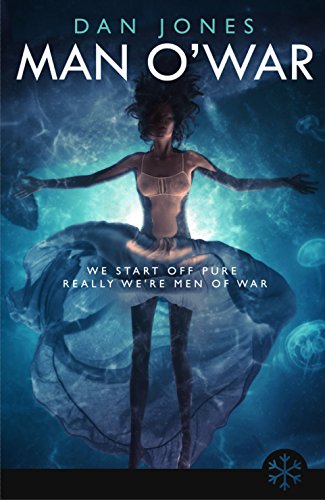 |
| Sometimes you can judge a book by its cover - great work by Snow Books' team |
PL: I stand corrected on the robots!
Have you always been this interested in theme as a writer? Or is this something that's developed for you over time? Come to think of it, how long have you been 'seriously' writing and how do you think you've developed in that time?
DJ: I do have nagging thoughts about the fragmentation of the self, and the atomisation of society as a whole, particularly western society. Until I started writing Man O'War I hadn't figured out a way to work it into a fictional setting, but a robot is a useful vehicle for exploring this topic because it’s understandable as an integrated system of systems.
So it's there, and to an extent always has been. In Eat Yourself, Clarice! one of the major tenets is the fragmentation of the self into different personas (in accordance with psychoanalytic understanding). These fragments are amplified by the proliferation of internet technologies, and manifest through a sort of socialised censorship, whereby we censor the parts of ourselves – and others – we don't want to see. That's quite abstract, but in Man O'War these ideas become tangible, most notably in the form of Naomi, who is a modular system of systems and therefore fragmentable, and also the Portuguese Man O'War creature, which is a colony of tiny creatures working together to make the creature function. And each of the human cast are, in their own way, fragmented, or broken.
I've been "seriously" writing since 2011, but only in the last four years or so have I really started to think about things like theme. Thinking is highly recommended! My take is that in the West we don't think about things as much as we react to them. I think that, as a civilisation, we'd get to a better place if we did rather more listening and thinking, than rushing to condemn. That leads to further fragmentation, and I suppose at some point there's a critical tension point beyond which society cannot divide any further. I can't imagine that being a very good place.
PL: Well that's a very cheery way to look at things. You think there is no potential for humanity's situation to improve through continued fragmentation? I'd have thought giving the various clashing cultures in the space more room to themselves and less need to rub against each other would be good.
DJ: Man, your questions are hard! OK, your question suggests fragmentation is something that we can consciously control, and I'm not sure that's the case. I think fragmentation is more basic than that, it's part of the condition of being human, or the state of being. Freud and Lacan knew this; they suggested we're in fact made up of different parts, a system of systems. In Freud's terms this was famously the id, the ego and the superego. Lacan went further; he suggested we're in fact made up of “partial objects” that we can't initially comprehend. So we make sense of things by learning language, thus ordering ourselves, and that's the first step towards making sense out of the whole world, because the whole world is just as fragmented, and crazy, and weird, and if you can't make sense of yourself then what hope do you have of ordering the rest of it? And all the characters in Man O'War are broken up or fragmented to begin with; they've all had the rug pulled out from under them in some way and they've got to deal with that, or there's no story! So in a sense they're all heroes, whether you think of them as "good" or "bad" in a classical sense, because they’re all trying to make sense of the mad situations in which they find themselves. And I think in a sense any story worth telling has to start with characters who in some way are fragmented (or who become fragmented), so they can make sense of themselves before they make sense of the world.
So to answer the question, no, I think to actively fragment is bad, really bad. The whole sense of being human is to come together in some sense - whether it's in a physical sense, or a social one, or sexual or psychological or religious or some other sense, so as to make sense of things and try and perpetuate this existence by understanding the things we're doing right. And in Eat Yourself I was forewarning that, to some extent, and possibly to a serious extent, that the proliferation of communicative technologies is overriding the need to come together to solve serious puzzles, and I think this manifests itself most dramatically in political spheres; that we can somehow exist in a digital cocoon in which we can self-censor the bits of the world we don't like, rather than deal with those things. Because that's what literary stories are all about, right? Venturing forth from your comfort zone and slaying dragons! Otherwise we all just stay in the Shire and wait for Sauron to just destroy the world. Or worse, we just stay asleep in the Garden of Eden and never even waken into consciousness at all. So there's a serious danger, a fundamentally nihilistic perspective that can arise from encouraging fragmentation.
This is getting way more philosophical than I thought it would!
 |
| The Man O'War itself |
PL: Let’s take this a little away from the philosophical and more to the literary, then. You've listed a lot of influences for the story, the majority not speculative fiction. Do you think people view fiction in too fragmented a way and pay too much attention to genre?
DJ: Ok, yes, let's move on. Yes, I think I largely agree with that. I've not been a huge SF reader. I've read bits and pieces: some Heinlein, some Iain M Banks, some JG Ballard, and a few anthologies, but as a rule more recently my genre fiction intake has skewed more fantasy, and after that I just read whatever takes my fancy. And I've thought about this, because it's not the first time someone's asked me why I'm writing SF when I don't particularly read it. I think I enjoy the innate speculative nature of SF, and I suppose I like it most when I'm doing the speculating!
Do people pay too much attention to genre? I think to unpack that you need to think about why people read, because on one level you just read what you like, what pushes your buttons, and there's no real reason why you like what you like, you just do. It's as simple as that. I'm going to ditch the word "genre" for a second, and instead use the word "flavour" instead, because SF and fantasy both have a very strong flavour, but then so does romance, and action, and "chick-lit" (hate that term, but it serves a purpose), and crime, and horror and whatever. But in all of those flavours the writers thereof should still be trying to do the same thing, which is trying to make sense of things and order and orient themselves and their characters in a way that conquers a little bit of the unknown. It's like food. Food can be spicy, or earthy, or rich, or light, or sour etc, but it's all sustenance, it all can be sustaining and make you live to tomorrow ie get you to a place where you can get more food.
And we're foraging creatures, but we don't need to literally forage for food in the modern world, so what do we forage instead? We forage information, and just as we might like different flavours of foods, we might like different flavours of information when presented to us in art or books. So genre alone doesn’t invalidate the power of art and literature to provide that satisfying information, that knowledge that sates our soul. And I get really annoyed when people snobbishly dismiss certain genres, because it only reveals themselves not to be very sophisticated; they haven't really thought beyond the superficial flavour of the genre to what lies underneath, and whether that literature, that food, is worth eating.
 |
| An oil refinery from near Port Harcourt - presumably much like one in the book |
PL: I never even realised you were more of a fantasy guy. Are there any areas where you feel this viewpoint and broad scope gives you an advantage or disadvantage as a genre writer? You ever had that moment where someone goes "I like it, but I don't know if it fits a genre well enough?"
DJ: Well I think it's a reasonable assumption to make that the more material to expose yourself to, the deeper your well of knowledge from which you can draw when you want to think and/or create. That makes sense to me because I like to write, and that's what I'm reasonably good at, but also I have a sense that I'm inadequate – not in a self-pitying way, but in a sense that there's so much more to know out there – so it makes sense that one absorbs as much material as possible, so as to keep learning. Rigidly sticking to one genre might not necessarily limit you in your learning - like I said, information is food, and all food (unless it's junk) is nourishing - but you are denying yourself all those other flavours of information. I'm not sure I see any disadvantage in reading as widely as possible!
Do you mean about my own writing? I don't think my audience is big enough yet to have to contend with that criticism, if it is a criticism at all. Genres have to have a loose set of rules, or a rough framework onto which the story is fashioned. Sometimes these things overlap. For example, is Star Wars fantasy or SF? Well, it has advanced technology like spaceships, but it also has magic. Perhaps it doesn't matter, because most of the time people just mash SF and F together into SFF and leave it there, which is a bit daffy really because SF and F are really not that similar when you think about it in terms of their respective archetypes, but anyways... What about Lord Of The Flies? Is it an Boys' Own-style action adventure, or is it literary, or is it fantasy, or even horror? So things start to get a little sketchy when you delve into things. And I like things that way. Things should move about. Fusion food!
PL: I wasn't thinking about the audience, so much as critique partners, your peers in the writing community and so on. I know you've been active there, so what have you taken from writing communities? And since I ask this of everyone - what's the best piece, and worst piece, of writing advice you've ever received?
DJ: I've taken everything from writing communities. I've been extraordinarily lucky to run into a bunch of people with whom I have an affinity and have become great friends, and whose abilities - and different types of abilities - we all respect in one another. It would be very difficult to progress without such things: advice, support, sounding boards, and just general talk. It gives me a sense that it's ok to be doing this, that even if what you're doing isn't "successful" (and that is very much governed by how you define success) that there's still something of huge value involved in the telling, in the doing itself. One thing which makes writers extraordinary is the ability to gee each other up; it's incredibly supportive. Even when we have our disagreements about detail, the general takeaway is that the value is in the doing. It's like tilling the fields, or whatever, the value is in the doing, because what else can you do? Give up? Will Self said that writing is an isolationist pursuit; people who can't stand their own company need not apply, but I think he's only halfway right. Writers are so prone to savage self-criticism, which often leads to the conclusion that the doing is worthless, and has no value, and so you'd better just stop. And that's no bloody good, is it? So finding a group that feels right makes the doing feel worthwhile, and when you're doing, when you're creating, you cannot by definition be self-critical, because you're distracted and screening all that stuff out. And when you successfully complete something, you get serotonin boosts and all that good stuff. And I think doing that without support requires a will of iron, really. So, if there's one piece of advice that I would dispense (and I'm aware that wasn't in the question!) it would be, to write.
Best piece of advice? Bryan Wigmore recently said that (and despite what I've just said about the indispensability of writing groups) one has to retain a confidence in the purity of one's own vision for the work. And I've been thinking about something along those lines for a while, and I could feel it inside, but bloody hell if that guy doesn't have a way of defining it so crisply and cleanly, like everything he writes, the git. But he's on the money; you need to be confident, that if you feel something in the way you're telling the story, then that feeling is right. The difficulty is articulating that dream-like sense of what you want your story to be. And it's in the articulation where you may need the help of others, such as editors and the like, because articulation is exceedingly difficult.
Worst advice? Anything that goes along the lines of "the rules say...", like "don't include a prologue," or "don't infodump," or "don't headhop" stuff like that. I mean, what's the point of fiction if you can't headhop? That just seems ridiculous to me. If you can make it work, then it works, by definition. People have got to have something to latch onto. I tell you what else was pretty dumb advice - and I forget where I got it from - but it was to do with submissions. The advice was to flood the market with submissions. Send your MS and synopsis and whatever off to as many agents and publishers as you can realistically keep track of, and if you throw enough mud, some will stick. And that's just so stupid I can't tell you. I mean, come on, you're sending your MS off to fifty, sixty agents? The only way you're going to do that is by sending off the same bloody letter to each one, without any thought about why you're approaching that particular agent? And I've met agents, I've seen the eye-watering piles of manuscripts on their desks. They're not looking for reasons to accept a manuscript; they're looking for reasons to discard them, because they receive so many of the bloody things.
And with hindsight that's so obvious it makes my head spin. So I figured that a more subtle, tailored approach would be better, and hey presto, it worked!
PL: Indeed it has - for here we are, talking about your first published book. One final question - which one component of Man O'War do you think you executed most successfully in terms of fulfilling your vision? Or, another way of putting it might be; what component are you most proud of?
DJ: Sometimes I'm just pleased and proud that I managed to finish the damn thing, given how much trouble I'm having with my follow up to it. One thing I've learned is that it's no small thing to complete a book in the way you want to. I'm really proud of Naomi. She's my Frankenstein's Monster, or at least my attempted approximation. I think she has layers and layers to her, more than I can understand right now.
You can try understanding Naomi yourself by reading Man O'War, published by Snow Books and available from the usual outlets. Thanks to Dan for doing this - you can find out more about him at his website.
Wednesday, 21 March 2018
Writing the Heavy Metal way
Warning - This post started as a self-indulgent attempt to remake the wheel when it comes to three act stories. It has since transmogrified into more of looking at how to populate said three acts, but this post still might be a self-indulgent attempt to remake the wheel. Caveat emptor.
Still, part of writing is looking for new twists, new ways to make old stories and ideas fresh and enthralling again, right? Right?
Well it is for me. I like looking at how art is created and stories told in other artforms and wondering if there's anything that can be stolen. And there's no other art that I think about more than Metal, so here's some ideas I sorta cribbed from Metal songs.
1) Intros as simple statements of theme
A lot of metal songs start with a single instrument playing one of the song's main riffs. Obvious advantages are that it gets right to the point and creates a strong cohesiveness. It can be used to provide instant energy while still allowing things to scale up in intensity - see At The Gates' Slaughter of the Soul - or it can be used to provide instant contrast while still being recognizably part of the whole - Dark Tranquillity's Freecard is a great example of that.
I think this is an idea that definitely can be used in writing books. Having a scene that really hits at the book's theme/main ideas/main source of entertainment in a simple and non-over the top way does the same thing. And I think it's a good thing. It goes a bit counter to the oft-given advice to start the character in their normal world before causing mayhem, but not if you're clever with it. The beginning of Game of Thrones both shows the Starks' normal world and starts asking questions about the use of power right away. I'd argue that it contains one of the series' iconic moments.
This one might seem obvious, but I can't think of too many books that I'd say do it. Too often books start at the logical beginning, or lose cohesion between the start and middle. And how many other books start with iconic moments? I get that we're dealing with very different art forms and this might be one of them, but I think going straight for a big thematically resonant oomph at the beginning rather than setting the scene might get more mileage at least some of the time.
2) Accentuating the theme and main characters through pace of events and secondary cast
I've come to see the theme, tone and main characters of a book as being akin to the lead melodies and frontman in a song, and the plot, structure and secondary characters as the rhythm section. The former is that which entertains and is remembered most; the latter is what gives the former the context needed to work. A lot of metal songs like to use the same riff over and over, but with the rhythm section giving it a different texture.
You see something akin to this in fiction already. The Dresden Files are very much the same riff over and over, just using different foes and buddies to provide a different backing track. And I'm sure we've all heard the advice to use shorter sentences to convey quicker scenes i.e. action scenes or having some comic relief to lighten things up. But it's something that I think authors could maybe concentrate on more, particularly when it comes to the structure and tempo of a book, and is often something I feel is the difference between great and good.
I also think playing with the pace of events could be a way of making things even more Epic. Would A Song of Ice and Fire be even better if GRRM had taken that chronological gap to allow the characters to grow up? Adrian Selby's Snakewood benefits heavily from its frequent historical recountings to build up the legend of the Twenty. I enjoy a good simple narrative arc as the character goes from 16 to 18 as much as the next person, but sometimes it's better to mix it up.
3) Putting the star centre stage
Think metal, think guitar solos. The idea that you want to hear the star attraction bust out all their moves is embedded deep in the heart of metal. It is one with a very clear literary equivalent too; the aristeia of Homer's heroes. And if Homer's doing it, it has to be worthy of consideration for Fantasy, right? Certainly a lot of authors feel that way when it comes to gigantic casts clashing in battles that reshape the world.
When fans start listing their favourite Epic Fantasy moments, they're usually the moments when characters slough off their failures and achieve brilliant redemptive victories by being the people the readers wished them to be. In other words, the characters' aristeia -their solos. Yet many authors skimp on this; either not allowing enough characters their moment, or not allowing characters to emerge from the collective, or simply not treating the decisive moment with enough gravity. Sometimes they go the other way and try to have too many such moments; but there is limited appetite for a song entirely of guitar solos.
It's not just the lead instruments that get solos either. Giving relatively minor support characters their moment in the sun not only keeps proceedings fresh through variety, but can give readers deep satisfaction. Snape's contribution to the Pensieve might be judged such a moment.
In conclusion, this blog post did feel something of a wheel reinvention exercise due to the many fictional examples I could think of to back up the relevance of these concepts to fantasy. These are things that great authors do. But there’s many good authors that don’t seem to. I just finished Joseph Brassey’s Skyfarer. He definitely executed number 3; I think he tried to execute number 2 but didn’t use the supporting cast enough; I think the book would have really benefited from a different opening that felt more cohesive with a book of derring-do so I think he could have done 1 better (although it was a statement of theme alright). And identifying tricks that make great authors great is never a total waste of time. I’ll probably re-do this blog post sometime, with the ideas more polished and fiction-centric - but this is how it started. And hopefully its worth something.
Subscribe to:
Posts (Atom)